
Fitness Smart Ring Buying Checklist
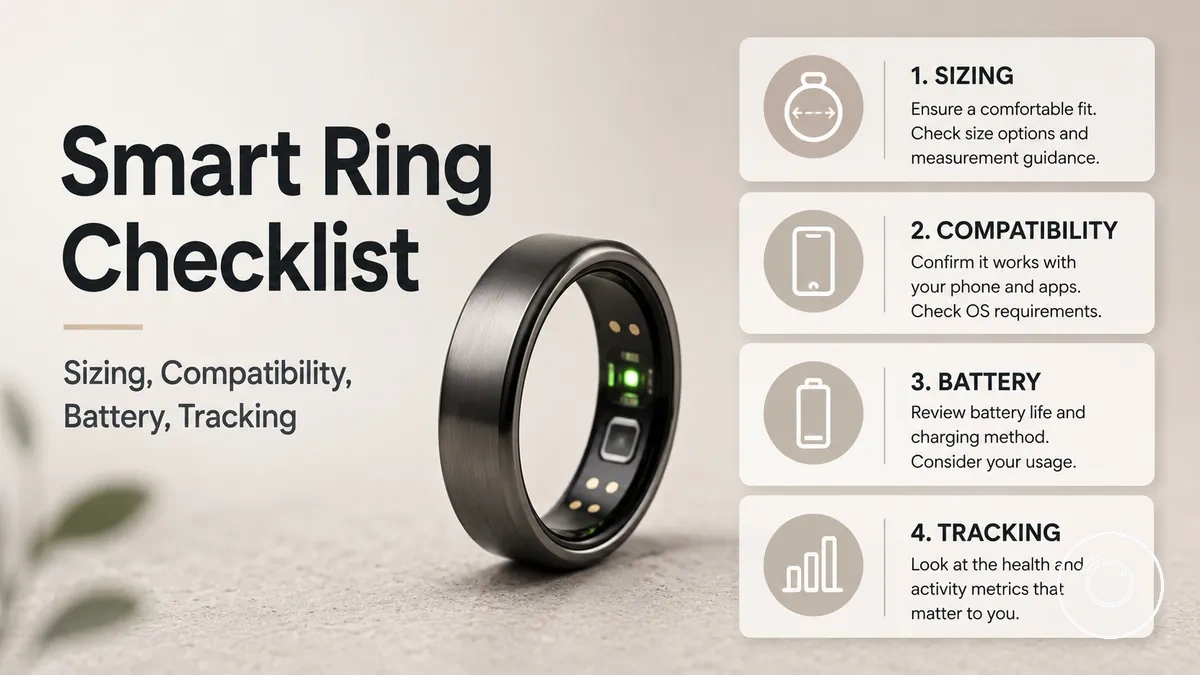
A fitness smart ring buying checklist should confirm that the ring matches your fit, phone compatibility, tracking priorities, battery routine, wear conditions, and total cost before you compare products or prices. Assessing these personal requirements first reduces the chance of choosing a ring that does not suit your daily use.
This checklist focuses on practical selection criteria rather than product promotion. Review ring sizing, app compatibility, tracking features, battery life, water resistance, subscription requirements, and ongoing ownership costs before considering individual models or merchant offers.
Different buyers prioritise different outcomes. Sleep-focused users may value comfortable overnight wear and sleep insights, while fitness-focused users may prioritise activity and recovery tracking. Buyers who prefer minimal maintenance should compare battery life with their expected charging routine. If a display, notifications, or on-device controls are essential, a smartwatch belongs in a separate comparison later in the buying process.
For a broader understanding of the category before narrowing your options, visit the fitness smart ring hub. Once the overall category is clear, this checklist helps organise the key decision criteria before comparing prices.
The checklist below groups the essential checks into a logical order so each requirement can be confirmed before evaluating individual products.
- Fit and sizing: Select the manufacturer's recommended ring size so the sensors maintain consistent skin contact while remaining comfortable during daily wear and sleep. If a sizing kit is offered, use it before purchase.
- Phone compatibility: Confirm that the companion app supports your phone's operating system and any stated minimum software version. Compatibility should be verified from the product specifications or app listing.
- Tracking priorities: Compare the available tracking categories with your personal goals, such as sleep, daily activity, heart-rate trends, recovery, or stress-related insights. If an essential category is unavailable, the ring may not meet your needs.
- Battery life: Check the manufacturer's stated battery duration and determine whether the charging routine fits your regular usage pattern, recognising that actual battery life may differ according to enabled features and usage.
- Water resistance: Match the stated water-resistance rating to your intended wear conditions, such as hand washing, showering, exercise, or swimming. If no rating is published, treat water exposure as unsupported.
- Subscription: Identify whether health insights are fully included with the purchase or whether selected features require an ongoing subscription. Include recurring fees when comparing long-term ownership costs.
- Total cost: Compare the complete ownership cost by considering the purchase price together with any subscription charges, accessories, and merchant-specific delivery or return costs.
- Decision support: Compare prices only after every essential criterion has been confirmed so products are evaluated against the same requirements rather than price alone.
Fitness Smart Ring Use Case and Tracking Priorities
Your fitness smart ring use case should determine which tracking priorities carry the most weight before you compare specifications or prices. Choose a primary goal—sleep tracking, workout tracking, daily wellness, or low-maintenance use—then judge app features, comfort, recovery insights, and charging demands against that goal.
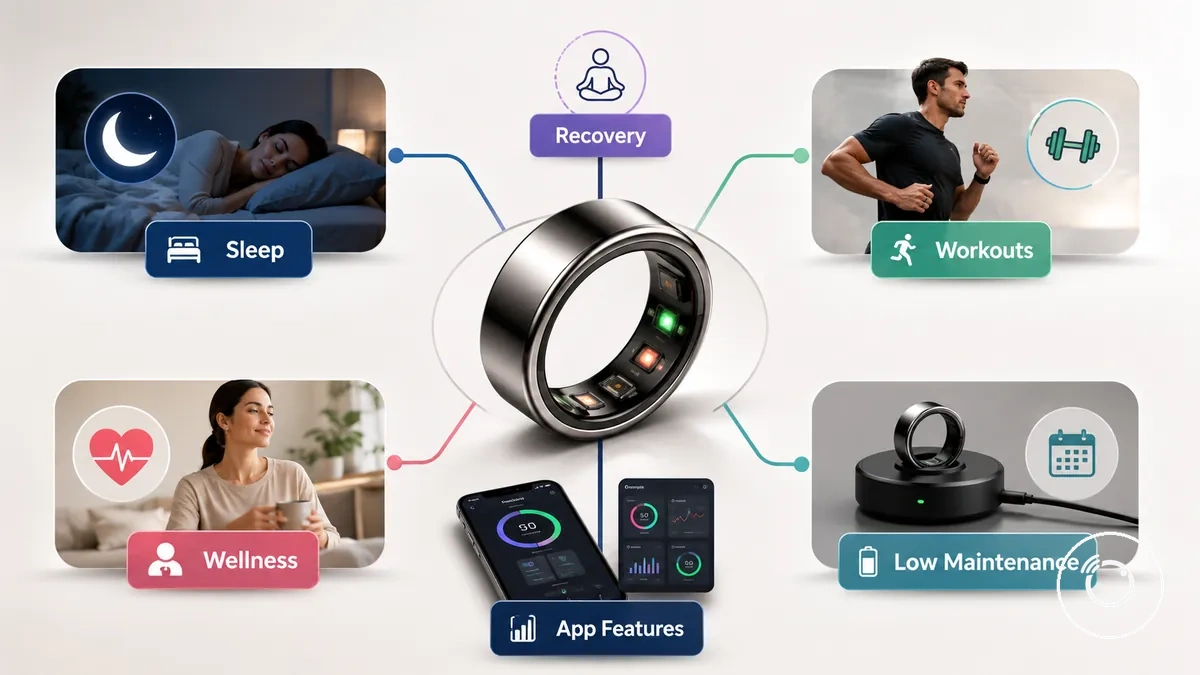
A sleep-first buyer should give greater weight to overnight comfort, sleep tracking, and recovery insights. A workout-first buyer should prioritise activity records, workout tracking, and training-related recovery data. Daily-wellness users may prefer a broader mix of sleep, activity, and wellness trends, while low-maintenance users should favour a charging pattern that fits their routine. Each scenario creates a different selection effect, so no single priority profile applies to every buyer.
Use this mini-checklist to filter later decisions without treating every specification as equally important.
- Primary use case: Select sleep, workouts, daily wellness, or low-maintenance use as the main decision category.
- Required tracking priority: Keep only the tracking categories that directly support the selected use case.
- App features: Confirm that the app presents the insights and review tools needed for that priority.
- Comfort tolerance: Give overnight comfort more weight for sleep-first use and continuous-wear comfort more weight for daily wellness.
- Charging habits: Give battery practicality more weight when frequent charging would interrupt the intended tracking routine.
- Selection effect: Compare detailed specifications and prices only after the priority-to-feature fit is clear.
Fitness Smart Ring Fit and Sizing Checks
Fitness smart ring fit should be checked before judging value because sizing affects comfort, wear consistency, and tracking reliability. A suitable fit follows the manufacturer’s sizing guidance, stays stable on the chosen finger, and avoids persistent pressure during normal and overnight wear.
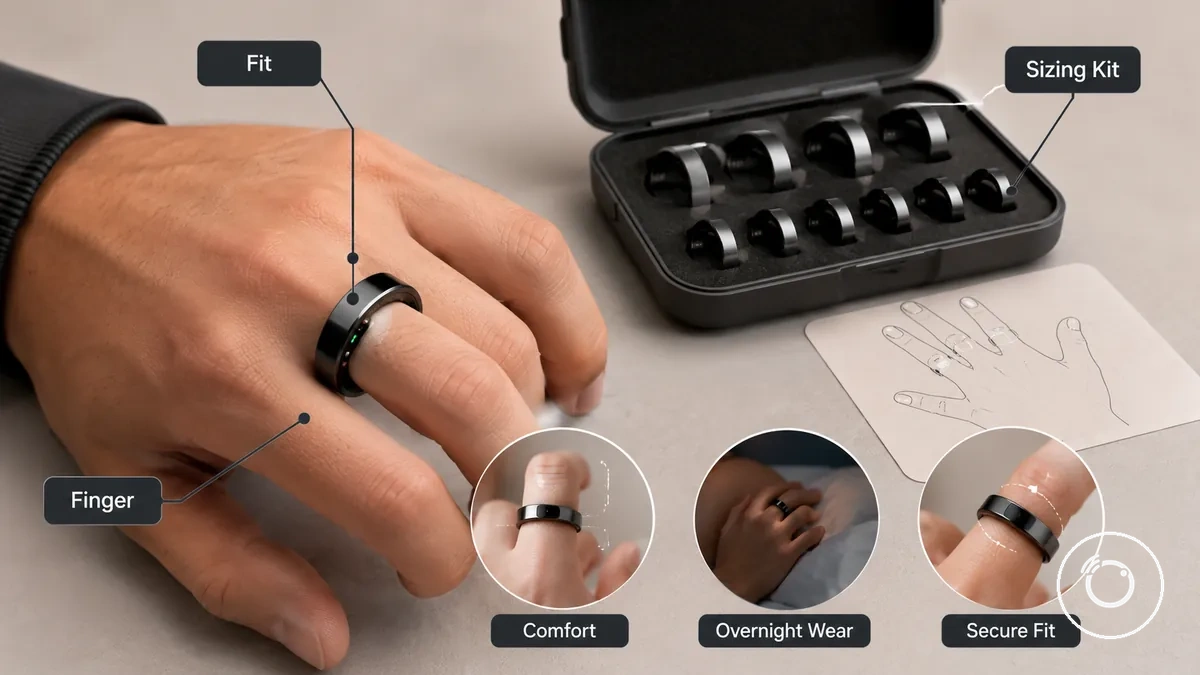
Fit risk extends beyond the labelled ring size. Finger placement, brand-specific sizing, normal changes in finger size, and wear conditions can change whether the ring feels secure, loose, or uncomfortable. Where a sizing kit or trial rings are available, they provide a practical way to test these conditions before comparing prices.
The fit and sizing visual clarifies how trial sizing, finger placement, tightness, and overnight comfort contribute to sizing confidence. Higher sizing confidence reduces the risk of choosing a ring that is uncomfortable, shifts during wear, or requires a size-related return or exchange.
Complete these sizing checks before buying so size confidence and tracking reliability are assessed before price becomes the deciding factor.
- Size method: Use the brand’s stated sizing method or sizing kit rather than assuming a standard jewellery size will match.
- Finger placement: Test the intended finger because comfort and contact can differ between fingers.
- Tightness: Choose a fit that remains secure without persistent pressure, pinching, or easy rotation.
- Overnight comfort: Test the trial size during sleep when overnight wear is part of the intended use.
- Finger changes: Recheck the fit at different times or under normal temperature changes if finger size noticeably shifts.
- Return risk: Review the relevant size-exchange or return conditions before purchase when sizing confidence remains low.
Sizing Kit Confirmation Before Purchase
A sizing kit should be treated as a pre-purchase requirement when brand-specific sizing replaces standard jewellery sizing or when purchase confidence is reduced by between-size uncertainty, finger choice, overnight fit changes, or return risk. Confirming a trial size before ordering provides a more reliable indication of smart ring fit than relying only on an assumed ring size.
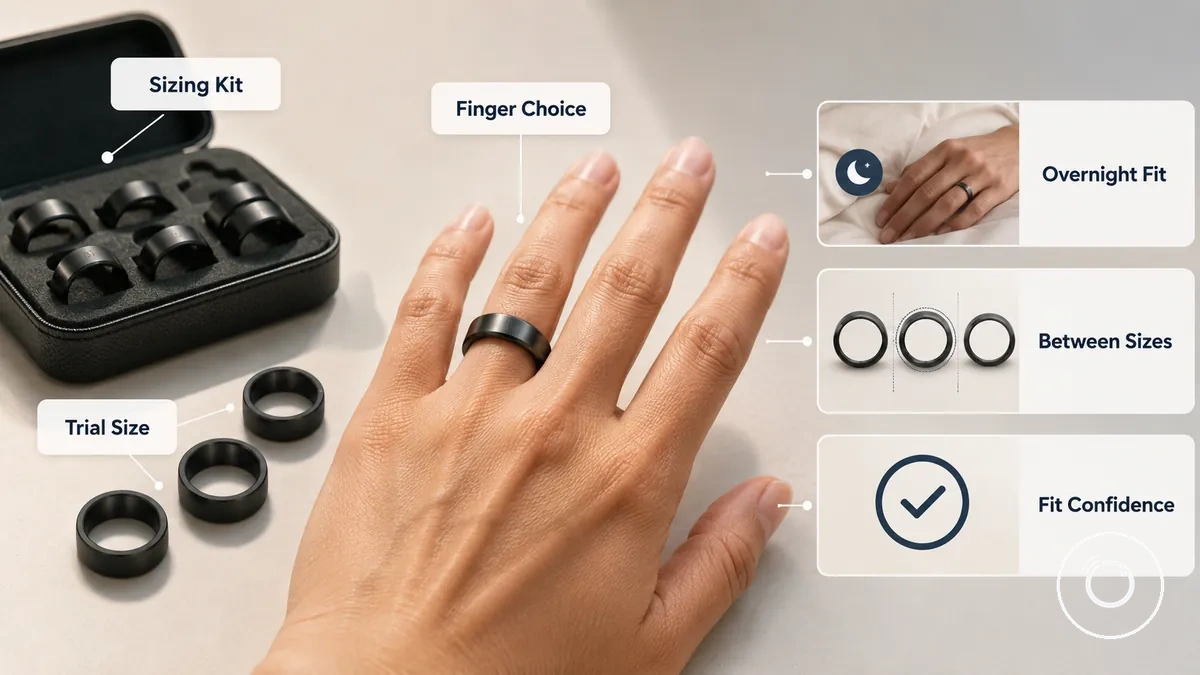
The sizing kit confirmation image highlights trial rings, finger placement, and a purchase confidence cue to reduce sizing uncertainty before purchase. Using a trial size helps compare daytime and overnight comfort when you are between sizes, notice normal finger size changes, or the manufacturer recommends its own brand-specific sizing system.
Use sizing kit confirmation before purchase in these situations:
- Between sizes: Compare the nearest trial sizes before making a final selection.
- Brand-specific sizing: Follow the manufacturer's sizing kit when its sizing differs from standard jewellery sizing.
- Finger choice: Test the finger intended for daily wear because fit can differ between fingers.
- Overnight change: Wear the trial size long enough to assess overnight comfort if sleep tracking is planned.
- Return risk: Confirm the size before ordering when sizing confidence remains low or finger size changes create uncertainty.
Daily and Overnight Wear Comfort
Daily and overnight wear comfort is a key buying criterion because consistent wear determines whether a fitness smart ring can support ongoing activity and sleep tracking. A ring body with balanced thickness, smooth edge shape, comfortable weight, and an acceptable skin feel is more likely to remain wearable throughout the day and night, while persistent discomfort can reduce wear consistency and increase abandonment risk.
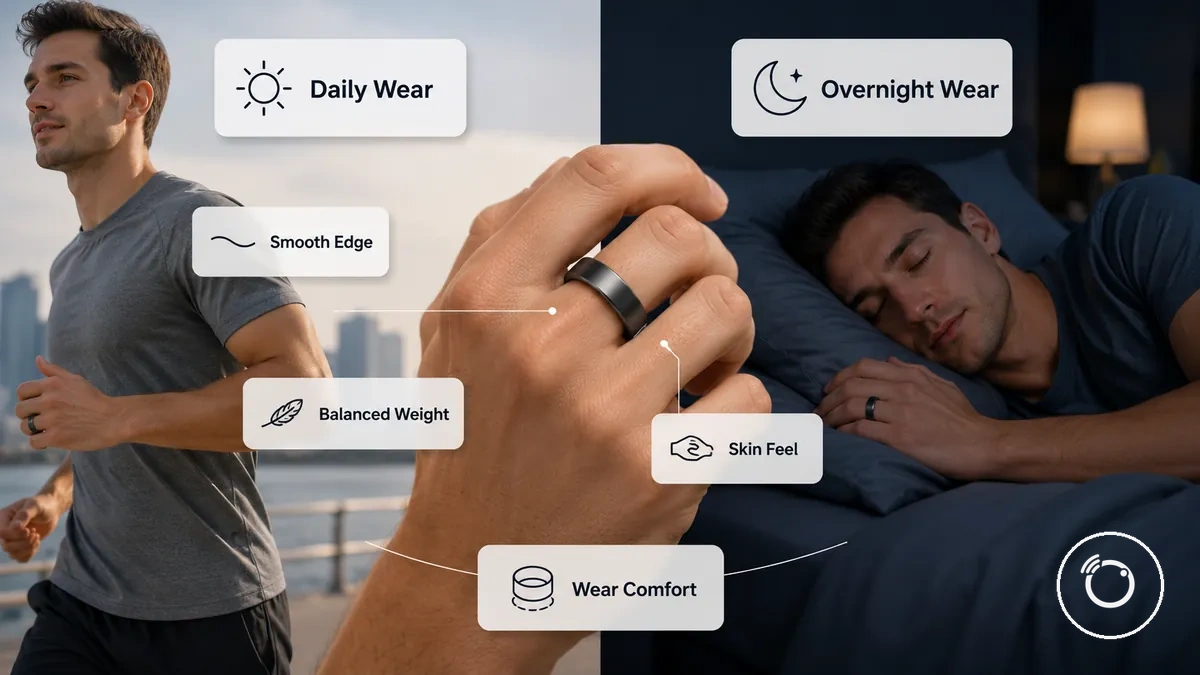
The daily and overnight comfort image illustrates a smart ring in normal daytime and overnight use to show how comfort influences consistent wear. Comfort is affected by hand shape, ring design, activity, and overnight tolerance, so a ring that feels comfortable during brief daytime use should also be checked during longer wear if sleep tracking is an important buying priority.
Review these comfort points before buying:
- Ring body: Choose a thickness that feels balanced instead of bulky for everyday activities.
- Edge shape: Smooth, rounded edges are generally less noticeable during daily movement.
- Weight: A comfortable weight should feel secure without feeling unnecessarily heavy.
- Skin feel: Assess comfort during normal daily wear rather than only a brief fitting.
- Overnight tolerance: If sleep tracking matters, confirm the ring remains comfortable throughout overnight wear.
Phone, App, and Health Platform Compatibility
Compatibility is suitable when the fitness smart ring supports your phone operating system, provides a companion app that is available in your region, and integrates with the health platform you intend to use. Verifying these conditions before purchase helps reduce the risk of limited setup, restricted syncing, incomplete data access, or reduced long-term usefulness.
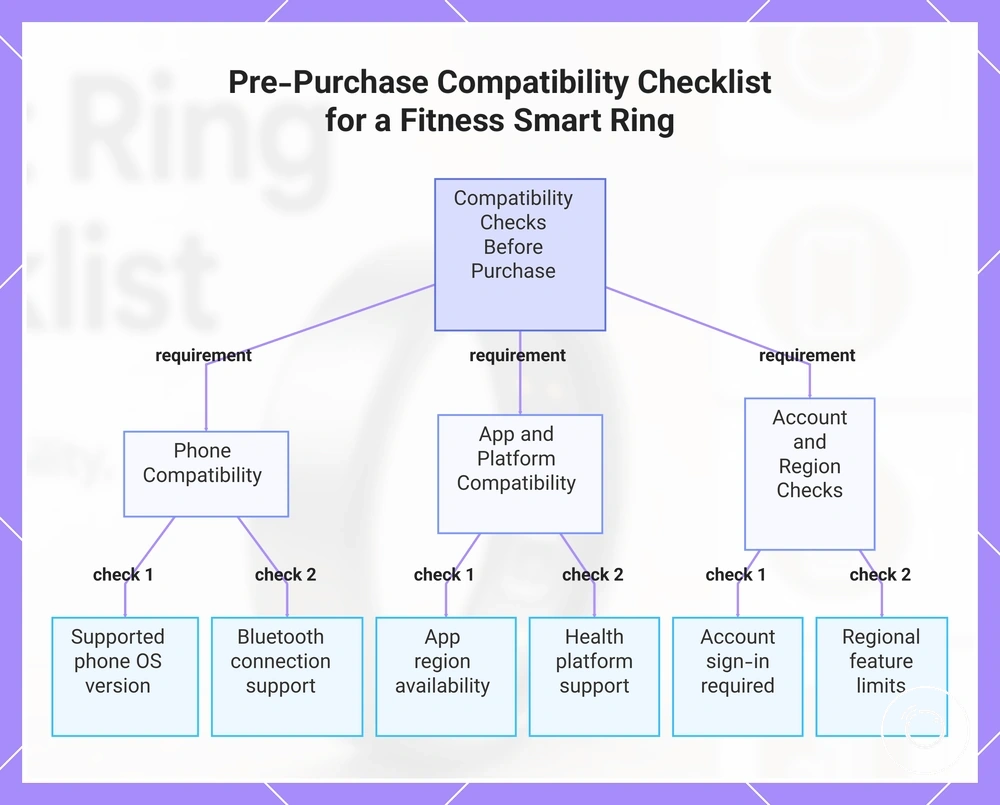
Phone compatibility normally requires a supported iPhone or Android version, Bluetooth connectivity, and access to the manufacturer's app. Health platform integration, syncing features, and available app functions may differ according to the supported operating system, account requirements, and regional app availability, so the advertised experience should be confirmed for the specific ring model.
Check these compatibility points before buying:
- Phone OS: Confirm that your iPhone or Android version is listed as supported for the selected fitness smart ring.
- Bluetooth: Verify that your phone supports the Bluetooth connection required by the companion app.
- App availability: Check that the manufacturer's app is available to download in your country or region.
- Health platform: Confirm whether the ring supports your preferred health platform when that integration is offered.
- Account requirements: Verify whether creating or signing in to an account is required before syncing data.
- Regional access: Review whether features or integrations are limited in your location.
These checks help determine purchase suitability before buying, while detailed pairing instructions and troubleshooting are outside the scope of this checklist unless they affect the buying decision. For model-specific compatibility checks, refer to the dedicated compatibility guide.
This chart summarizes the compatibility conditions and checks for a fitness smart ring, covering phone OS, Bluetooth, app availability, health platform, account requirements, and regional access.
iPhone and Android Support
A fitness smart ring is compatible with an iPhone or Android phone when the selected ring model supports the phone's operating system version and its companion app provides the required features for that platform. Basic Bluetooth pairing is different from full feature access because health syncing, app functions, and data reliability also depend on app availability, permissions, and ongoing software support.
Check operating system support beyond the device name:
- OS version: Verify that your iPhone or Android version is included in the companion app's supported operating system list.
- App store availability: Confirm that the companion app is available through the Apple App Store or Google Play Store in your region.
- Permissions: Check that the app can receive the permissions needed for Bluetooth, health data, notifications, and background syncing when those functions are used.
- Update policy: Confirm that the app continues to support your operating system version after future app or phone updates.
Basic pairing: Bluetooth connection allows the ring to connect to the phone. Full feature access: Complete ecosystem integration also requires a supported operating system version, app-feature availability, the required permissions, and compatible software updates.
App Features and Health Platform Access
App access determines how much value a fitness smart ring provides beyond the hardware because the companion app controls which metrics can be viewed, interpreted, synced, or exported. Compatibility is suitable when the required dashboard features, health platform access, account type, app version, and subscription level match the buyer’s intended use.
| App feature | What to verify | Why it matters |
|---|---|---|
| Dashboard | Confirm that the app displays the fitness smart ring metrics and interpretations needed for regular use. | A limited dashboard reduces access to the information collected by the ring. |
| Health platform sync | Check whether the app transfers the required data categories to the buyer’s preferred health platform. | Supported syncing helps maintain health-platform continuity across compatible services. |
| Data history | Verify which historical records remain available under the required account, subscription level, and app version. | Accessible data history allows the buyer to review changes over time rather than only current readings. |
| Subscription limits | Identify which dashboard, interpretation, history, sync, or export functions are included and which require a subscription. | Restricted functions can change the practical value of the fitness smart ring. |
| Notification settings | Confirm whether reminders and alerts can be enabled, disabled, or adjusted for the intended use. | Suitable controls allow useful prompts while limiting unwanted notifications. |
Buyers who need health-platform continuity should verify both the sync direction and the data categories transferred, because a connection does not confirm that every metric, interpretation, or historical record is shared. This check improves buyer confidence without assuming permanent access, unlimited data, or that all app features are included.
Tracking Features and Metric Quality
Tracking features are useful when a fitness smart ring measures metrics that match the buyer’s main use case and presents them with enough consistency to support practical decisions. Metric quality should be judged through sensor design, fit, wear condition, and algorithm interpretation rather than by feature count alone.
Essential metrics are those directly linked to the intended purpose, such as sleep, heart rate, recovery, or workout tracking. Useful extras add decision value only when their sensor input and app interpretation remain relevant under normal wear conditions, while unrelated metrics add little selection value even when they increase the number of listed features.
| Metric or feature | Condition to check | Why it matters | Buying decision |
|---|---|---|---|
| Sleep | Check whether the ring supports consistent overnight wear and whether the app presents sleep trends in a usable format. | Interrupted wear reduces data continuity, while clear trend reporting improves interpretation. | Prioritise sleep tracking when overnight use is the primary use case and the fit supports regular wear. |
| Heart rate | Check whether the sensor maintains stable skin contact during the activities and daily conditions relevant to the buyer. | Sensor contact affects the quality of the input used by the app to present heart-rate information. | Treat heart-rate tracking as essential when the expected wear conditions support stable contact. |
| Recovery | Verify which sensor inputs and app calculations contribute to the recovery score or status. | Recovery is an interpreted output rather than a direct sensor reading, so its decision value comes from relevant and understandable inputs. | Choose recovery features when the interpretation supports the buyer’s training or rest decisions. |
| Workout tracking | Check whether the ring records the activity types and workout information needed for the intended exercise routine. | A tracking feature has limited usefulness when the supported workout data does not match the buyer’s activities. | Prioritise workout tracking for exercise-led use cases and treat it as an extra for buyers focused mainly on sleep or recovery. |
| Additional metrics | Confirm that each extra metric has a clear sensor input, app explanation, and practical use within the buyer’s routine. | Extra measurements add decision value only when they answer a relevant question or support a repeatable action. | Do not favour a ring solely because it lists more metrics than the buyer expects to use. |
A suitable fitness smart ring combines relevant metric categories with consistent wear, appropriate sensor input, and understandable app interpretation. Consumer wellness metrics are most useful for comparison and personal trend review rather than clinical measurement or diagnosis.
Sleep, Heart Rate, Stress, and Recovery Metrics
Wellness metrics are most useful when a smart ring provides the sleep estimate, heart rate, HRV, stress, recovery, and temperature-related signals that support the buyer’s main sleep or readiness goal. Metric usefulness should be judged through ring fit, sensor input, wear consistency, and app interpretation because these conditions shape the daily decision value of consumer wellness data.
Check metric availability separately from metric interpretation:
- Sleep estimate: Verify that the app reports sleep duration and overnight patterns in a format suitable for regular comparison. This metric supports personal sleep-trend review rather than sleep diagnosis.
- Heart rate: Confirm that the ring records resting or overnight heart-rate information under the intended wear conditions. Stable skin contact provides a more consistent sensor input for daily wellness review.
- HRV: Check whether the app presents heart rate variability as a trend, baseline comparison, or recovery input. HRV has greater decision value when interpreted against repeated personal measurements rather than a single reading.
- Stress: Verify which sensor inputs contribute to the app’s stress interpretation and whether the result appears as a trend, category, or score. A consumer stress metric supports wellness reflection rather than medical assessment.
- Recovery: Confirm which inputs, such as sleep, heart rate, HRV, or activity data, contribute to the recovery result. Recovery guidance is more relevant when those inputs match the buyer’s routine and intended rest or training decisions.
- Temperature-related signals: Check whether the app reports changes relative to a personal baseline rather than presenting a clinical conclusion. Baseline comparison can add context to sleep or recovery trends when wear remains consistent.
These metrics do not have equal value for every buyer: sleep estimates and overnight trends may be essential for a sleep-led use case, while stress or temperature-related signals may be useful extras when their interpretation supports a repeatable daily decision.
For example, a buyer comparing a lower-than-usual recovery result with recent sleep, HRV, and heart-rate trends may choose a lighter activity day when the app explains the contributing signals; broader sleep tracking buying factors can help assess whether the ring’s overnight features match that purpose.
Workout, Activity, and Step Tracking Limits
Workout tracking, activity tracking, and step tracking are suitable when a smart ring’s workout modes, movement sensors, automatic detection, and app review match the buyer’s exercise routine. Fitness-use suitability is lower when the buyer needs display-based coaching, built-in GPS, or real-time workout controls on the wearable.
Ring-based tracking can differ from watch-based tracking during movement-heavy activities because movement type, fit, sensor contact, and app interpretation affect step estimates and heart rate during movement. Buyers should compare each wearable option with the conditions in which it will be used rather than assume that every recorded activity has equal reliability.
| Smart ring may fit | Smartwatch may fit better |
|---|---|
| Daily activity and step trends are reviewed later in the companion app. | Step counts, pace, or workout status need to be viewed during exercise. |
| The available workout modes cover the buyer’s regular activities. | The buyer needs broader workout selection or on-device workout controls. |
| Automatic detection is acceptable when the app identifies and summarises a supported activity after it occurs. | The buyer needs to start, pause, adjust, or end a workout from the wearable in real time. |
| Heart rate during movement is used as a qualified activity trend under stable fit and sensor contact. | The buyer prioritises continuous on-screen exercise feedback during movement-heavy sessions. |
| Phone-assisted route data is sufficient when the ring does not provide built-in GPS. | Built-in GPS and independent route recording are required. |
A smart ring should not be treated as a replacement for every sports watch when GPS, live coaching, or real-time controls are primary requirements. Check the supported workout modes, automatic detection behaviour, movement-related heart-rate presentation, and app review workflow against the buyer’s workout tracking buying factors before choosing it as the main exercise tracker.
Battery Life, Charging, and Daily Use Practicality
Battery life is practically suitable when the claimed battery duration and charging routine allow the fitness smart ring to cover the buyer’s daily use and overnight tracking schedule without frequent data gaps. The useful value is therefore routine fit, not an advertised duration treated as a guaranteed outcome.
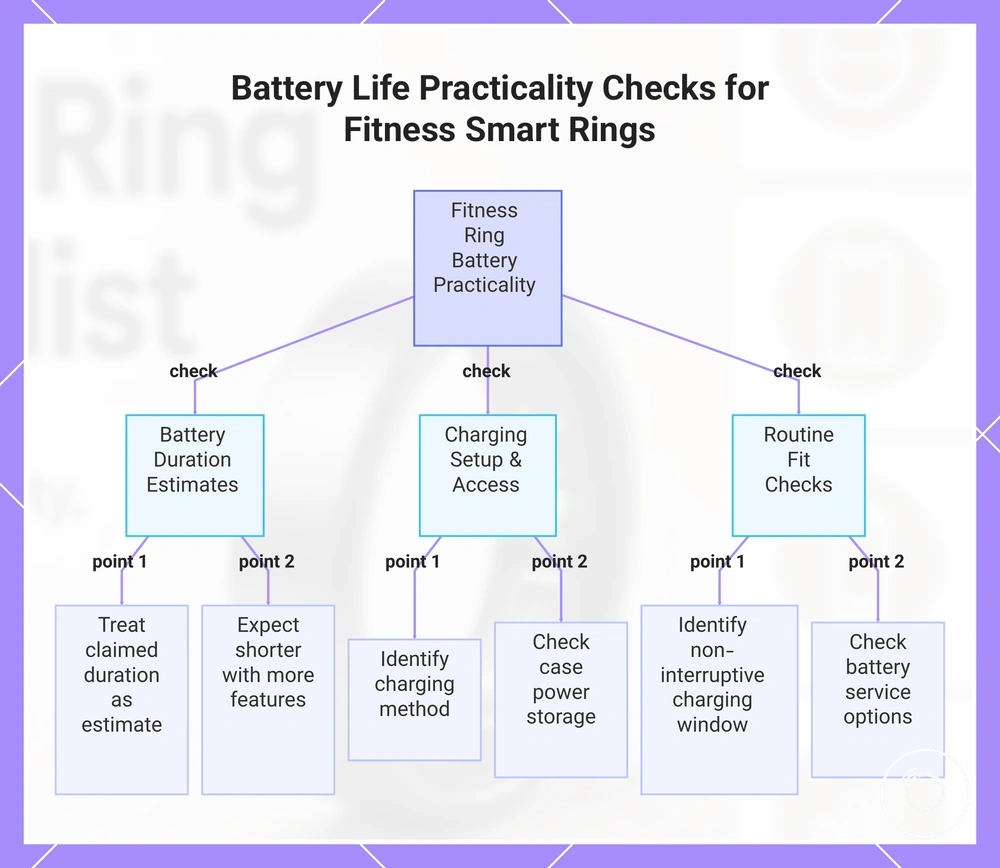
Real-use variation should be expected because battery duration changes with the ring model, enabled features, sensor use, synchronisation behaviour, battery condition, and wear pattern. Check the following conditions to determine whether charging will interrupt the periods the buyer wants to track:
- Claimed battery duration: Treat the stated duration as a model-specific estimate and verify which feature and usage conditions apply to it.
- Real-use variation: Expect shorter intervals between charges when more frequent sensing, activity recording, or data synchronisation is enabled.
- Charging method: Confirm whether the ring uses a dedicated dock, cable, or charging case and whether that accessory fits the buyer’s regular location and travel routine.
- Charging opportunity: Identify a repeatable period when the ring can be removed without losing important daily activity or overnight tracking data.
- Charging case: Check whether the case stores additional power or functions only as a holder and charging interface, because those categories provide different travel convenience.
- Routine interruption: Choose a model whose charging frequency can be placed outside the buyer’s priority tracking periods rather than one that regularly interrupts sleep or exercise records.
- Long-term practicality: Check the model’s stated battery service or replacement options rather than assuming the original claimed duration will remain constant throughout ownership.
For a buyer focused on overnight tracking, a convenient daytime charging window may matter more than the longest claimed duration; for irregular travel or continuous daily wear, portable charging access may carry greater weight. These battery life checks help determine whether the charging behaviour supports the intended routine without turning an advertised range into an exact battery-life promise.
This chart shows the key conditions to verify when assessing whether a fitness ring’s battery life and charging routine will support the buyer’s daily use and overnight tracking needs.
Battery Duration and Long-Term Battery Health
Advertised battery duration is a starting expectation rather than a guaranteed ownership outcome. Long-term battery health should be judged by how enabled features, charging cycles, battery age, firmware behaviour, and real-use conditions affect the interval between charges over time.
Use these checks to separate the initial battery claim from realistic ownership expectations; edge cases matter when a change in features, firmware, or usage pattern materially alters charging frequency:
- Advertised battery duration: Treat the stated duration as a model-specific estimate that applies under the manufacturer’s described usage conditions.
- Enabled features: More frequent health tracking, activity recording, or background functions increase power use and can shorten the interval between charges.
- Charging cycles and age: Battery condition changes through normal charging and ageing, so the initial duration should not be treated as a fixed lifespan value.
- Firmware behaviour: Software updates can change power management, making the interval between charges longer or shorter according to the update and enabled functions.
- Ownership confidence: A suitable model retains practical value when its expected charging frequency still fits the buyer’s routine under everyday rather than idealised conditions.
Charging Case and Charging Routine
A charging case, charging dock, or cable is practically suitable when it fits the buyer’s daily routine, travel habits, and replacement expectations. Convenience is shaped by the charging accessory supplied with the smart ring, while proprietary design and replacement availability should be checked by model and seller because both affect daily-use practicality. Use these checks to separate charging hardware from charging behaviour:
- Charging case or dock: Confirm whether the ring charges through a dedicated case or dock, because the supplied method determines how the ring is powered during everyday use.
- Cable and portability: A compact charging accessory is easier to carry when regular charging away from home is part of the intended routine.
- Proprietary design: A dedicated charging accessory increases replacement risk when compatible alternatives are limited to the specific model.
- Replacement availability: Check whether the manufacturer or seller lists a replacement charging accessory for the exact model before purchase.
- Daily-use practicality: Choose a charging setup that matches where the ring will normally be charged so the routine remains practical at home and during travel.
Travel readiness matters most when the ring relies on a dedicated charging accessory that must be packed separately. Replacement risk also affects purchase suitability when a lost or damaged case, dock, or cable would prevent charging until a model-compatible replacement becomes available.
Durability, Water Resistance, and Wear Conditions
A fitness smart ring is suitable for daily wear when its ring body, material, water resistance rating, surface finish, and stated use conditions match the expected exposure. Durability should be assessed from those specifications rather than from assumptions that a ring is waterproof, scratch-proof, or resistant to every type of contact.
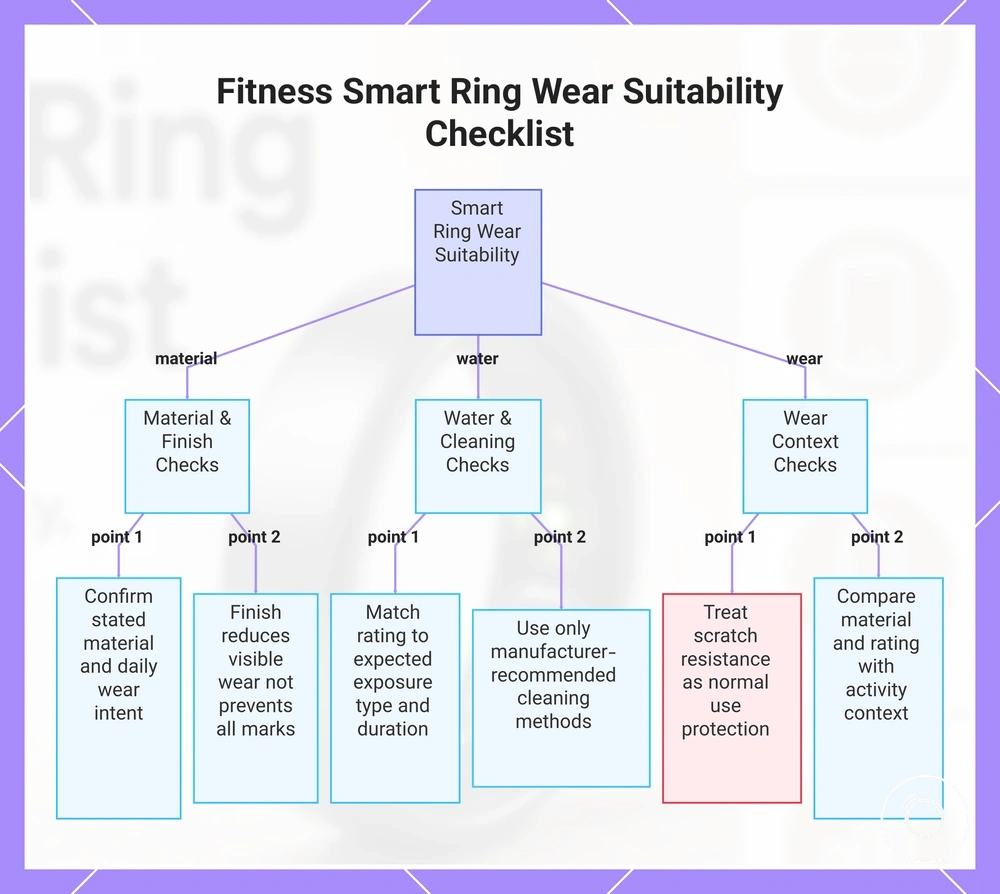
The ring body material and finish determine how the surface responds to normal contact, while the water resistance rating defines the supported type and duration of water exposure. Scratch resistance means reduced susceptibility under stated use conditions, not complete protection, and cleaning exposure remains suitable only when the method follows the manufacturer’s care guidance.
Wear conditions should be checked against the stated rating and material limits before purchase. Routine hand washing may be suitable when included within the model’s stated water exposure conditions, whereas prolonged immersion, abrasive contact, or chemical cleaning increases buying risk unless the manufacturer explicitly supports that use. Use this checklist to verify suitability:
- Ring body material: Confirm the stated material and whether it is intended for routine daily contact.
- Surface finish: Check whether the finish is described as reducing visible wear rather than preventing all marks.
- Scratch resistance: Treat scratch resistance as protection under normal use conditions, not as a scratch-proof guarantee.
- Water resistance rating: Match the stated rating to the expected exposure type and duration.
- Cleaning exposure: Use only cleaning methods and substances included in the manufacturer’s care guidance.
- Activity context: Compare the ring’s material and rating with the surface contact and water exposure expected during intended activities.
This chart groups the key specification checks to verify whether a fitness smart ring is suitable for daily wear and expected conditions.
Price, Subscription, and Total Ownership Cost
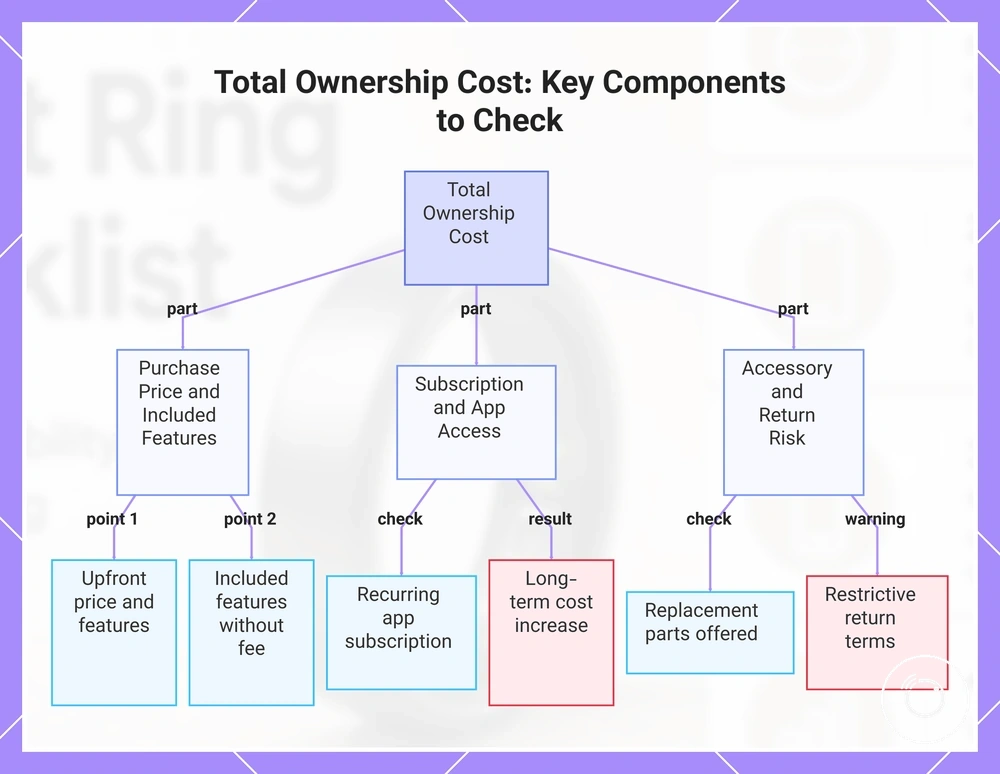
Total ownership cost includes the fitness smart ring’s purchase price and any ongoing or replacement costs linked to normal use. Before comparing prices or offers, check the following cost components:
- Purchase price: Compare the upfront price with the features included at the time of purchase.
- App subscription: Check whether core app access is included or requires a recurring payment.
- Included features: Confirm which health metrics, reports, and services are available without an added fee.
- Accessory bundle: Verify whether the charging case, dock, cable, or other required accessory is included.
- Replacement charging parts: Check whether model-compatible replacement parts are offered if the original charging accessory is lost or damaged.
- Return limitations: Review the seller’s stated return or exchange conditions because restrictive terms increase purchase risk.
An app subscription increases long-term cost when access to required features continues only through recurring payments. A ring with the required app features included can offer stronger long-term value for a buyer who does not want an ongoing subscription.
An accessory bundle affects value when it includes the charging hardware needed for normal use. Replacement charging parts and return limitations also affect ownership risk because a missing proprietary accessory or restricted return option can create an additional cost after purchase.
A higher purchase price may be acceptable when the required features and accessories are included and the likely ongoing costs are lower. Use price and subscription checks as a criterion when comparing upfront price, app access, accessory inclusions, and replacement risk.
Long-term value is stronger when the ring’s included features, subscription requirement, accessory bundle, and replacement options match the intended period of use. Compare these cost components before treating a lower purchase price as the lower total ownership cost.
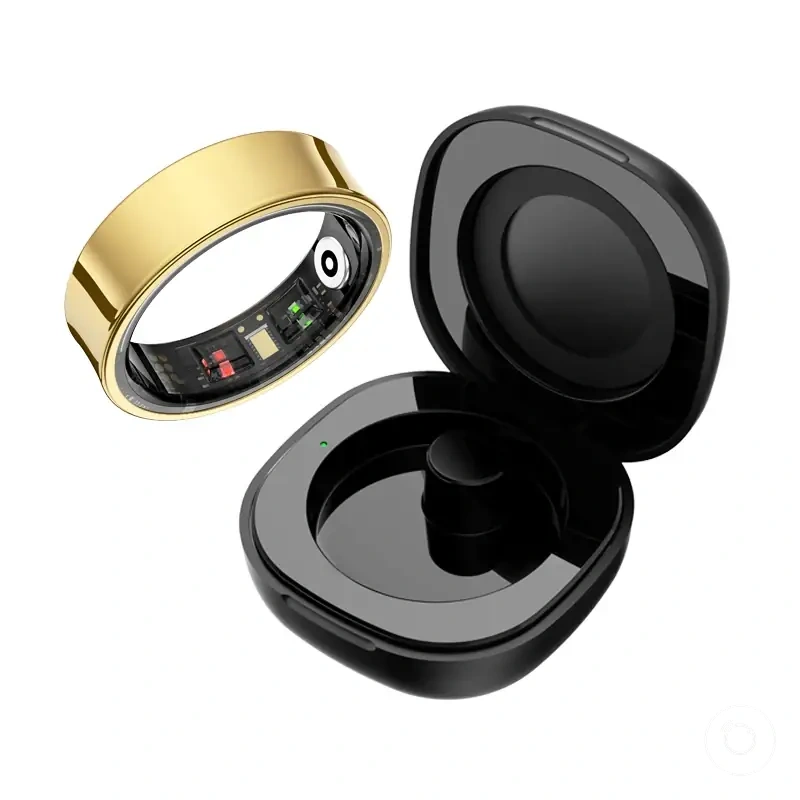
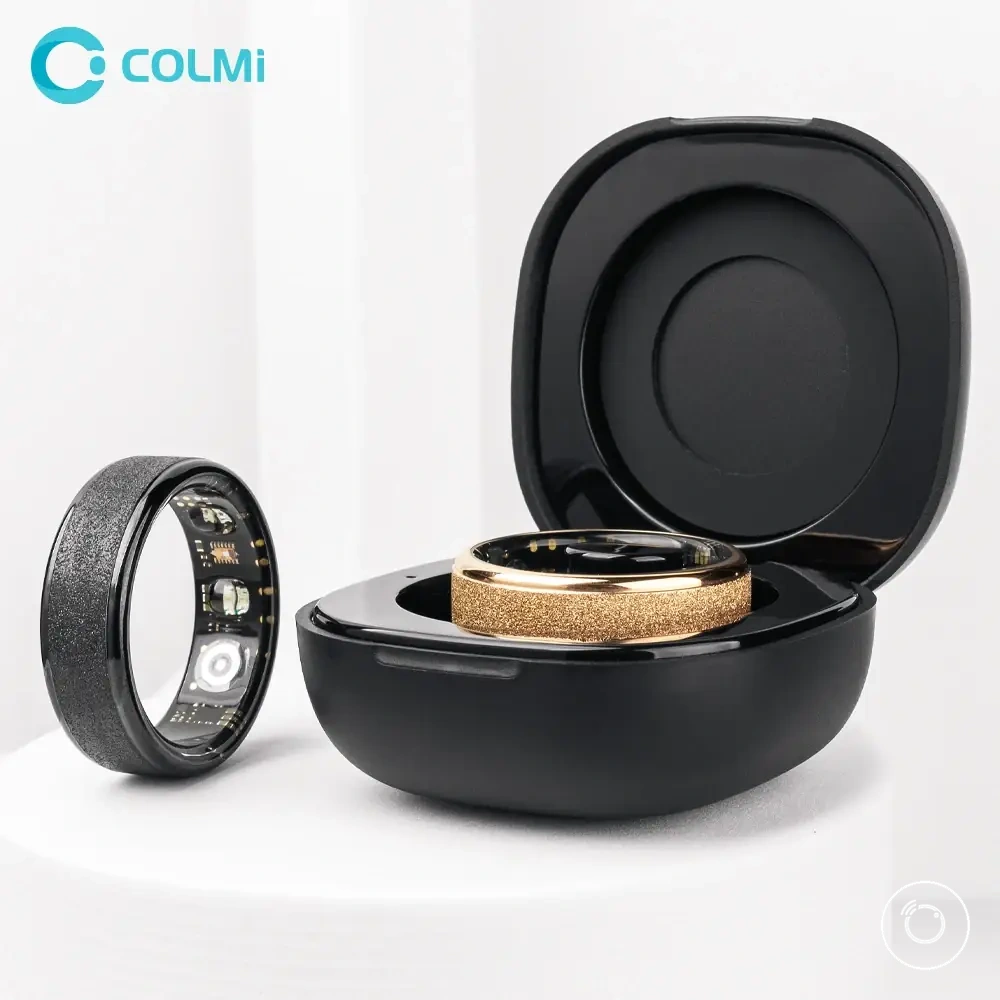
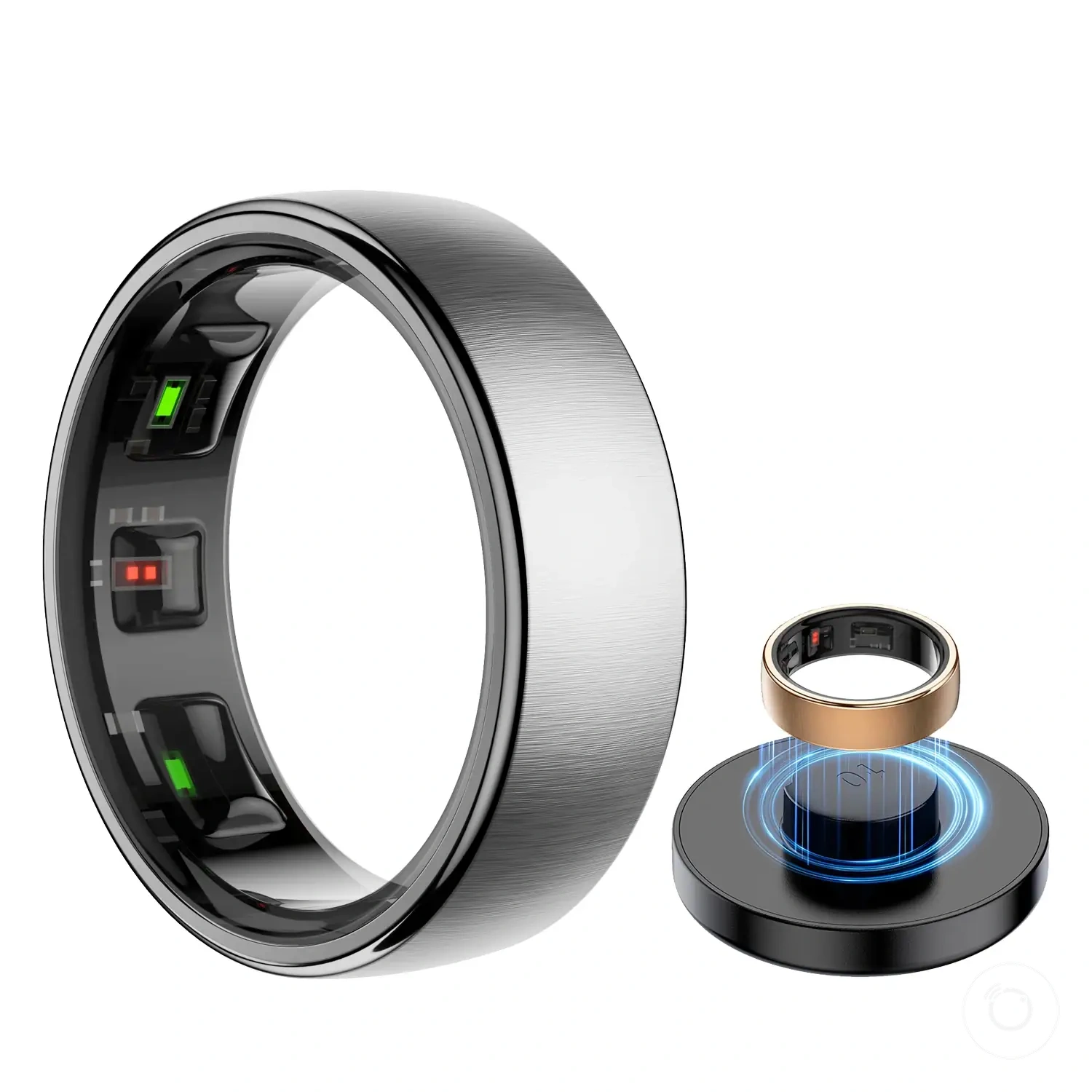
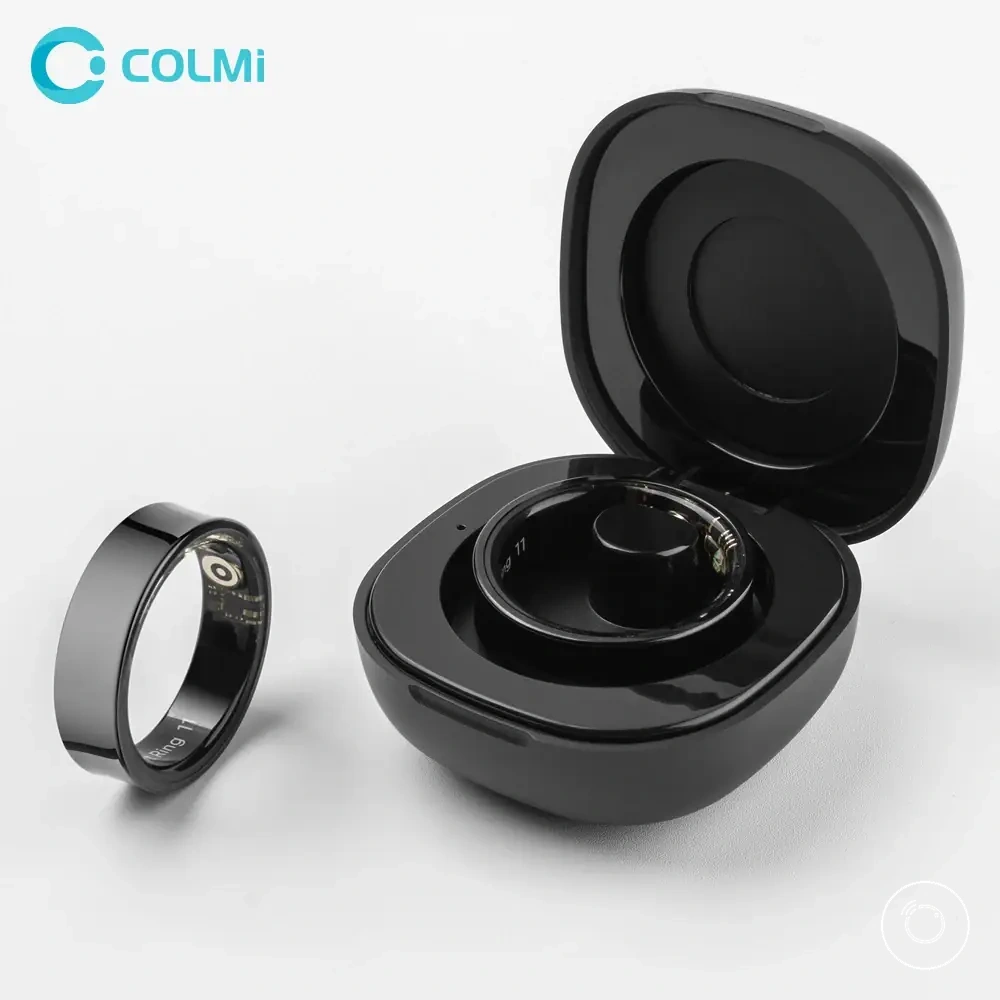
The products below are useful examples for comparing available options. Before buying, check that the compatibility criteria, key features, and product details match your needs.
This chart shows the main cost components to check when evaluating the total ownership cost of a fitness smart ring, including upfront price, subscription access, and accessory and return risk.
Subscription Requirements and Included App Features
Subscription requirements affect a smart fitness ring’s value when free app access excludes features the buyer expects to use. Long-term cost is lower when the required metrics, history access, and coaching tools remain included without ongoing payment, while paid access increases cost for as long as those features are needed.
Compare the included app features by access level and intended use before purchase. Current subscription details should be verified before completing a purchase because free features, paid metrics, history access, coaching tools, and cancellation effects can change.
| Feature area | Free or paid check | Buying implication |
|---|---|---|
| Free features | Confirm which core measurements and summaries remain accessible without a subscription. | Free access is suitable when it includes the features required for routine use. |
| Paid metrics | Check whether advanced metrics require recurring payment. | Paid-only metrics increase long-term cost when they are central to the intended use. |
| History access | Verify whether full historical data, limited history, or no extended history is included without payment. | Limited history reduces value for buyers who need long-term trend review. |
| Coaching tools | Confirm whether guidance, recommendations, or coaching features are free, paid, or unavailable. | A subscription may be acceptable when the coaching tools are required and their ongoing cost fits the buyer’s budget. |
| Cancellation effect | Check which app features remain accessible after a subscription ends. | Long-term value is lower when cancellation removes access to required metrics, history, or coaching tools. |
Bundle Value and Included Accessories
Bundle value is higher when included accessories reduce the need for separate purchases after buying a fitness smart ring. Two similar-looking offers can differ in total value because included accessories, app access, and support may not be the same across retailers or product bundles.
Missing accessories can create ownership friction by adding extra cost or delaying setup. Compare each included item with what would otherwise require a separate purchase, and verify the bundle contents before completing a purchase because included accessories and support can differ between offers.
- Sizing kit: An included sizing kit helps confirm ring size before final use, while a separately purchased kit adds an extra step and possible cost.
- Charging case and cable: An included charging case and cable provide the equipment needed to charge the ring, whereas missing charging accessories may require a separate compatible purchase.
- Spare accessories: Included spare charging components or replacement accessories reduce the need to source compatible items later when those parts are supplied with the bundle.
- App access: Included app access adds value when the required features are available without an immediate additional subscription requirement.
- Return support: Return support should be checked before purchase because available return options and conditions can differ between offers and affect ownership flexibility.
Final Selection Checks Before Comparing Prices
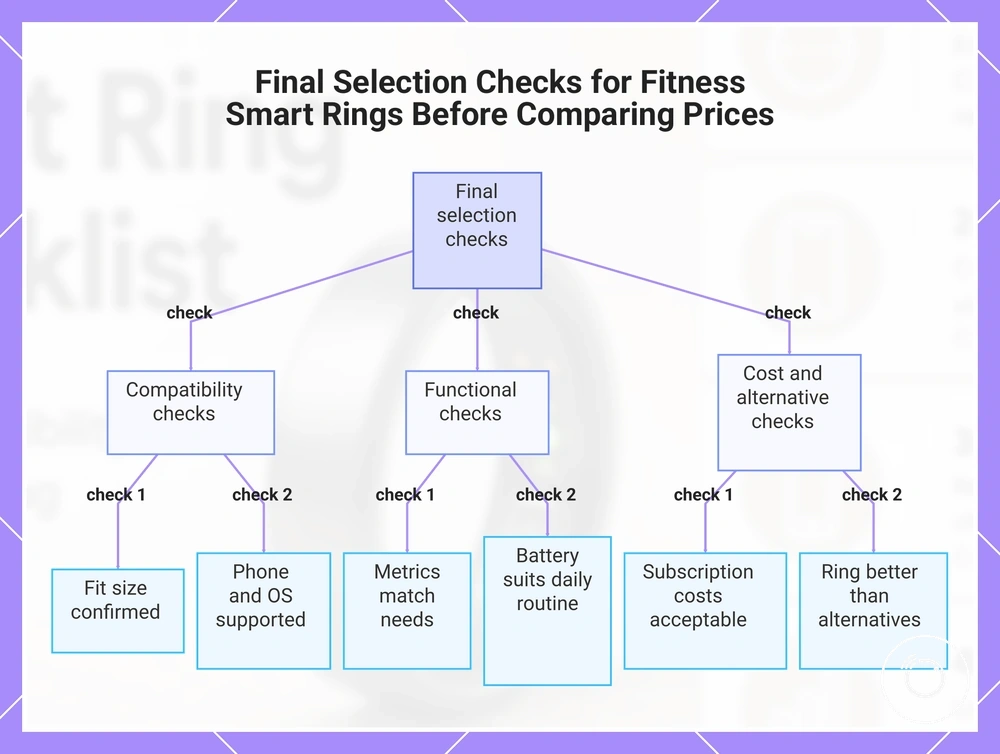
Final selection checks should remove unsuitable fitness smart ring options before you compare prices. A ring is ready for price comparison only when its fit confidence, compatibility pass, metric relevance, battery practicality, durability fit, subscription tolerance, and alternative-device suitability match the intended use.
Use the final checklist to confirm that the selected size is appropriate, the ring supports the required phone and operating system, the available metrics match regular tracking needs, the charging routine fits daily habits, the stated durability suits expected wearing conditions, the subscription requirements are acceptable, and a smartwatch or fitness band would not be a better functional match.
- Fit confidence: Keep the option when the selected size is confirmed or a suitable sizing process is available.
- Compatibility pass: Keep the option when the required phone and operating system are supported.
- Metric relevance: Keep the option when the available health and activity metrics match the intended tracking needs.
- Battery practicality: Keep the option when battery duration and charging frequency suit the expected routine.
- Durability fit: Keep the option when the stated water resistance and construction suit the expected wearing conditions.
- Subscription tolerance: Keep the option when ongoing app costs and feature-access conditions are acceptable.
- Alternative-device suitability: Keep the ring only when its form factor and feature set suit the intended use better than a smartwatch or fitness band.
Treat essential requirements as deal-breakers and non-essential features as preferences. A lower price does not improve the final selection outcome when an option fails compatibility, lacks required metrics, creates an impractical charging routine, or introduces an unacceptable subscription requirement.
Options that satisfy every essential criterion are ready to compare by price. Options with unresolved fit, compatibility, metrics, battery, durability, subscription, or alternative-device questions need further checking before commercial comparison.
The products below are useful examples for comparing available options. Before buying, check that the compatibility criteria, key features, and product details match your needs.
This chart shows the essential checks that a fitness smart ring must pass before it is ready for price comparison.
When a Smartwatch May Fit Better
A smartwatch may fit better when the wearable must provide a screen, on-device workout controls, visible notifications, or GPS through the selected model. A fitness smart ring may fit better when tracking priorities favour low-profile comfort, passive data collection, and a sleep-wear preference that avoids a wrist display.
| Fitness smart ring may fit | Smartwatch may fit better |
|---|---|
| Tracking priorities focus on passive health and activity data without frequent on-device interaction. | Tracking priorities require a screen for live feedback, menus, or immediate data review. |
| Comfort and sleep-wear preference favour a ring rather than a wrist-worn display. | Comfort needs allow a wrist-worn device, and sleep wear is not the primary selection criterion. |
| Workout interaction is limited to recording sessions and reviewing results later in the app. | Workout interaction requires on-device controls, live workout information, or direct session management. |
| GPS and notification needs are secondary or can be handled through a connected phone. | GPS and notifications are required from the wearable, subject to the selected smartwatch model supporting those functions. |
The selection effect is to choose the wearable option whose screen, GPS, workout controls, notifications, comfort, sleep-wear preference, and tracking priorities match the intended use. When those needs remain unresolved, compare with a smartwatch first to avoid following the wrong purchase path.
Buying Risks and Deal-Breaker Checks
Buying risks become deal-breaker checks when a fitness smart ring fails an essential requirement rather than a minor preference. A purchase decision should stop or be delayed when fit, phone support, app access, charging practicality, water-rating clarity, included accessories, or workout capability does not match the intended use.
Use this final mini-checklist to separate practical stop signals from preferences:
- Wrong size: Pause when the selected size is unconfirmed or the available sizing method does not provide enough fit confidence for regular wear.
- Unsupported phone: Stop when the required phone or operating system is outside the model’s stated compatibility scope.
- Locked app features: Compare alternatives when required tracking or analysis features are available only through an app tier or subscription you do not accept.
- Weak battery routine: Delay the purchase when the stated charging frequency does not fit the planned wearing and tracking routine.
- Unclear water rating: Pause when the available product information does not state a water-resistance category suitable for the intended exposure.
- Missing accessories: Recheck the offer when required sizing, charging, or setup accessories are not listed as included.
- Unsuitable workout expectations: Compare another wearable when the required workout controls, live feedback, or activity support are outside the ring’s stated functions.
Proceed to price checking only when each essential criterion has a confirmed, acceptable value. Pause when information remains unresolved, and compare alternatives when the confirmed fit, compatibility, access, battery, durability, accessory, or workout conditions do not support the intended purchase decision.