
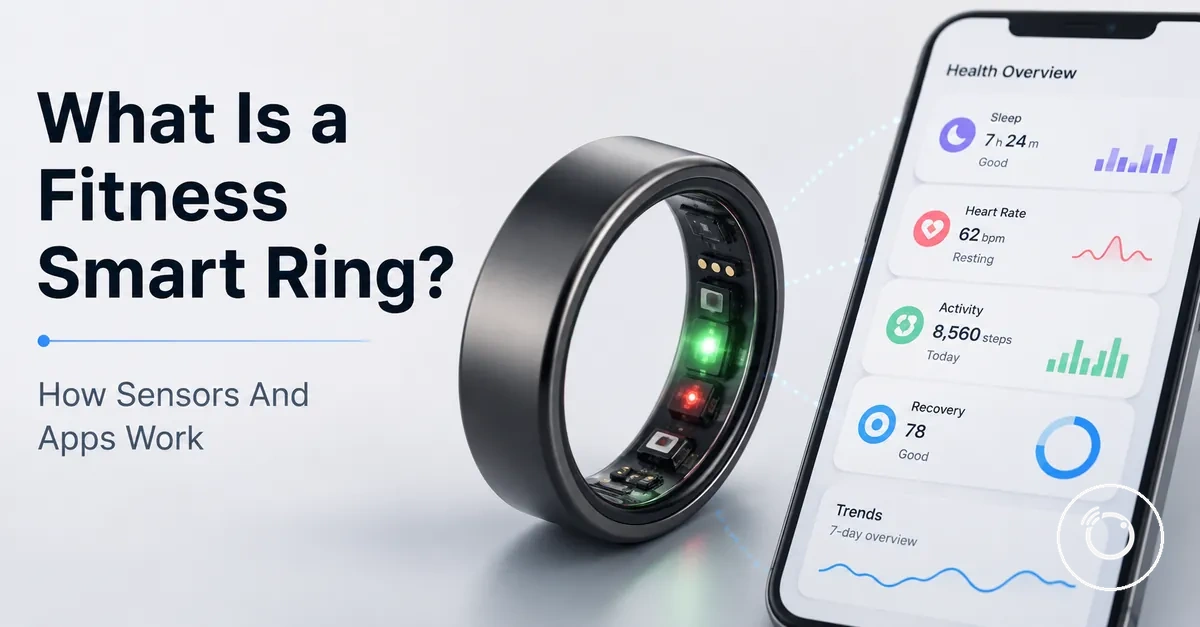
Fitness Smart Rings as Wearable Health Trackers
A fitness smart ring is a compact, finger-worn device that records wellness and movement signals during daily wear. It places tracking technology in a ring-sized form rather than on the wrist. The fitness smart ring is a wearable health tracker.
Built-in sensors collect signals for activity tracking, sleep tracking, and recovery. A connected app interprets those signals and presents them as readings, scores, or trends. Health tracking is most useful when the ring maintains consistent contact with the finger. Available capabilities remain specific to the model’s sensor set, app design, and supported tracking categories.
A fitness smart ring provides wellness data, not a diagnosis. Fit influences sensor contact, while the model and connected app determine which measurements are shown and how accuracy should be interpreted. The ring therefore supports trend awareness rather than medical certainty.
The meaning of a smart ring rests on the relationship between the wearable, its sensors, and the connected app. The ring gathers signals, and the app converts them into trends that help users review sleep, recovery, and activity over time.
What a Fitness Smart Ring Is
A fitness smart ring is a finger-worn wearable that uses built-in sensors and a connected app to support health tracking and activity tracking. It gathers wellness data in a compact ring form and is designed for wearable use rather than serving as ordinary jewellery.
What a fitness smart ring is becomes clearer by looking at its main parts working together. The image below identifies the ring form factor, the sensor area, and the connected app that displays recorded information. Built-in sensors capture supported health and movement signals, while the connected app organises them into features such as activity tracking and sleep tracking. Available tracking functions and the interpretation of wellness data differ by model, sensor set, and app.
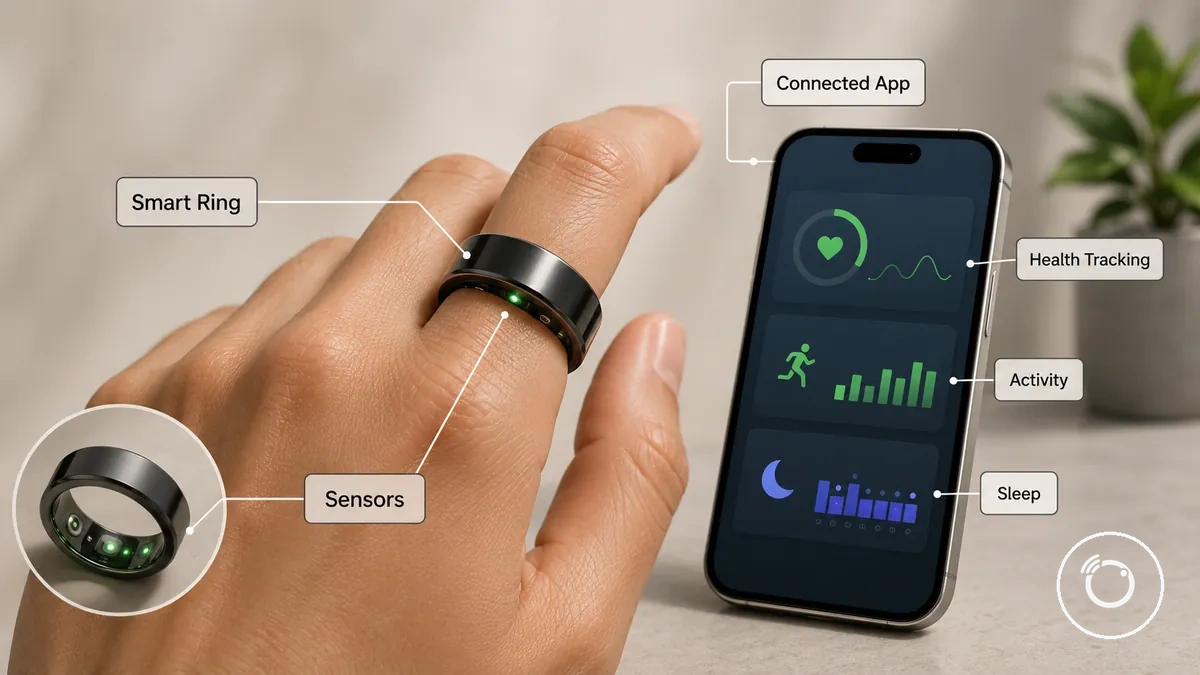
- Form: A compact finger-worn wearable worn like a normal ring.
- Sensor function: Built-in sensors collect supported wellness-related signals.
- App connection: A connected app presents health tracking, activity tracking, sleep tracking, and other supported wellness data.
- Boundary: A fitness smart ring is not just jewellery and is not a medical diagnostic device.
For a broader overview of the wearable category, continue with the fitness smart ring guide. This page remains focused on defining the category before explaining individual features, tracking methods, and related topics.
How it differs from a normal ring
A normal ring is mainly worn for a decorative or symbolic role, while a fitness smart ring adds electronic functions that support digital data collection. Function is the primary difference between the two.
How it differs from a normal ring becomes easier to understand by comparing their components and data output. The image below highlights the sensor area, internal electronics, and app feedback concept. A fitness smart ring includes built-in sensors, electronics, a battery, and a wireless connection that sends supported data output to a companion app, while a normal ring does not produce digital data. Smart ring hardware and app features can differ by model, but both normal rings and fitness smart rings are designed for different purposes.
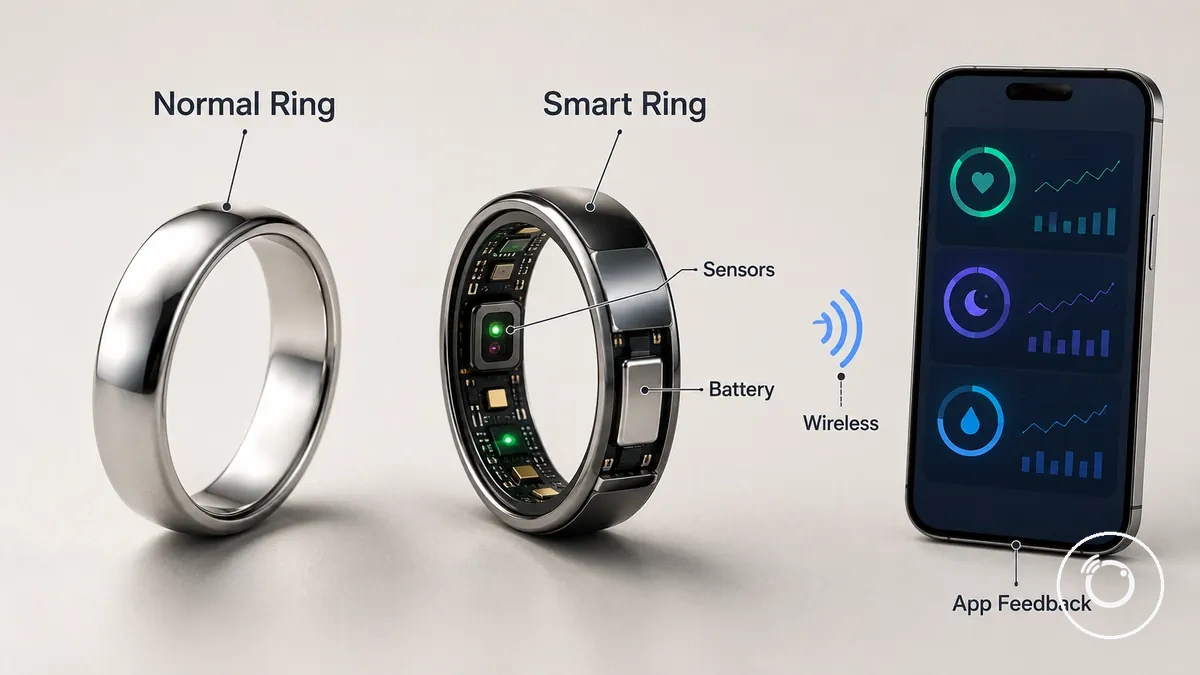
| Normal ring | Fitness smart ring |
|---|---|
| Function: Decorative or symbolic wear | Function: Health and activity tracking |
| Components: Traditional ring materials | Components: Sensors and electronics |
| Power: No battery | Power: Rechargeable battery |
| Connectivity: No wireless connection | Connectivity: Wireless connection to a companion app |
| Data output: No digital data output | Data output: App feedback based on supported wellness data |
How it fits within wearable fitness tracking
A fitness smart ring is a wearable fitness tracking device designed for ring-based data collection in a compact, screenless wearable format. It belongs to the broader wearable fitness tracking category while emphasizing comfort, discreteness, and everyday wear.
How it fits within wearable fitness tracking becomes clearer by comparing the main wearable formats and the information they organize. The image below shows how a fitness smart ring relates to other wearable trackers. A fitness smart ring supports passive tracking and presents health trends through app output, while the available metrics and insights depend on the supported sensors and companion app. It fits within wearable fitness tracking as a distinct ring-based category rather than as a replacement for a smartwatch or fitness band.
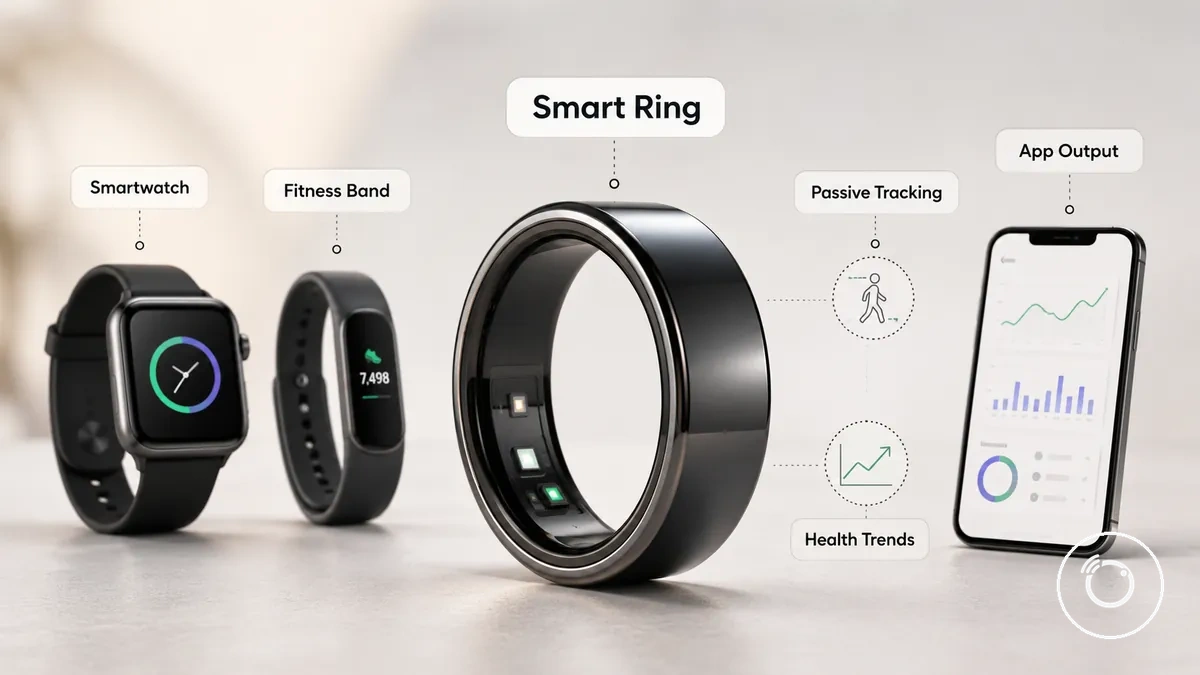
The comparison below highlights how each wearable format typically fits within wearable fitness tracking.
| Wearable format | Typical strength | Main limit |
|---|---|---|
| Fitness smart ring | Screenless wearable with passive tracking and app-based health trends | App output depends on the supported sensors and companion app |
| Smartwatch | On-wrist display with quick access to tracking information | Larger wearable format than a ring |
| Fitness band | Lightweight wrist-based activity tracking | Available features depend on the model and companion app |
How a fitness smart ring works
A fitness smart ring works by using finger sensors to capture signals, syncing sensor data through Bluetooth to a companion app, and interpreting that information into health or activity trends through a sensor-to-app process.
Finger sensors maintain skin contact to collect supported wellness signals. The ring converts those signals into sensor data before preparing them for wireless transfer. The available measurements depend on the supported sensors, firmware, and fit because these factors influence the quality of the collected data rather than producing identical outputs across every model.
Bluetooth sync transfers sensor data from the ring to a companion app for app processing. Algorithmic interpretation organizes the incoming information into health trends or activity trends, and the displayed scores or summaries can differ between apps because processing methods, firmware, supported sensors, and device models are not identical.
How a fitness smart ring works becomes easier to understand by following the path from finger contact to app interpretation. The diagram below summarizes how signals move through each stage before they appear as user-facing trend information.
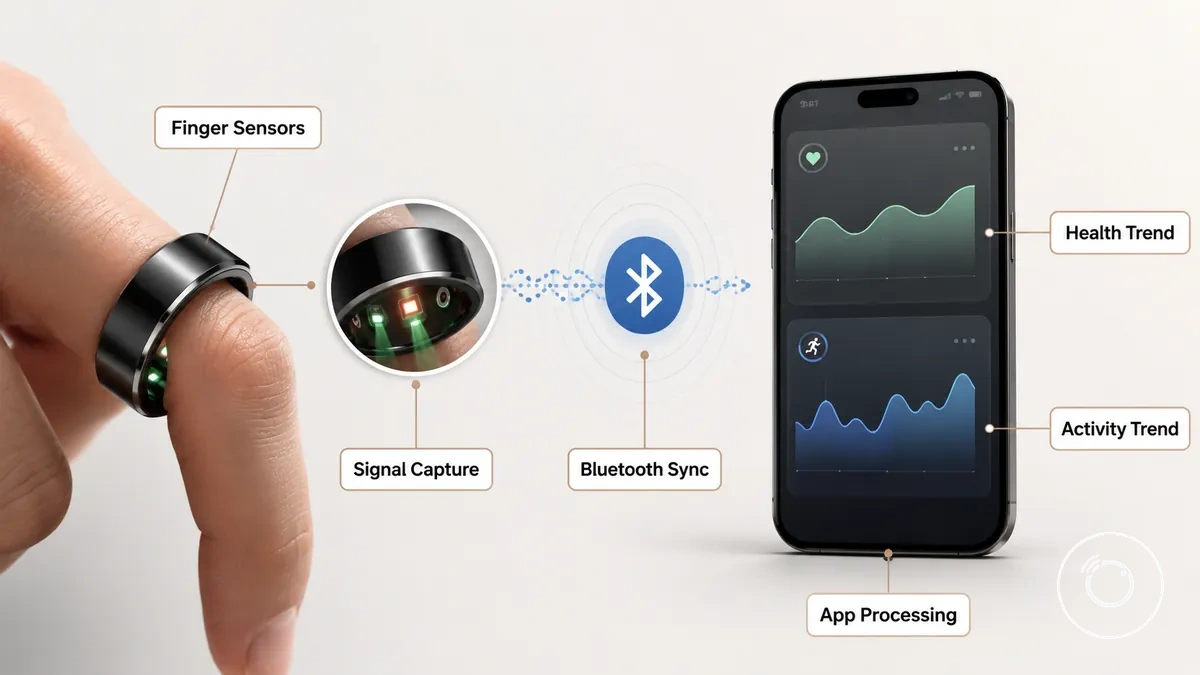
- Finger contact
- Signal capture
- Bluetooth sync
- App processing
- Health or activity trend
For a closer look at the components behind this process, continue to smart ring sensors and health metrics, where each sensor type and its contribution to app trends are explained in more detail.
Finger sensors collect physiological and movement signals
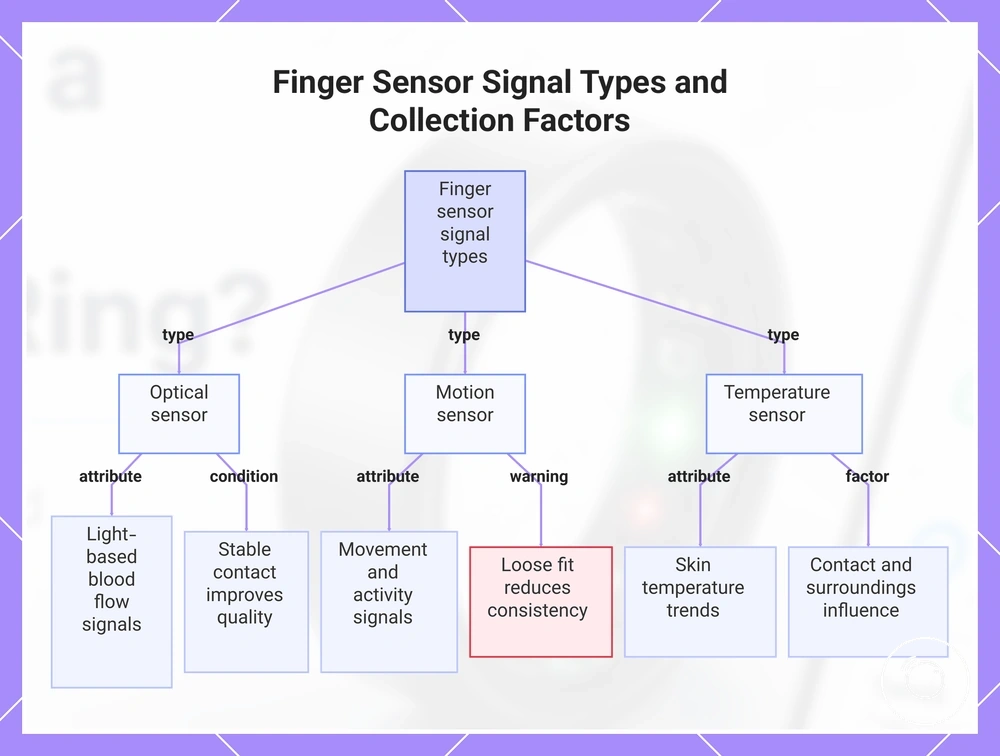
Finger sensors collect physiological and movement signals through continuous finger contact with the skin. This position allows a smart ring sensor to gather different signal types while making stable sensor contact the local requirement for consistent signal collection.
An optical sensor captures physiological signals associated with light-based blood flow measurements, while a motion sensor records movement signals related to activity and hand movement. A temperature sensor measures skin temperature trends rather than a universal body temperature value. Because each sensor module is designed for a different signal type, signal quality depends on factors such as skin contact, ring fit, and wearing conditions, so readings are interpreted within those conditions rather than as fixed values.
Different sensor families focus on different signal types:
- Optical sensor: Collects physiological signals from light-based blood flow changes, with stable skin contact supporting stronger signal quality.
- Motion sensor: Detects movement signals for activity tracking, with rapid hand movement or loose fit potentially reducing signal consistency.
- Temperature sensor: Monitors skin temperature trends, with finger contact and surrounding conditions influencing the collected readings.
This chart shows the three main finger sensor types in a smart ring, what signals they capture, and the conditions that affect signal quality.
The app turns sensor data into health and activity trends
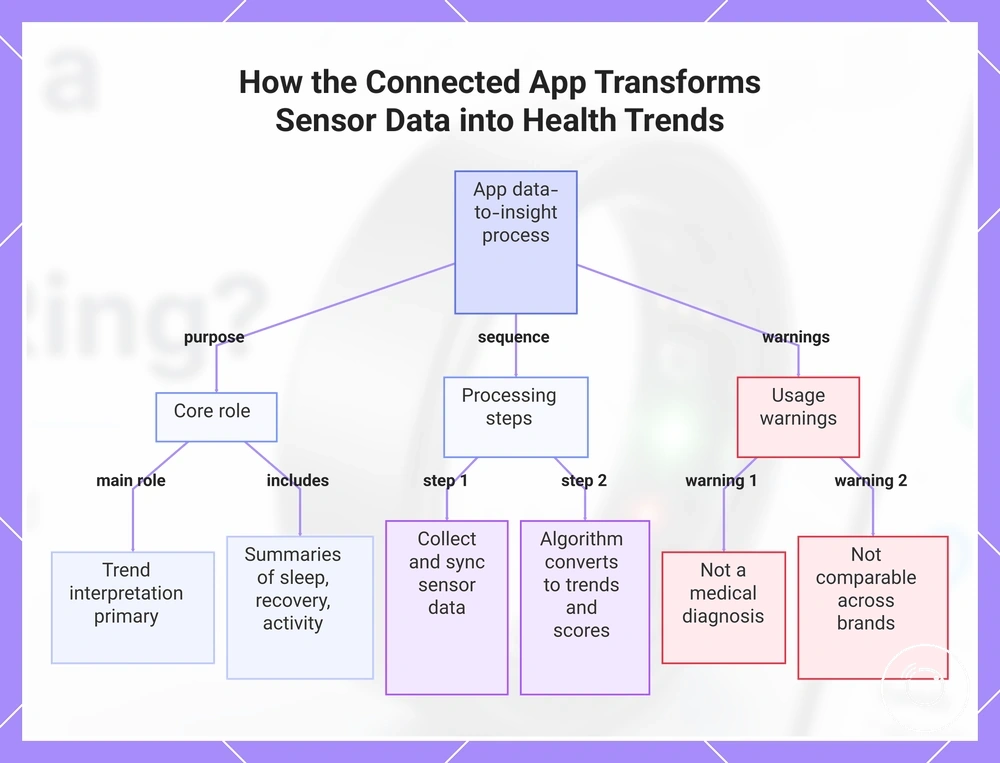
The connected app turns sensor data into health and activity trends by organizing raw measurements into metric summaries, scores, and visual trends. Rather than displaying sensor signals alone, the connected app converts processed data into information that supports user interpretation, making trend interpretation its primary role.
After the smart ring completes a sync with a connected phone, app processing applies an algorithm to organize sensor data into trend views, metric summaries, and scores displayed in the health app or app dashboard. These summaries can include sleep, recovery, and activity trends, while the underlying algorithm determines how the information is presented. Because processing methods differ between apps, scores are intended for user interpretation within the same tracking app and should not be treated as diagnoses or as directly comparable across different brands.
The data-to-insight process follows a simple sequence:
- Collect sensor data
- Sync with the connected app
- Process data using an algorithm
- Display trends, scores, and metric summaries
This chart shows the purpose, processing steps, and usage warnings of the app's data-to-insight pipeline.
What a fitness smart ring can track
A fitness smart ring can commonly track health, sleep, recovery, activity, and related wellness signals, although the available metrics depend on the model and its supported sensors. These tracking categories are best understood by the signals collected and how the connected app interprets them, so model support remains an important boundary.
Common metrics include heart rate, sleep, recovery, activity, temperature, and blood oxygen where supported. Each metric is derived from sensor output and is typically presented as a trend, score, or summary instead of an isolated measurement. The displayed information is intended to help users interpret changes over time rather than represent identical outputs across different devices.
The table below groups common tracking categories by signal type and typical interpretation.
| Tracking category | Signal or input | Typical app output | Qualification |
|---|---|---|---|
| Heart rate | Optical sensor signal | Heart rate trend | Model support and tracking confidence depend on supported sensors and wearing conditions. |
| Sleep | Movement and physiological signals | Sleep trend or summary | Sleep interpretation is based on app processing rather than a single sensor reading. |
| Recovery | Combined health metrics | Recovery score or wellness trend | Recovery outputs are generated only when the required metrics are supported. |
| Activity | Movement signal | Activity trend or summary | Tracked activities depend on the available sensors and supported features. |
| Temperature | Temperature sensor input | Temperature trend | Temperature is generally presented as a trend instead of a standalone health assessment. |
| Blood oxygen | Optical sensor signal | Blood oxygen metric where supported | Blood oxygen tracking is available only on supported models. |
Model support determines which metrics are available, while tracking confidence is influenced by sensor capability, ring fit, and app interpretation. Different hardware and processing methods can produce different trends or summaries, so capabilities should be understood within the supported feature set of each device.
For a detailed explanation of measurement reliability and interpretation, see fitness smart ring accuracy.
Heart rate, sleep, recovery, activity, temperature, and blood oxygen signals
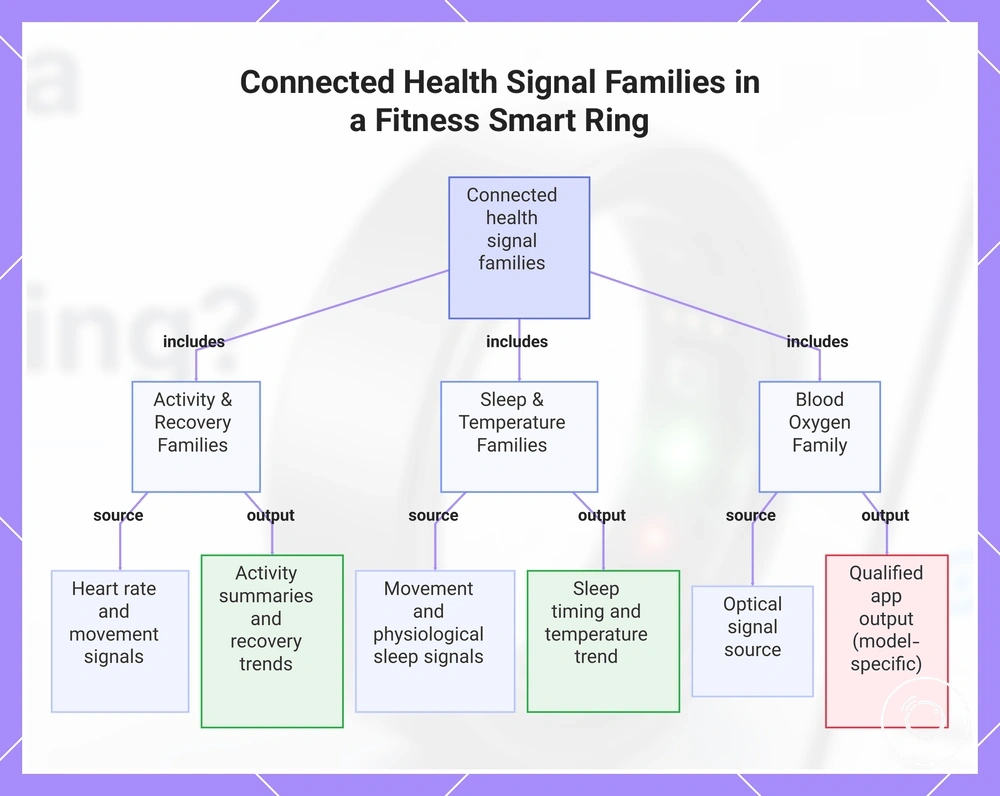
During everyday wear, a fitness smart ring may organize heart rate, sleep, recovery, activity, temperature, and blood oxygen into related metric families when the required sensors and model support are available. These tracking signals are commonly interpreted together as connected health signals rather than as isolated measurements.
Each metric family combines a signal source with an app output that supports everyday health awareness. Heart rate and movement signals can contribute to activity and recovery trends, while sleep timing can produce sleep summaries and wellness trends through app interpretation. Temperature trends provide contextual information about change over time, and blood oxygen app output is available only on supported models, so feature availability remains model-specific rather than universal.
The metric families can be summarized as follows:
- Heart rate: Optical signal source that produces a heart rate trend to support everyday awareness of resting or activity-related changes.
- Sleep: Movement and physiological signal sources that generate app output describing sleep timing and sleep trends.
- Recovery: Combined health signals that contribute to a recovery wellness trend or recovery score for day-to-day interpretation.
- Activity: Movement signal source that creates activity summaries and activity trends reflecting daily movement.
- Temperature: Temperature signal source that produces a temperature trend whose interpretation is influenced by wearing conditions and app processing.
- Blood oxygen: Optical signal source that provides a qualified blood oxygen app output where model support includes that feature.
This chart shows the main metric families, their signal sources, and app outputs, highlighting the model-specific availability of blood oxygen tracking.
Metrics that depend on model, fit, and sensor quality
Tracking metrics can differ between fitness smart rings because the displayed results reflect both device capability and measurement conditions rather than a single fixed standard. Model, fit, and sensor quality are the primary variables that influence tracking confidence.
Model support determines which sensor set and metric categories are available, while firmware and app interpretation determine how collected signals become user-facing outputs. Fit affects finger contact, and stable skin contact helps maintain stronger signal quality than loose placement. Sizing and everyday movement influence signal consistency, so the same tracking category can produce different trends across rings and users without any single factor fully determining the result.
The checklist below highlights the main conditions that influence tracking confidence. For guidance on positioning and sizing, see fitness smart ring fit and finger placement.
- Confirm that the model supports the metric being viewed.
- Maintain a snug fit that preserves reliable finger contact.
- Keep stable skin contact to support consistent sensor quality.
- Consider movement conditions because excessive motion can reduce signal consistency.
- Keep firmware and the companion app current so app interpretation matches the installed software.
- Interpret each metric according to its tracking category because tracking confidence differs across supported metric types.
What fitness smart rings are useful for
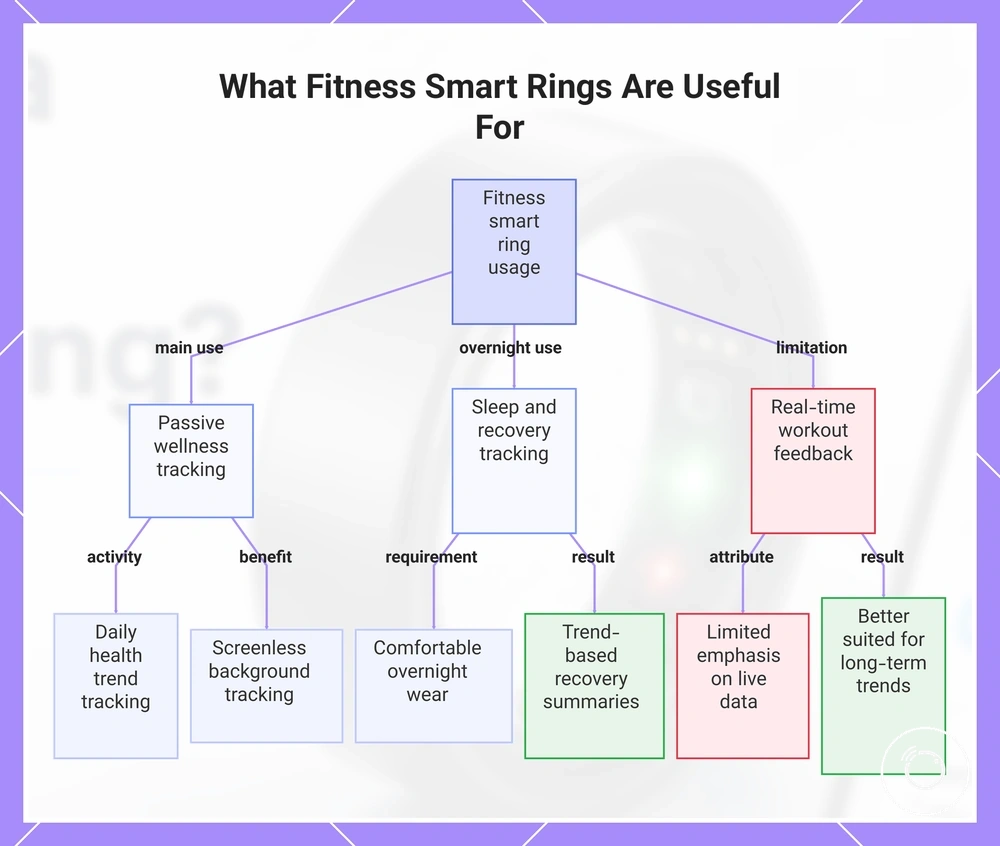
Fitness smart rings are most useful for passive tracking when the goal is ongoing wellness awareness through comfortable daily wear rather than constant interaction with a screen. Their practical value centres on passive wellness awareness.
A low-profile wearable can support everyday tracking by collecting health trends during daily wear and overnight use, with app review helping users observe patterns over time. Sleep tracking and recovery summaries are often most useful for people who prefer comfortable overnight wear, provided the fit is consistent and the supported features match their tracking needs. Passive tracking also suits users who want a screenless tracker that works in the background instead of requiring frequent manual interaction.
The usefulness of a fitness smart ring depends on the user's tracking needs:
- Need: Passive wellness awareness → Useful attribute: Passive tracking during daily wear → Condition: Regular app review helps identify longer-term health trends.
- Need: Sleep tracking → Useful attribute: Comfort during overnight wear → Condition: A consistent fit supports uninterrupted wear.
- Need: Recovery patterns → Useful attribute: Trend-based recovery summaries → Condition: Supported metrics are most meaningful when reviewed over time rather than from a single reading.
- Need: Discreet everyday tracking → Useful attribute: Low-profile wearable design → Condition: Suitable for users who prefer minimal distraction throughout the day.
- Need: Real-time workout feedback → Useful attribute: Limited emphasis → Condition: Fitness smart rings are generally better suited to passive tracking and long-term health trends than continuous exercise guidance.
This chart shows the main use cases for fitness smart rings, focusing on passive wellness tracking, sleep and recovery, and their limitation for real-time workout feedback.
Passive health tracking in a smaller wearable
A smaller wearable supports continuous wear by collecting background data with minimal screen interaction, making passive tracking the primary use case. The combination of continuous wear and low screen distraction defines passive tracking in the smart ring format.
For example, a person can wear a wearable ring throughout work, sleep, and everyday activities while background data is collected for later app review instead of frequent on-screen checks. Reviewing trends during regular app review helps connect daily habits with longer-term patterns rather than isolated readings. The compact tracker format also reduces screen distraction during daily use, while comfort remains dependent on individual fit and wearing preferences rather than the smaller form factor alone.
Sleep and recovery tracking during longer wear
Fitness smart rings support sleep tracking and recovery monitoring when overnight wear allows continuous signal collection across the sleep period. Longer wear connects sleep timing with overnight heart rate trends, temperature patterns, and other supported recovery indicators.
Overnight comfort can support regular wear when the ring fits securely without feeling disruptive, while fit stability helps maintain consistent skin contact and signal quality. Supported sensors may record heart rate trends and temperature patterns for app-based recovery outputs, and sleep timing can show when rest periods begin and end. The available metrics remain model-specific, so useful overnight tracking requires both stable wear and support for the relevant signals.
Sleep and recovery outputs should be treated as wellness indicators for observing personal patterns over time, not as clinical conclusions. A change in an app output can prompt closer attention to sleep habits or wearing conditions, but it does not establish a medical cause or diagnosis.
Benefits and limits of fitness smart rings
Fitness smart rings combine meaningful benefits and practical limits because the same ring-sized design creates both convenience and trade-offs.
The main benefits come from comfort, a screenless design, and passive tracking during continuous wear. A compact ring can suit day and overnight use when the fit remains stable, allowing supported sensors to collect background data with minimal screen distraction. This approach suits users whose primary goal is reviewing long-term trends in a companion app rather than interacting with the device throughout the day.
The main limits also result from the compact design. A limited display and limited controls reduce on-device interaction, so detailed settings and data review usually take place in the companion app. Variable accuracy is another trade-off because supported sensors, ring fit, movement, and model capabilities affect recorded metrics, making fitness smart rings more appropriate for wellness tracking than definitive measurement.
The comparison below shows how each benefit introduces a condition or limitation. The relevant trade-off is the one that matches the user's need for comfort, passive tracking, on-device controls, battery duration, or measurement confidence.
| Benefit | Limit or condition |
|---|---|
| Comfort can support longer daily and overnight wear when the ring remains secure without causing distraction. | Poor fit can reduce comfort and fit stability, which can interrupt wear and weaken signal consistency. |
| Passive tracking collects background data with little user interaction. | Useful interpretation requires regular app review because the ring itself provides limited detail. |
| A screenless design reduces screen distraction during daily use. | A limited display moves detailed information, settings, and trend review to the companion app. |
| Battery duration can reduce charging interruptions when the model's stated runtime covers the intended wear period. | Enabled sensors and tracking features can shorten runtime, so battery expectations should be checked against the selected model and use pattern. |
| Simple controls keep the wearable unobtrusive. | Limited controls are less suitable for users who need frequent on-device sport features or real-time interaction. |
| Health trends can support ongoing wellness awareness. | Variable accuracy reflects differences in supported sensors, fit, movement, and measurement conditions, so suitability rests on the user's required level of confidence. |
Where smart rings can be more convenient than watches
A smart ring can be more convenient than a watch when the user's priority is a low-profile design, screenless use, passive tracking, and longer wear duration rather than frequent on-device interaction. These convenience differences depend on comfort, fit, and the intended use.
A low-profile design can make daily wear and sleep comfort easier for users who prefer a smaller wearable, while screenless use reduces visual distraction from displays and notifications. Passive tracking allows supported health data to be collected in the background without frequent interaction, and battery expectations may support longer uninterrupted wear when the selected model and enabled features are designed for extended use. A watch remains more suitable when the user needs a display, active controls, notifications, or frequent access to workout functions.
The comparison below highlights where ring-based convenience differs from a watch-style wearable based on user need.
| Ring convenience | Watch-style trade-off |
|---|---|
| A low-profile design can improve comfort during continuous wear when the ring fits securely. | A watch provides a larger interface but occupies more wrist space. |
| Screenless use reduces display-related distraction during daily wear. | A watch display supports immediate information but encourages more active interaction. |
| Sleep comfort can improve for users who prefer a small finger-worn device during overnight wear. | A watch may feel more noticeable during sleep because of its larger wrist-worn design. |
| Passive tracking collects background data with minimal manual input. | A watch offers active controls and real-time interaction for users who prefer direct device access. |
| Battery expectations can support extended wear duration when the selected model and enabled features allow it. | Display use and broader active features can require more frequent charging, depending on the watch configuration. |
Where smart rings are limited by size, sensors, and interpretation
A smart ring is most limited when the user needs extensive on-device interaction, detailed workout guidance, or highly consistent measurements across changing conditions. The primary limitation sources are ring size, sensor limits, and app interpretation.
Ring size leaves less space for hardware, resulting in a smaller battery, a limited display, and limited controls compared with larger wearables. Fewer active workout tools make a smart ring less suitable when the user needs live exercise feedback or frequent manual input. Sensor limits create signal constraints when finger contact is unstable, movement affects measurements, or the supported sensor set does not include the required metric. App interpretation converts captured signals into summaries or proprietary scores, so results should be interpreted within the same platform rather than assumed to match outputs from other apps.
The following criteria show how each limitation affects practical use:
- Ring size: A smaller battery can shorten uninterrupted wear when power-intensive tracking features or frequent synchronisation are enabled.
- Display and controls: A limited display and limited controls shift detailed settings and data review to the companion app, reducing convenience for users who expect direct device interaction.
- Active workout tools: Fewer active workout tools provide less support for real-time exercise guidance and manual workout control.
- Sensor limits: Signal constraints become more noticeable when ring fit is unstable or movement reduces measurement quality, affecting tracking consistency.
- App interpretation: Proprietary interpretation methods can produce different wellness scores across apps because each platform applies its own processing approach.
What a fitness smart ring does not replace
A fitness smart ring does not replace medical diagnosis or every feature of an advanced sport watch. The primary boundaries remain medical evaluation and sport-watch functionality.
A fitness smart ring is designed to show a wellness trend rather than provide a medical diagnosis or a clinical measurement. Ring data can support personal health awareness, but diagnosis and treatment decisions require clinical assessment by a qualified clinician using appropriate medical methods. This boundary helps prevent wellness information from being interpreted as medical evidence.
A fitness smart ring also does not replace a sport watch when the user needs built-in GPS, a display for live exercise information, or advanced active workout features. Screenless designs emphasise passive tracking and companion-app review instead of continuous on-device coaching and workout control. Users whose priority is route tracking, display-based guidance, or frequent interaction during exercise are typically better served by a sport watch with those capabilities.
The comparison below summarises the main replacement boundaries.
| Not replaced | Why it matters |
|---|---|
| Medical diagnosis | A wellness trend does not diagnose a medical condition or replace clinical judgement. |
| Clinical measurement | Clinical devices are intended for medical assessment, while ring data supports general wellness tracking. |
| GPS | Location-based exercise features and route recording require GPS support that many fitness smart rings do not provide. |
| Display-based coaching | A sport watch display delivers live workout guidance that a screenless ring cannot present. |
| Active workout tools | Training controls and interactive workout features are more suitable on devices designed for active exercise. |
| Route tracking | Users who need mapped activity records should confirm that the selected device supports route tracking. |
Medical devices, diagnosis, and clinical measurement limits
A fitness smart ring is a wellness tracker rather than a medical device unless the specific model is validated for that medical purpose. Its wellness data can support personal awareness, but it remains separate from diagnosis and clinical measurement.
Clinical measurement requires a validated device and methods intended for medical assessment. Blood pressure or oxygen interpretation should be limited to the functions and validation stated for the selected model, because support differs between devices. When symptoms, unexpected readings, or health decisions are involved, clinician guidance and appropriate clinical measurement provide the correct boundary between wearable signals and clinical decisions.
Caution: Treat smart ring outputs as supportive wellness information rather than diagnostic evidence, and seek professional guidance when a result could affect care or when symptoms require assessment.
Advanced sport watch features and active workout tools
Advanced sport watch features prioritise active training, while a fitness smart ring is generally oriented towards passive wellness tracking and recovery. The key difference is active-workout feature fit rather than device superiority.
A sport watch is more likely to provide built-in GPS, a display for live pacing, workout controls, route mapping, and deeper sport mode options during exercise. A fitness smart ring may still record activity, but screenless designs and app-based review limit continuous on-device coaching and direct workout interaction. Users who prioritise passive wellness tracking may prefer a ring, while users who need active training guidance should prioritise a sport watch with the required features.
The comparison below summarises the main feature-fit differences.
| Active workout need | Ring limitation or condition |
|---|---|
| GPS | Fitness smart rings without built-in GPS require a connected device for location-based tracking. |
| Live display | A screenless ring does not present continuous workout information during exercise. |
| Live pacing | Real-time pacing requires a device that can display pace data while the user is moving. |
| Route mapping | Route mapping requires GPS data from the ring itself or a connected device. |
| Sport-mode depth | Deeper sport mode options and workout controls are more commonly associated with devices designed for active training. |
Common fitness smart ring questions
A direct answer to each fitness smart ring question requires the relevant condition, such as model support, fit, or intended use. These qualified answers clarify residual doubts.
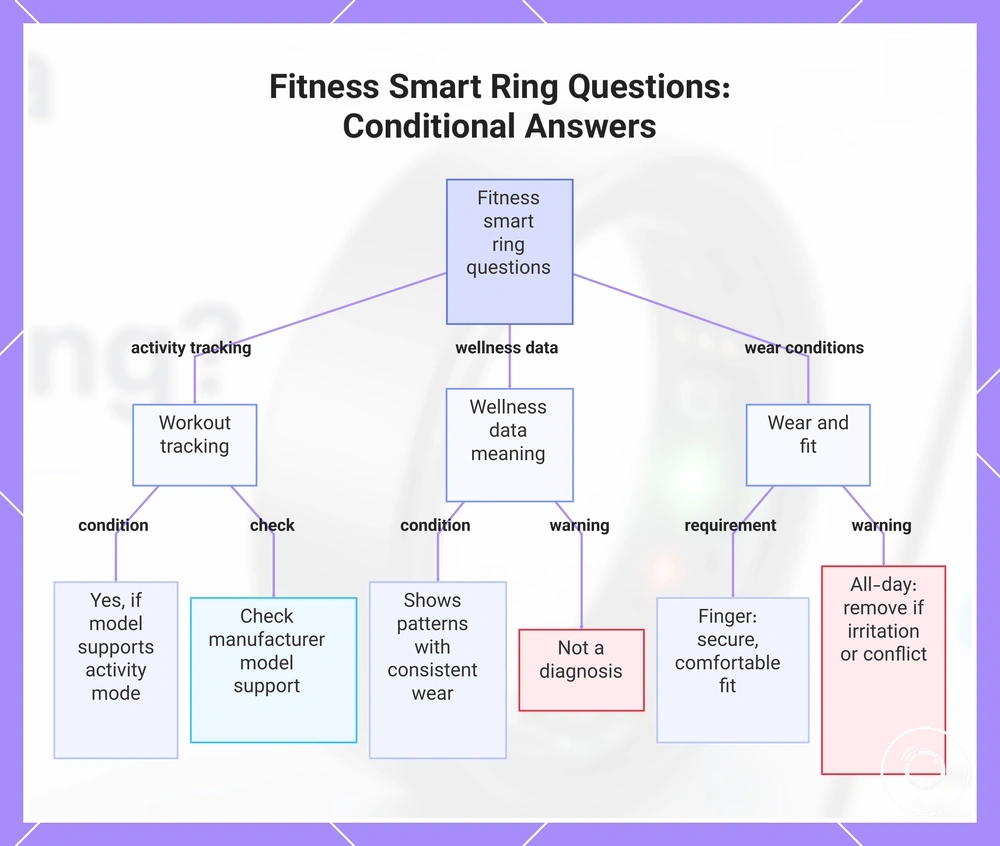
Does a fitness smart ring track workouts?
Yes, when the selected model supports the required activity or sport mode. A smart ring may record movement and workout-related metrics, but its capability and limitation should be checked against the model support stated by the manufacturer.
What does fitness smart ring wellness data mean?
Wellness data can show personal patterns when the ring is worn consistently, but it does not provide a diagnosis. A clinician may use a clinical device and other assessment methods when a health concern requires a qualified answer.
Which finger should a fitness smart ring be worn on?
The suitable finger is the one that provides a secure, comfortable fit and consistent sensor contact under the model's fitting guidance. A ring that rotates freely or presses tightly may reduce comfort or interrupt reliable skin contact.
Can a fitness smart ring be worn all day and night?
Yes, when the ring remains comfortable, maintains sensor contact, and the model supports the relevant wear conditions. Remove the ring if irritation develops or when an activity conflicts with the device's stated use limits.
This chart shows the conditional answers to common fitness smart ring questions about workout tracking, wellness data, finger choice, and all-day wear, based on model support, fit, and comfort.
Do fitness smart rings track blood pressure
Most fitness smart rings do not provide clinical blood pressure tracking unless a specific model clearly lists that capability. A wellness ring may provide related wellness data, but that information is not a diagnosis and should not replace a cuff used for clinical measurement. Medical interpretation should follow the model support stated for the device and the boundary between smart ring data and clinician-grade assessment.
What do doctors say about smart rings
Clinicians may use smart ring data as wellness context, but not as a standalone diagnosis. Health trends can add patient context when reviewed alongside symptoms, while a validated device is needed for clinical assessment. This distinction keeps wellness data separate from professional medical interpretation and should not be treated as medical advice.
Which finger should a smart ring be worn on
Finger choice should follow the ring maker guidance for the model and provide a fit that supports comfort and stable sensor contact. The smart ring should feel snug without causing pressure, while dominant-hand comfort may affect which wearing finger is practical. The selected finger should also remain comfortable during overnight wear and keep the sensors in steady contact for signal stability.
Use these checks to verify that the chosen finger meets the ring’s fit and sensing conditions:
- Confirm the recommended finger placement in the ring maker guidance.
- Choose a size with secure snugness that limits unwanted movement.
- Check comfort during normal dominant-hand use.
- Confirm stable sensor contact against the skin.
- Recheck overnight wear comfort if finger swelling makes the ring feel tight.