
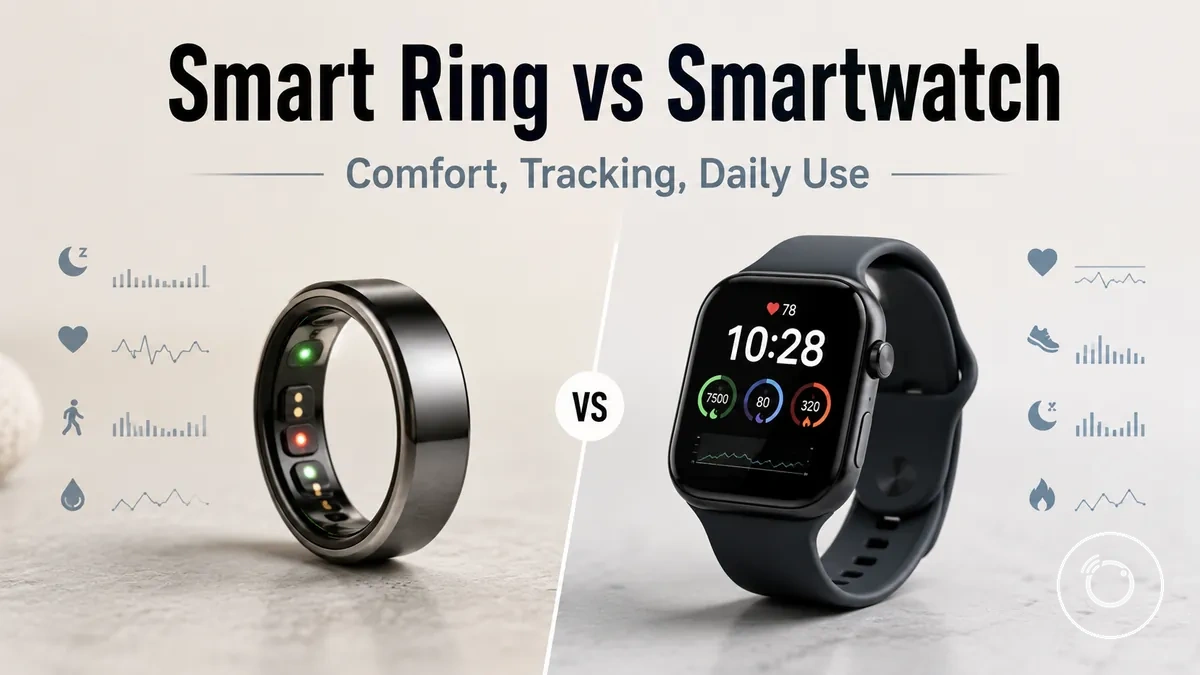
Fitness Smart Ring vs Smartwatch for Fitness and Health Tracking
A fitness smart ring suits low-profile passive tracking, while a smartwatch suits live interaction through a display and on-wrist controls. Both wearable formats support fitness tracking and health tracking, but they present information differently: a ring usually sends results to an app for review, whereas a watch can show feedback, notifications, GPS information, or workout controls where those features are available. Comfort and daily use also differ because a ring sits on the finger and a watch occupies more space on the wrist. The better format is the one that matches the required level of interaction, fit, model features, ecosystem, and use case.
Choose a fitness smart ring when the priority is screenless, passive tracking with minimal interruption during everyday wear. Choose a smartwatch when the priority is checking information during an activity, responding to notifications, or using live controls without opening a phone app. A suitable ring fit supports consistent finger placement, while a suitable watch fit keeps the device stable on the wrist without creating avoidable discomfort. The main trade-off is discreet monitoring and app-based review versus immediate display feedback and direct control.
These wearable devices differ mainly in format, interaction, and placement rather than in a universal hierarchy of quality. The first comparison is how the ring and watch formats shape comfort, tracking behaviour, and everyday use.
How Smart Rings and Smartwatches Differ as Tracking Wearables
A smart ring is a finger-worn tracker with a compact, usually screenless and app-led interface, while a smartwatch is a wrist-worn wearable with a display, alerts, and direct interaction. Their form and interaction differ even when their tracking purpose overlaps. Sensor position is on the finger for a ring and on the wrist for a watch, which changes fit, comfort, feedback access, and the conditions that support tracking continuity. A smart ring is not simply a smaller smartwatch, and a smartwatch is not only a larger tracker.
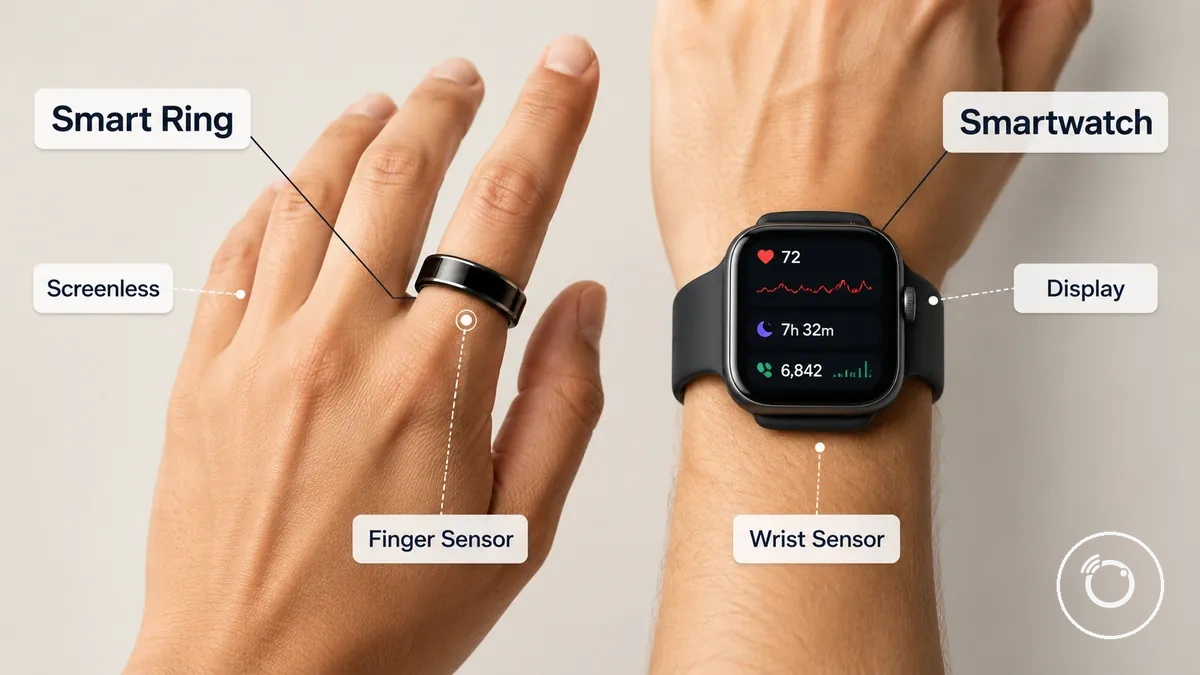
The compact comparison below clarifies how form factor, interface, sensor position, interaction style, feedback, and wear continuity distinguish these wearable formats. In direct terms, a smart ring prioritises discreet, app-led tracking, while a smartwatch prioritises visible feedback and on-device interaction; the practical effect remains conditional on model, fit, activity, ecosystem, and use case. The broader guide compares these differences without treating either format as universally superior, while the fitness smart ring guide explains the ring format in greater depth.
| Dimension | Fitness smart ring | Smartwatch | Decision effect |
|---|---|---|---|
| Form factor | Compact finger-worn tracker | Wrist-worn wearable with a larger body | The ring provides a lower-profile format, while the watch provides more space for visible information and controls. |
| Interface | Usually screenless and reviewed through a connected app | Uses a display for alerts, information, and direct input | The ring supports passive, app-led review, while the watch supports immediate on-device interaction. |
| Sensor position | Placed against the finger when the ring fits securely | Placed against the wrist when the strap fits securely | Either position supports tracking continuity when the device remains stable during the intended activity. |
| Feedback | Feedback is mainly reviewed through the companion app | Feedback appears on the display through alerts, live metrics, or controls where supported | The ring suits quieter monitoring, while the watch suits use cases that prioritise visible feedback. |
| Wear continuity | The compact format supports passive wear when finger fit remains comfortable | Continuity relies on keeping the wrist-worn wearable fitted during the relevant period | The more suitable format is the one the user can wear consistently without disrupting comfort or activity. |