How Men's Chronograph Watches Work
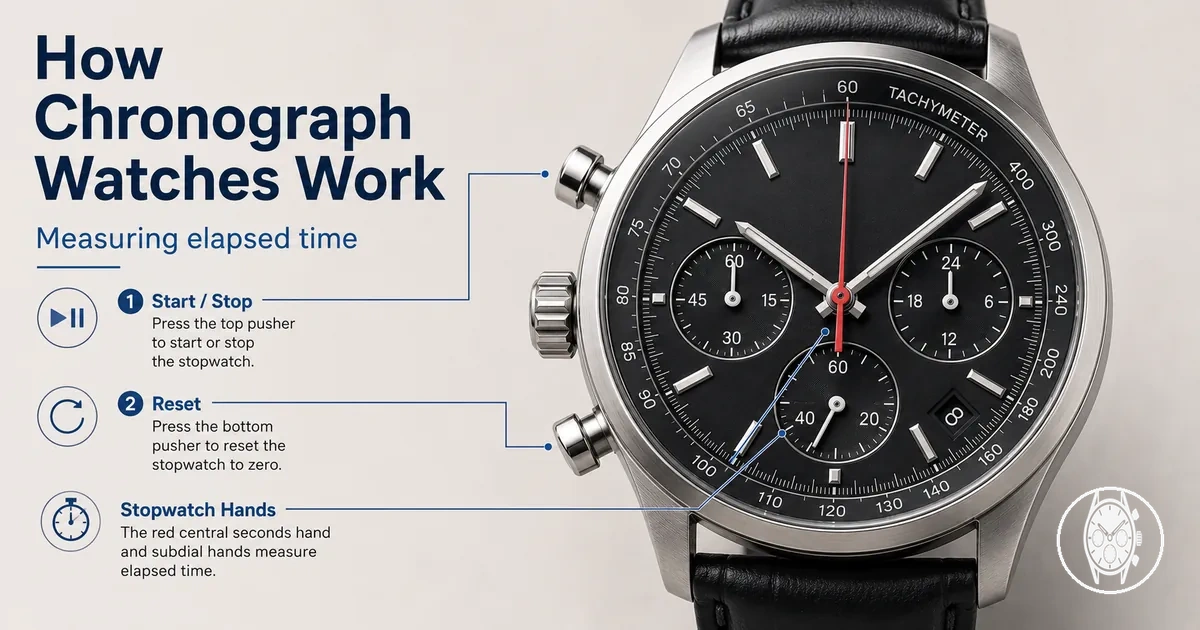
A men's chronograph watch combines normal timekeeping with a chronograph function that operates as a stopwatch while the watch continues to show the current time. Seiko defines this function as measuring elapsed time while indicating the current time, so men's chronograph watches separate ordinary time display from elapsed-time measurement.
A men's chronograph watch combines normal timekeeping with a chronograph function that operates as a stopwatch while the watch continues to show the current time.
Normal time is shown by the watch's timekeeping hands, while the chronograph uses dedicated hands or counters to display the measured interval; the exact layout is model-dependent. For example, Seiko specifies that its mechanical 8R46 and 8R48 movements use a central stopwatch seconds hand and a stopwatch minute hand with a 30-minute scale, while the 8R48 also uses a stopwatch hour hand and can measure up to 12 hours; the 8R46 measures up to 30 minutes.
The pushers control the chronograph, the hands and subdials communicate the result, and the movement provides the watch mechanism that drives those functions.
The pushers control the chronograph, the hands and subdials communicate the result, and the movement provides the watch mechanism that drives those functions. In Seiko's 8R46 and 8R48 mechanical chronographs, Button A starts and stops timing and Button B performs the reset to zero; Seiko's documented example records an elapsed time of 20 minutes 41 seconds using the start, stop, and reset sequence. Mechanical and quartz chronographs can use different mechanisms and display arrangements, so these control assignments and counters should be treated as model-specific rather than universal.
Mechanical and quartz chronographs can use different mechanisms and display arrangements, so these control assignments and counters should be treated as model-specific rather than universal.
A tachymeter is also model-dependent rather than essential to the chronograph function: Seiko documents chronograph models without a tachymeter and states that its position can differ with model design when one is present. The working principle remains the relationship between normal time, elapsed-time measurement, controls, displays, and the movement; setting, reset procedures beyond basic operation, hand alignment, and troubleshooting require the instructions for the relevant watch or movement.
Table of Contents
What the chronograph function does in a men's watch
The chronograph function is a stopwatch function built into a watch that can continue showing normal time while a separate interval is timed. Its explicit function is elapsed-time measurement.
Its explicit function is elapsed-time measurement.
The chronograph function measures the interval between starting and stopping the timer, while the watch dial continues to show normal time with its hour and minute hands. Depending on the model, dedicated chronograph hands and subdials or counters display elapsed seconds, minutes, or hours, while pushers provide the controls for starting, stopping, and resetting the timing display. This separation between the timing function and its controls and displays also clarifies what a chronograph watch means.
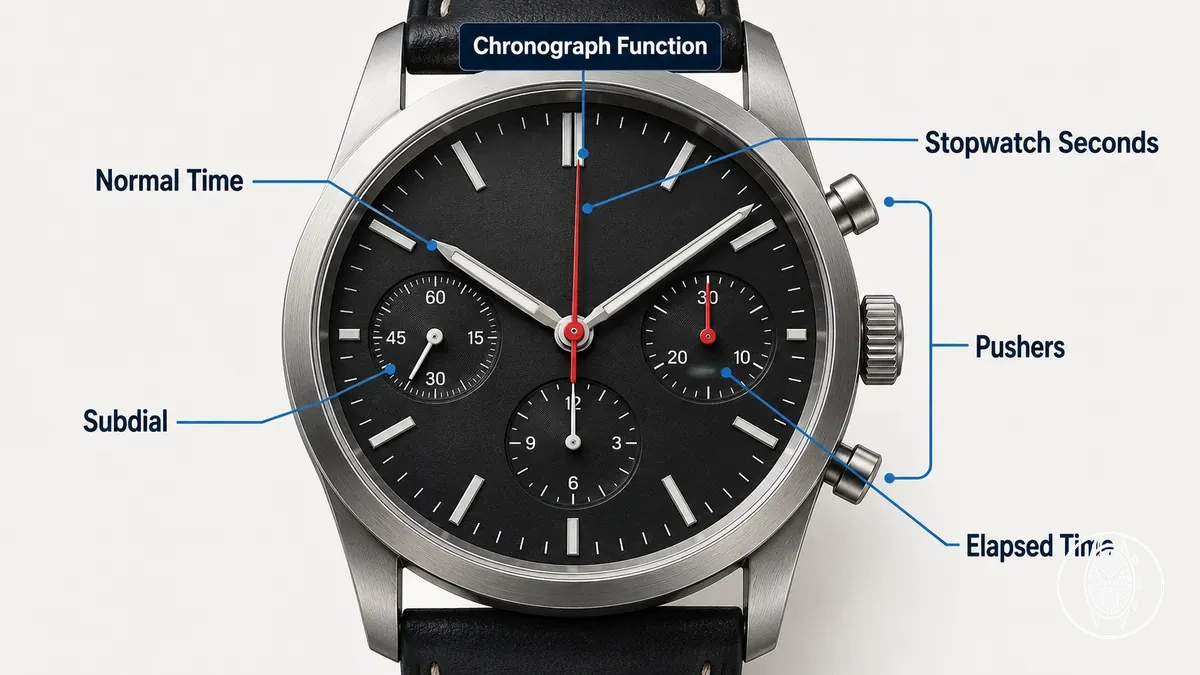
The chronograph is the function itself; pushers are control parts, while subdials, counters, and dedicated chronograph hands are display parts that help operate or read it. Their number and arrangement are model-specific rather than defining characteristics of the chronograph function.
How chronograph timing runs alongside normal timekeeping
Chronograph timing can run alongside normal timekeeping because the two timing layers have separate display roles: the hour hand and minute hand continue indicating the current time while the stopwatch layer records elapsed time. Seiko specifies this simultaneous behaviour for its 8R46 and 8R48 mechanical chronograph movements, separating stopwatch timing from the normal time display.
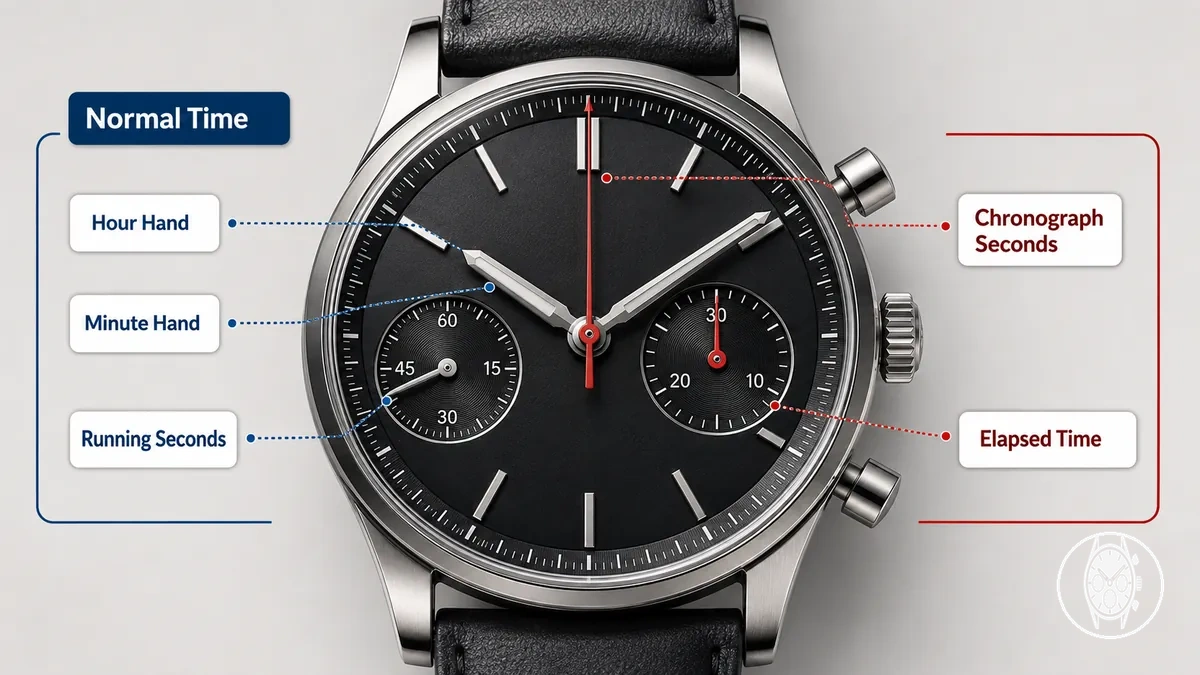
On Seiko Calibres 8R46 and 8R48, normal timekeeping uses the hour hand, minute hand and small running seconds hand, whereas chronograph timing uses a central chronograph seconds hand and a stopwatch minute counter with a 30-minute scale. Seiko specifies that the 8R46 measures elapsed time for up to 30 minutes, while the 8R48 adds a stopwatch hour hand and measures up to 12 hours, demonstrating that counter capacity and displayed indicators depend on the movement. The contrast below separates the roles of the two timing layers without implying that every chronograph uses the same dial arrangement.
| Display role | Normal timekeeping | Chronograph timing |
|---|---|---|
| Displayed value | Current time | Elapsed time |
| Hands or indicators | Hour hand, minute hand and running seconds | Chronograph seconds and movement-dependent elapsed-time counters |
For a model-specific boundary example, Seiko specifies that starting its 8R46 or 8R48 stopwatch begins movement of the chronograph seconds and minute indicators while the movement continues normal timekeeping. On a properly functioning watch with this design, starting chronograph timing therefore normally changes the elapsed-time display rather than the hour-and-minute time display; the exact indicator arrangement and timing capacity remain dependent on the movement.
How pushers start, stop, and reset the chronograph
Chronograph pushers control the basic timing cycle by starting elapsed time, stopping the measurement, and resetting the chronograph hand and counters to the zero position. Seiko specifies Button A for start and stop and Button B for reset on Calibres 8R46 and 8R48, while Citizen specifies an upper-right start/stop button and lower-right reset button on Calibre B620, so the exact button layout is subject to model variation.
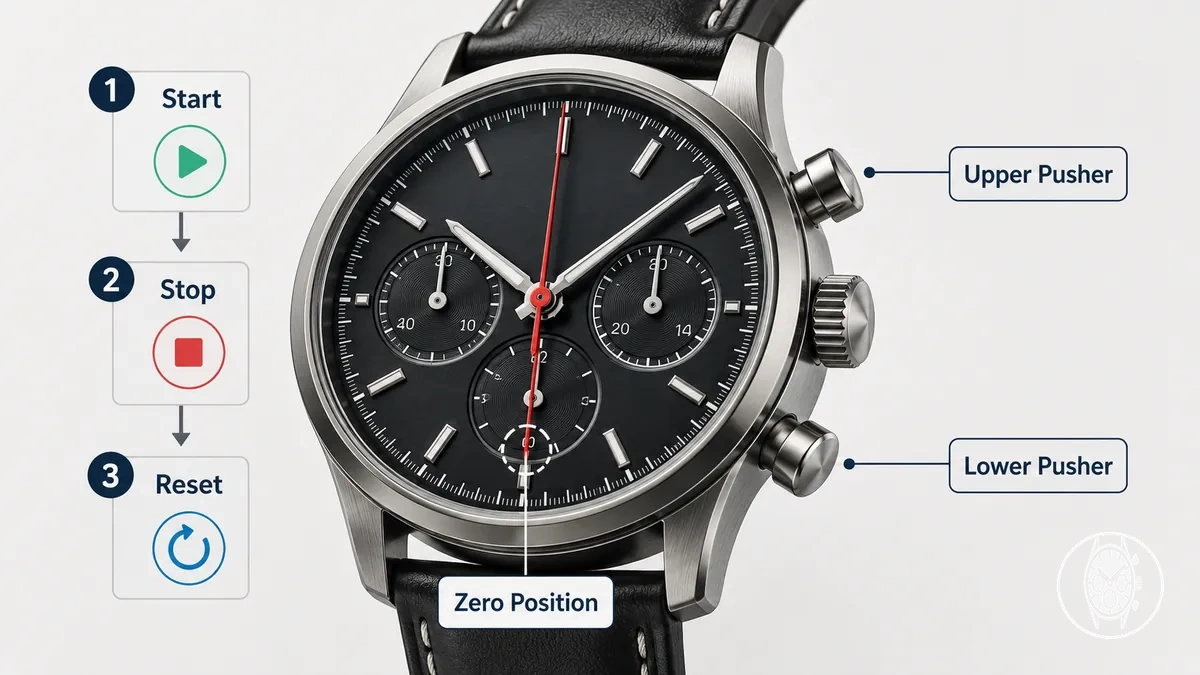
Starting the chronograph moves its timing indicators from zero to record elapsed time, while stopping holds the measured interval for reading. Seiko's 8R46/8R48 instructions give a numerical example in which Button A starts and stops a measurement at 20 minutes 41 seconds before Button B returns the stopwatch indicators to 0 minutes 0 seconds.
- Start timing: Operate the model's start/stop pusher; Seiko assigns this action to Button A on 8R46/8R48, while Citizen assigns it to the upper-right button on B620. The chronograph hand then begins displaying elapsed time; check the model's user manual rather than assuming the same pusher position on another movement.
- Stop timing: Operate the same start/stop pusher again. The chronograph indicators stop at the measured elapsed time; Seiko's documented 8R46/8R48 example stops at 20 minutes 41 seconds, while the normal control assignment remains specific to the movement.
- Reset to zero: After stopping the chronograph, operate the assigned reset pusher to return its timing indicators to their reset position. Citizen's B620 instructions specify the lower-right button for reset while the chronograph is stopped, and Seiko specifies Button B on 8R46/8R48 to return its stopwatch display to 0 minutes 0 seconds; because reset behaviour can differ by movement, the stopped-before-reset condition should be confirmed in the relevant user manual.
For operating details beyond this basic pusher sequence, including controls for a specific movement, see how to use a chronograph watch.
Starting and stopping elapsed time
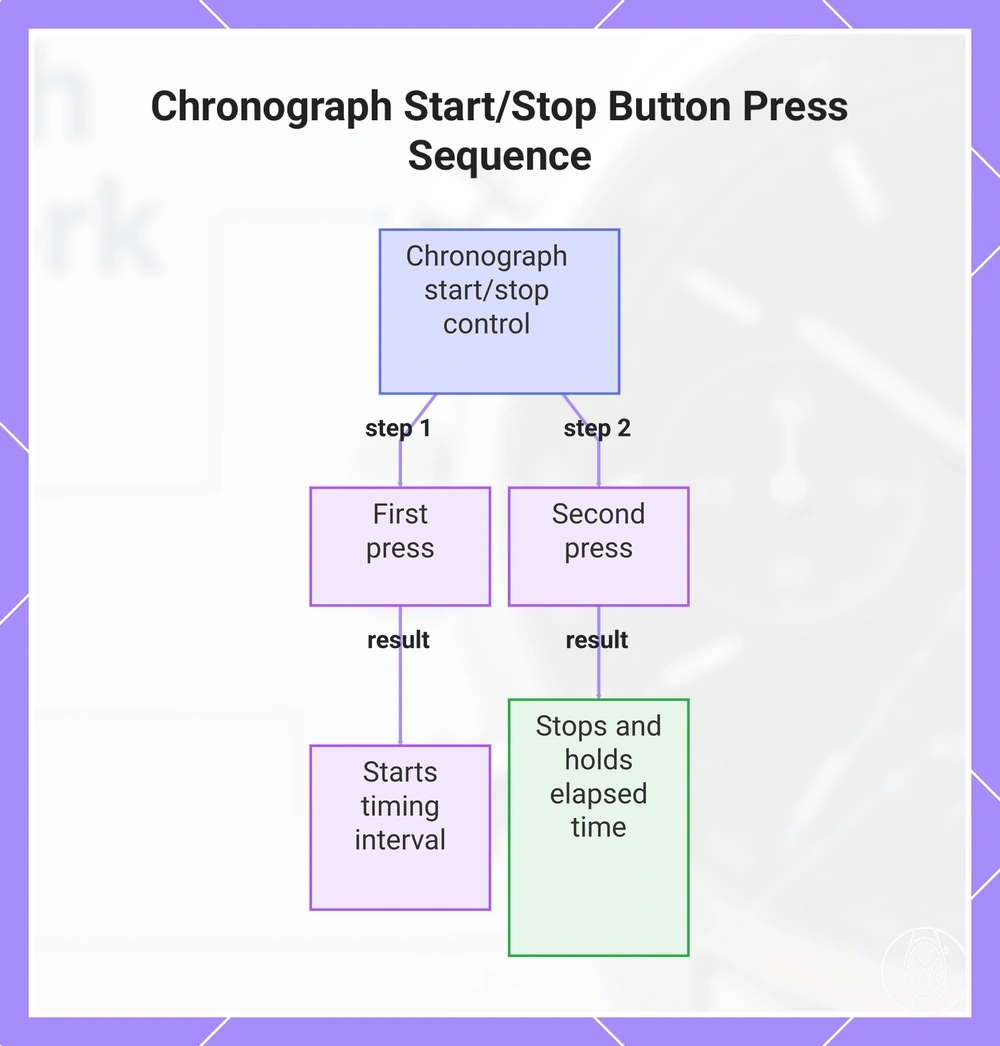
A pusher press starts the active timing interval, causing the chronograph hand to move and accumulate elapsed time; a second press of the model's start/stop control stops the interval and holds the measured value on the stopped display. Seiko specifies this start-stop behaviour for Calibres 8R46 and 8R48, where Button A starts and stops the stopwatch, although the chronograph hand's motion style and exact button feel are model-dependent.
The chronograph indicators then remain at that elapsed-time value for reading, making the change from an active timing interval to a stopped display directly visible.
For example, Seiko's operating instructions for Calibres 8R46 and 8R48 show Button A starting the stopwatch and a second Button A press stopping it at 20 minutes 41 seconds. The chronograph indicators then remain at that elapsed-time value for reading, making the change from an active timing interval to a stopped display directly visible.
This chart shows how pressing Button A twice controls the chronograph: first press starts timing, second press stops and holds the elapsed time.
This chart shows how pressing Button A twice controls the chronograph: first press starts timing, second press stops and holds the elapsed time.
Resetting the chronograph back to zero
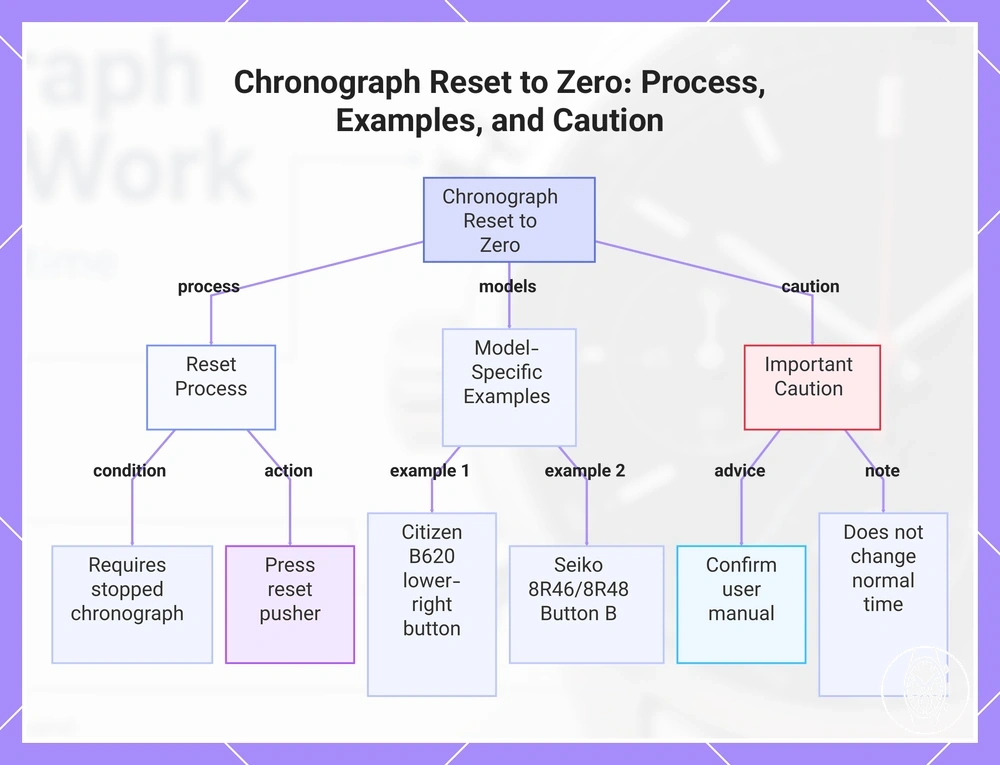
Reset returns the chronograph indicators to their zero position or starting position by operating the model's reset pusher after the chronograph has been stopped where the movement requires that condition. Citizen specifies that Calibre B620 must be in a stopped chronograph state before its lower-right reset button is pressed, while Seiko assigns stopwatch reset to Button B on Calibres 8R46 and 8R48, demonstrating model-dependent behavior in reset control and sequence.
Resetting the chronograph display returns its elapsed-time indicators to their starting alignment; it does not set or change the watch's normal time display.
Caution: Confirm the movement's user manual because the reset pusher assignment, stopped-before-reset requirement, and indicator alignment at the zero position can differ by model. Resetting the chronograph display returns its elapsed-time indicators to their starting alignment; it does not set or change the watch's normal time display.
This chart explains the process of resetting a chronograph to zero, including model-specific examples and a key caution about checking the user manual.
This chart explains the process of resetting a chronograph to zero, including model-specific examples and a key caution about checking the user manual.
How hands and subdials display elapsed time
Chronograph hands and subdials convert elapsed time into separate readable values: the chronograph seconds hand shows elapsed seconds, a minute counter shows accumulated minutes, an hour counter shows accumulated hours where fitted, and running seconds belongs to normal timekeeping rather than the stopwatch display. This creates a clear display-part → measured-value → reading-condition relationship.
This creates a clear display-part → measured-value → reading-condition relationship.
The dial layout is model-dependent, so the presence, position, scale, and capacity of each counter must be interpreted for the specific movement rather than assumed from the number of subdials. Seiko specifies that Calibres 8R46 and 8R48 use a central stopwatch seconds hand and a 30-minute stopwatch minute hand; the 8R48 also includes a stopwatch hour hand for measurements up to 12 hours, while a separate small seconds hand indicates running seconds for normal timekeeping.
| Display part | Timing role | Value shown | Reading condition |
|---|---|---|---|
| Chronograph seconds hand | Elapsed-time indicator | Elapsed seconds | Read its position on the stopwatch seconds scale during or after a timing run; Seiko identifies a separate central stopwatch seconds hand on Calibres 8R46 and 8R48. |
| Minute counter | Elapsed-time counter | Accumulated minutes | Read against its minute scale; Seiko specifies a 30-minute stopwatch minute scale on Calibres 8R46 and 8R48. |
| Hour counter | Elapsed-time counter where fitted | Accumulated hours | Read with the associated minute indication; Seiko specifies a stopwatch hour hand on Calibre 8R48 for measurements up to 12 hours, while 8R46 does not include this hour counter. |
| Running seconds | Normal timekeeping indicator | Current-time seconds | Read as part of normal timekeeping rather than adding it to elapsed time; Seiko identifies the small seconds hand separately from the stopwatch indicators on Calibres 8R46 and 8R48. |
For a model-specific example, Seiko's 8R48 instructions show that when the stopwatch hour hand is in the second half of an hour, 30 minutes is added to the minute-counter reading; the documented example is read as 6 hours 50 minutes 10 seconds. This illustrates why the relationship between hands and subdials matters as much as their physical dial layout; see chronograph subdials and buttons for clarification of the individual display and control components.
Chronograph seconds hand
The chronograph seconds hand shows elapsed seconds while the stopwatch is active and, on movements such as Seiko Calibres 8R46 and 8R48, is a central hand that starts and stops with the timing interval; when timing stops, its position on the dial scale provides the stopped reading. Seiko specifies a frequency of 28,800 vibrations per hour for these movements, equivalent to 8 vibrations per second, while Citizen specifies a 1/5-second chronograph hand for Calibre B620, showing that tick behavior is model-dependent. A stationary chronograph seconds hand after stopping the stopwatch does not mean normal timekeeping has stopped, because the separate running-seconds indicator continues to serve the watch's ordinary seconds display.
Minute and hour counters
Minute and hour counters accumulate the longer portions of an elapsed interval: the minute counter, or minute totaliser, records elapsed minutes on its subdial scale, while an hour counter, when fitted, records accumulated hours. Seiko specifies a 30-minute stopwatch minute counter for Calibres 8R46 and 8R48; Calibre 8R48 also includes an hour counter and measures up to 12 hours, while Calibre 8R46 has a 30-minute stopwatch limit, demonstrating model-specific layout variation.
The counter limit determines the reading condition for longer timing intervals.
The counter limit determines the reading condition for longer timing intervals. In Seiko's Calibre 8R48 instructions, for example, the minute counter uses a 30-minute subdial scale and the hour totaliser distinguishes the hour and half-hour position; when the hour hand is in the second half of an hour, 30 minutes is added to the minute-counter reading, with Seiko's documented example producing an elapsed interval of 6 hours 50 minutes 10 seconds. A men's chronograph watch without an hour counter cannot be read by this 8R48-specific method, so the dial scale, counter limit, and model instructions determine how accumulated time is interpreted.
Running seconds versus stopwatch seconds
Running seconds and stopwatch seconds are separate dial indicators with different timing roles: running seconds show the seconds of normal timekeeping and indicate ongoing watch operation, while stopwatch seconds, shown by the chronograph seconds hand, measure seconds within an elapsed-time measurement. Seiko specifies this distinction for Calibres 8R46 and 8R48 by identifying a small seconds hand for normal timekeeping and a separate centre stopwatch seconds hand for chronograph timing, although visual placement and movement behaviour can vary by model.
| Running seconds | Stopwatch seconds |
|---|---|
| Display role: Normal timekeeping. This dial indicator represents the watch's ordinary seconds display and supports reading current time. | Display role: Elapsed-time measurement. This dial indicator represents chronograph seconds during an active timing interval and preserves the stopped reading when timing ends. |
| Interpretation: Movement of the running-seconds indicator relates to watch operation rather than the measured stopwatch interval. | Interpretation: A stationary chronograph seconds hand after timing stops represents a stopped elapsed-time display and should not be confused with the running-seconds indicator. |
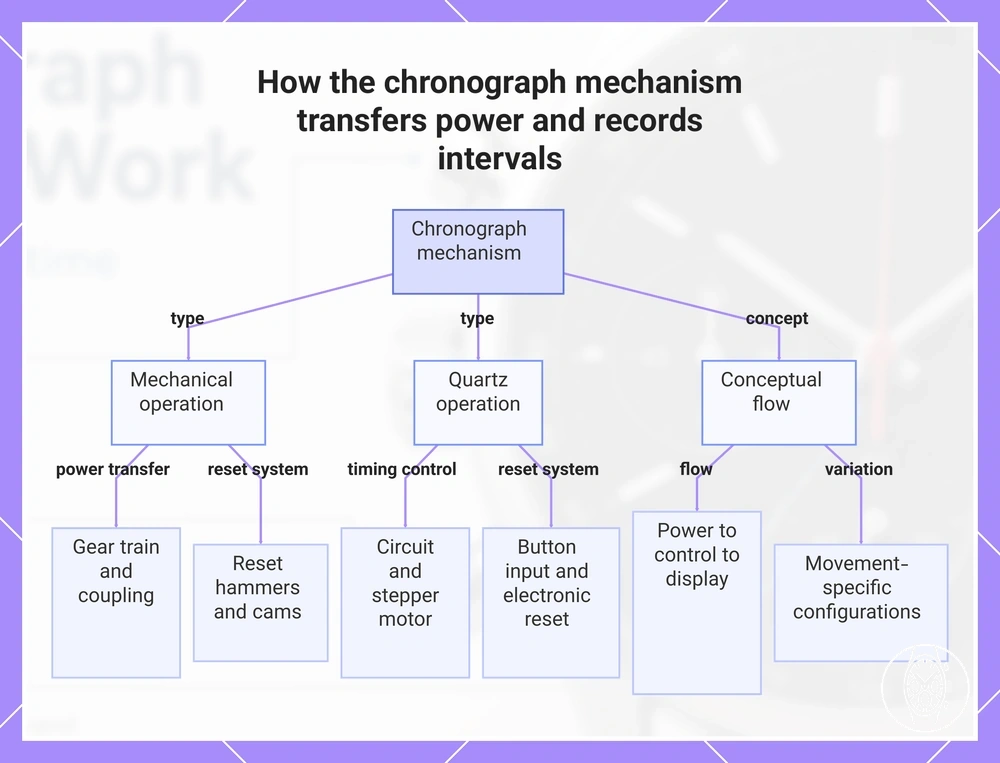
How the chronograph mechanism transfers power and records intervals
The chronograph mechanism transfers power from the movement into a controlled timing path that records an interval by connecting energy, start-stop control, and the elapsed-time display. In a mechanical chronograph, this path uses a gear train and physical coupling; in a quartz chronograph, a circuit processes the timing command and controls the display-driving system, so the mechanism can record elapsed time separately from normal timekeeping.
The chronograph mechanism transfers power from the movement into a controlled timing path that records an interval by connecting energy, start-stop control, and the elapsed-time display.
In mechanical operation, the start-stop control changes the state of the coupling so the movement's gear train can drive the chronograph timing mechanism during an active interval and disengage or otherwise stop the elapsed-time indication when the interval ends, depending on the design. The reset system provides a separate zero-return state: a common mechanical arrangement uses reset hammers acting on heart-shaped cams to return chronograph indicators to their starting positions, while a quartz design can use button input, an electronic circuit, and a stepper motor to control the equivalent timing and reset functions. Conceptually, the system works like a controlled branch from the watch's power source: the movement supplies energy, the control determines whether that energy produces elapsed-time indication, and the display records the resulting interval.
The exact gear train, coupling, lever arrangement, circuit, stepper-motor control, and reset system are not universal attributes of every chronograph mechanism; their configurations are movement-specific, while the shared macro-level function remains power → control → interval recording → display. Mechanical and quartz chronographs therefore reach the same functional outcome through different physical or electronic architectures, and the dedicated chronograph movement types section explains those variants beyond this mechanism overview.
This chart shows the two main architectures (mechanical and quartz) and the shared conceptual flow of a chronograph mechanism, explaining how power is transferred and intervals are recorded.
This chart shows the two main architectures (mechanical and quartz) and the shared conceptual flow of a chronograph mechanism, explaining how power is transferred and intervals are recorded.
Mechanical chronograph operation
A mechanical chronograph uses physical movement parts to engage, stop, and reset interval timing: the mainspring supplies mechanical power through the gear train, and a clutch or other coupling provides the physical engagement that connects the chronograph mechanism to that drive. Fratello's technical explanation by watchmaker Henrik Korpola describes the chronograph as taking energy from the mainspring through the going train, with lever action and the engagement system controlling whether that power reaches the chronograph mechanism.
The physical arrangement is design-specific: a mechanical chronograph can use a column wheel or cam as part of its control system, while the clutch or coupling and lever arrangement determine engagement and stopping, and a reset hammer acting on heart-shaped cams can provide zero return. Fratello's explanation identifies column-wheel and cam-controlled constructions as distinct mechanical arrangements and describes the reset hammer and heart-shaped cam relationship; integrated and modular designs can arrange these supporting parts differently, so these terms describe functional categories rather than one universal mechanical chronograph layout.
Quartz chronograph operation
A quartz chronograph measures elapsed time through electronic timing control: a quartz oscillator provides the timing signal, circuit control processes that signal and button input, and the quartz movement drives the elapsed-time indication electronically. Seiko's technical specifications for quartz chronograph Calibre V192 identify a 32,768 Hz crystal oscillator, a C-MOS integrated circuit containing oscillator, frequency-divider and driving circuits, and three stepper motors, providing a model-specific example of this electronic time base and control path.
With analog hands, a stepper motor converts circuit commands into indicator movement, while a quartz chronograph with a digital display can use display logic instead of the same motor-driven hand arrangement; reset behavior is likewise determined by the movement's electronic control and display configuration. In Seiko Calibre V192, for example, the three stepper motors drive separate indicator functions and the stopwatch uses a 1/5-second hand with a 60-minute measurement capacity, illustrating how one analog quartz chronograph converts the oscillator's timing signal and circuit control into visible elapsed time without implying that every quartz chronograph uses the same indicator or reset arrangement.
How elapsed time can be read from the dial
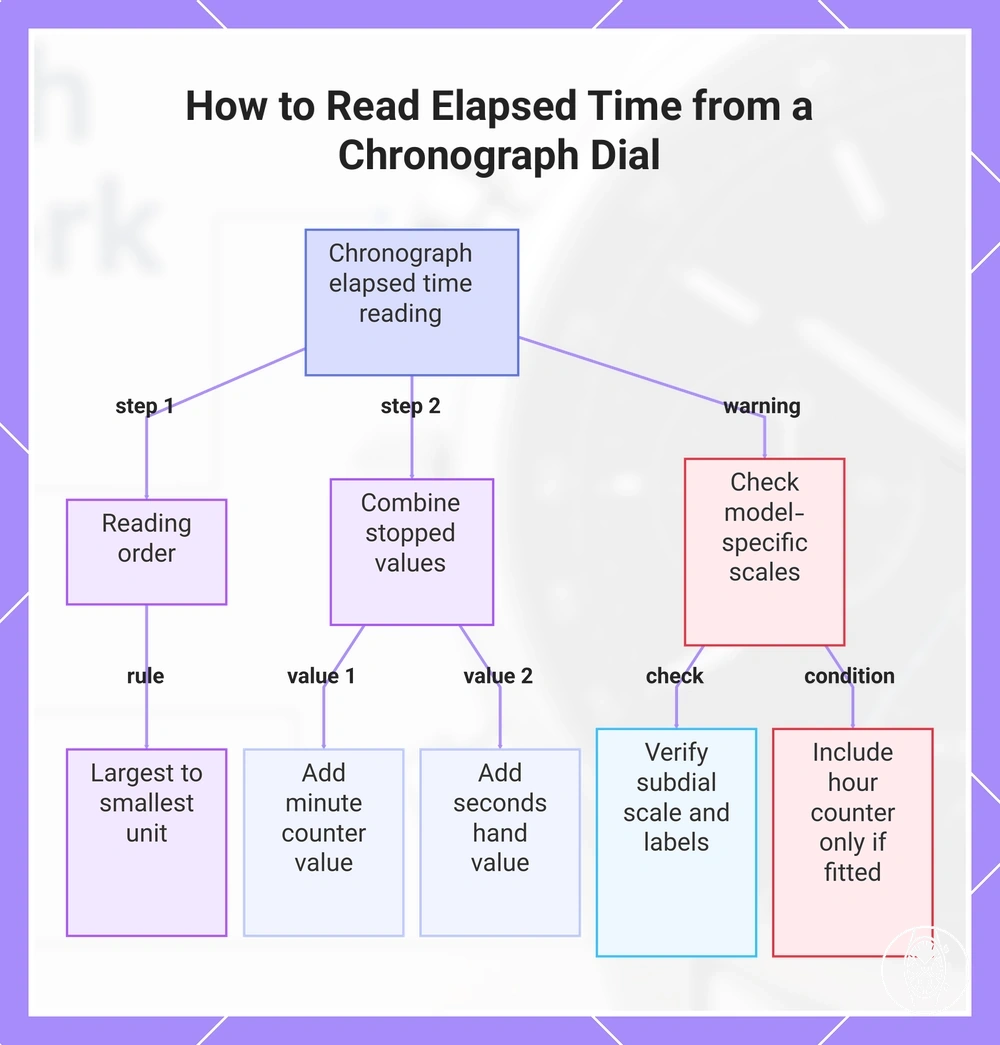
Read elapsed time from the dial by combining the stopped values shown by the chronograph seconds hand, minute counter, and hour counter when one is fitted. Use the scale markings at each stopped hand position and follow a reading order from the largest displayed elapsed-time unit to the smallest; the resulting indicator → value → condition sequence produces the final elapsed time.
Because these values are hypothetical and belong to the same stopped timing interval, the combined elapsed time is 20 minutes 41 seconds.
For example, suppose a chronograph's minute counter has a stopped hand position of 20 minutes and its chronograph seconds hand stops at 41 seconds. The minute counter contributes 20 minutes. The seconds hand contributes 41 seconds. Because these values are hypothetical and belong to the same stopped timing interval, the combined elapsed time is 20 minutes 41 seconds.
For example, suppose a chronograph's minute counter has a stopped hand position of 20 minutes and its chronograph seconds hand stops at 41 seconds.
Check the subdial scale and labels for the specific dial before combining its values because the available counters, their scale markings, and their ranges are model-specific; an hour counter should be included in the reading only when the watch provides one for elapsed-time measurement. Seiko's instructions for Calibres 8R46 and 8R48 illustrate this model variation: both use a 30-minute stopwatch minute scale, while the 8R48 also provides an hour indication for measurements up to 12 hours, so its longer elapsed-time readings require the hour indication to be interpreted with the minute counter rather than treating the minute subdial as a standalone total.
This chart shows the steps to read elapsed time from a chronograph dial, including combining stopped values and checking model-specific scales.
This chart shows the steps to read elapsed time from a chronograph dial, including combining stopped values and checking model-specific scales.
Reading seconds, minutes, and hours together
Read a chronograph's combined interval by matching each timing indicator to its printed scale, then combining the seconds hand value, minute counter value, and hour counter value when an hour counter is present. For example, suppose the stopped display shows 41 seconds, 20 minutes, and 6 hours.
- Seconds hand value: 41 seconds.
- Minute counter value: 20 minutes.
- Hour counter value: 6 hours, when the watch provides an hour counter.
- Combined interval: 6 hours 20 minutes 41 seconds.
This example is illustrative rather than a rule for every dial layout. Before combining values on a specific watch, match each subdial to its printed scale because the presence, position, and range of seconds, minute, and hour indicators are model-dependent.
Tachymeter scale timing logic
A tachymeter scale uses elapsed seconds from the timing function to estimate a rate over a known distance or other fixed unit; the chronograph seconds hand supplies the elapsed-time reading, while the tachymeter provides the corresponding scale reading rather than timing the interval independently. The criteria are fixed: elapsed time must be known and the measured unit must be fixed before the scale reading can be interpreted as a rate.
The criteria are fixed: elapsed time must be known and the measured unit must be fixed before the scale reading can be interpreted as a rate.
For example, Citizen Watch specifies that when a chronograph records 45 seconds over a known distance of 1 km, the chronograph seconds hand points to approximately 80 on the tachymeter scale, corresponding to an estimated rate of 80 km/h. Citizen's instructions apply this tachymeter method to intervals of up to 60 seconds, so the rate interpretation depends on both the recorded elapsed seconds and the known 1 km distance.
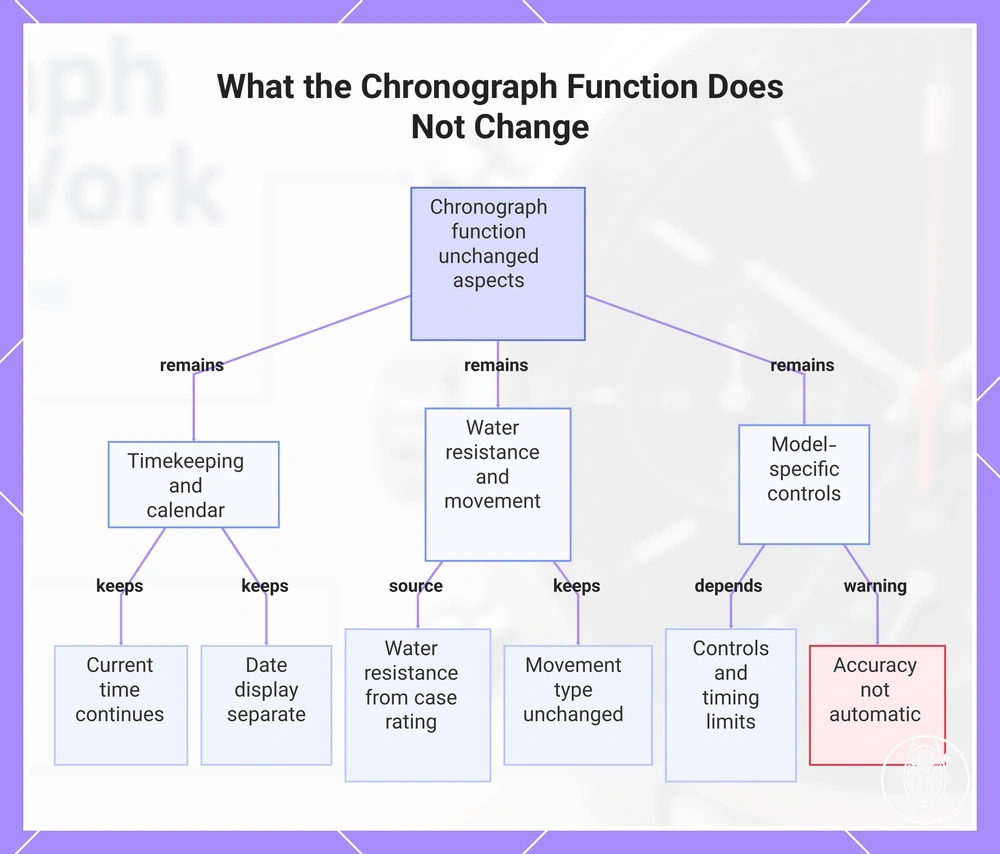
What the chronograph function does not change
The chronograph function is normally an added function for measuring elapsed time rather than a replacement for normal timekeeping, so the current time continues to be displayed while timing is active when the watch is functioning as designed. Seiko specifies this simultaneous operation for Calibres 8R46 and 8R48, where the watch continues indicating the current time while the stopwatch operates; the same added-function boundary should be confirmed for the specific movement rather than assumed for every model.
Model-specific controls and timing limits also remain specific to the movement, so a chronograph is not automatically more accurate or suitable for every timing task merely because the stopwatch function is present.
A date display, when present, also remains a separate calendar indication unless the manufacturer's instructions specify different behaviour; Citizen documents normal date indication during chronograph operation for Calibre H50. Water resistance remains tied to the watch's stated case rating and operating conditions rather than to the presence of a chronograph, while movement type remains the watch's existing mechanical, quartz, or other configuration. Model-specific controls and timing limits also remain specific to the movement, so a chronograph is not automatically more accurate or suitable for every timing task merely because the stopwatch function is present.
- Current time: Normally continues alongside chronograph timing when the movement is designed for simultaneous timekeeping and stopwatch operation.
- Date display: When present, remains a separate indication; its behaviour should follow the model's documented calendar design.
- Water resistance: The chronograph function does not establish a water-resistance rating; the applicable value comes from the case rating and the manufacturer's operating conditions.
- Movement type: Starting the chronograph does not change the underlying movement type or make the watch automatically more accurate; accuracy remains movement-specific.
- Model-specific controls: Button assignments, timing capacity, and suitability for a particular timing task depend on the documented movement. Seiko, for example, specifies a 30-minute stopwatch limit for Calibre 8R46 and up to 12 hours for Calibre 8R48.
This chart shows the aspects that remain unchanged when the chronograph function is activated, including timekeeping, date display, water resistance, movement type, and model-specific controls.