What Is a Men's Chronograph Watch?
A men's chronograph watch is a regular watch with an added stopwatch function that measures elapsed time separately from normal timekeeping. The Federation of the Swiss Watch Industry describes a chronograph as a watch with two independent timing systems: one indicates the time of day, while the other measures shorter intervals on demand.
A men's chronograph watch is a regular watch with an added stopwatch function that measures elapsed time separately from normal timekeeping.
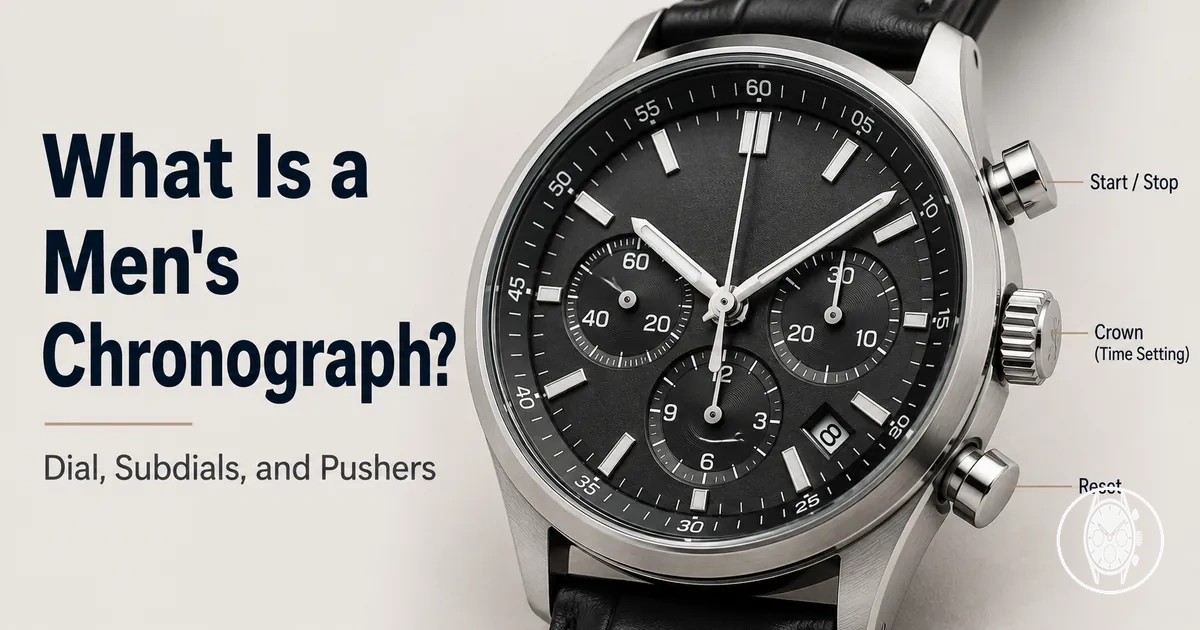
A chronograph can usually be recognised by dedicated elapsed-time displays on the watch dial and pushers used to start, stop, or reset the timing function. The Federation of the Swiss Watch Industry notes that chronographs use a central chronograph hand and may include counters for minutes and hours, so the number and arrangement of subdials are not fixed characteristics of every men's chronograph watch.
A chronograph can usually be recognised by dedicated elapsed-time displays on the watch dial and pushers used to start, stop, or reset the timing function.
Regular timekeeping and elapsed timing therefore perform separate functions: the normal display shows the time of day while the chronograph records a selected interval. For example, a chronograph with a 30-minute counter can distinguish an illustrative elapsed time of 12 minutes from the current clock time; the counter capacity and exact display arrangement must be verified for the individual watch rather than treated as universal chronograph specifications.
Regular timekeeping and elapsed timing therefore perform separate functions: the normal display shows the time of day while the chronograph records a selected interval.
For readers comparing men's chronograph watches, the defining criterion is the presence of an independently controlled elapsed-time function, while the number of subdials, dial layout, and movement type can differ between watches. A chronograph should not be treated as a synonym for a chronometer: the former describes an elapsed-time function, whereas the latter is a separate accuracy-related designation.
Table of Contents
What Chronograph Means on a Men's Watch
A chronograph on a men's watch is a stopwatch function built into the watch for elapsed-time recording while normal timekeeping remains available. The Federation of the Swiss Watch Industry describes a chronograph as a timepiece with two independent measuring systems: one indicates the time of day and the other records short periods of time.
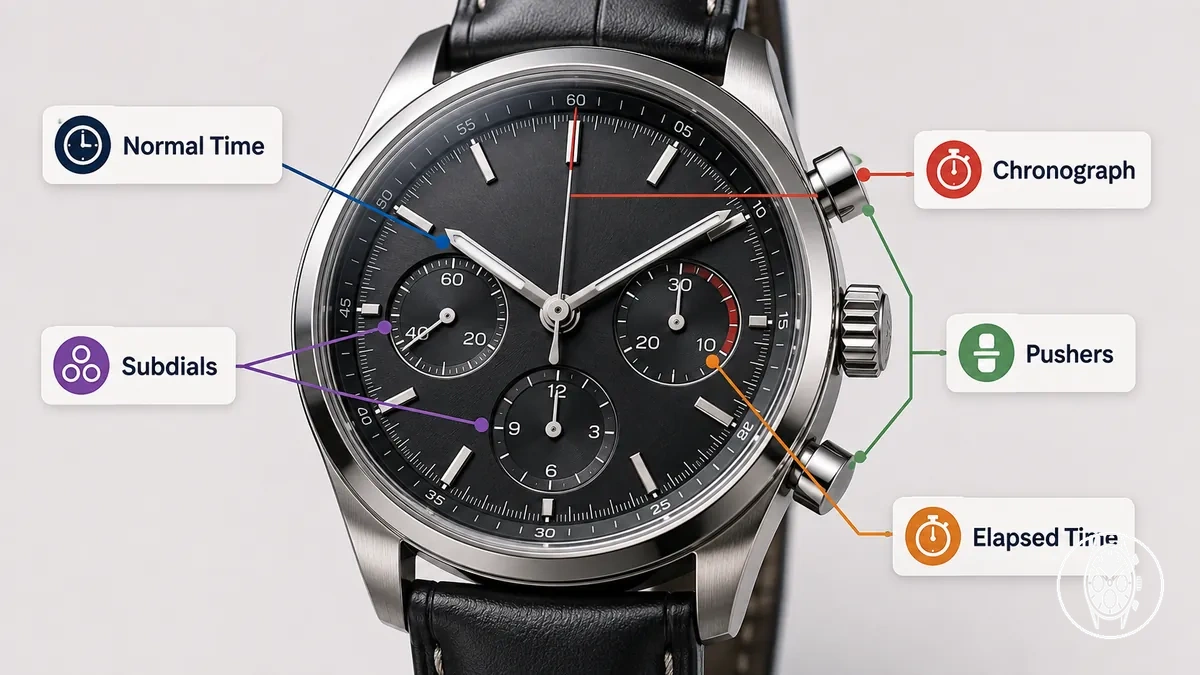
The chronograph function records elapsed time on the dial through dedicated hands or subdials, while the normal hands continue timekeeping. The Federation of the Swiss Watch Industry identifies start, stop, and return-to-zero as chronograph controls and notes that chronograph counters can record seconds, minutes, and hours; the exact number of subdials and arrangement of pushers are therefore model-specific rather than part of the term's fixed meaning.
Chronograph describes the elapsed-time function rather than a specific movement type, brand, quality level, or automatic mechanism.
Chronograph describes the elapsed-time function rather than a specific movement type, brand, quality level, or automatic mechanism. On a men's watch, the term therefore identifies stopwatch-style timing as the defining function, while the power source, dial layout, number of subdials, and pusher arrangement must be established from the specifications of the individual watch.
What a Chronograph Adds to Regular Timekeeping
A regular watch provides timekeeping for the current time, while a chronograph watch adds a separately controlled stopwatch function for measuring elapsed time. The Federation of the Swiss Watch Industry describes a chronograph as having one system for the time of day and another for measuring short time intervals, so the added information is a measured interval rather than a replacement for normal timekeeping.
Current time and elapsed time can therefore appear on the same dial through separate indications.
Current time and elapsed time can therefore appear on the same dial through separate indications. For example, Timex specifies for the MK1 Chronograph that the large seconds hand serves the chronograph, a small subdial shows normal running seconds, and another subdial counts chronograph minutes; this is a model-specific example of how the two timing functions can remain visually distinct.
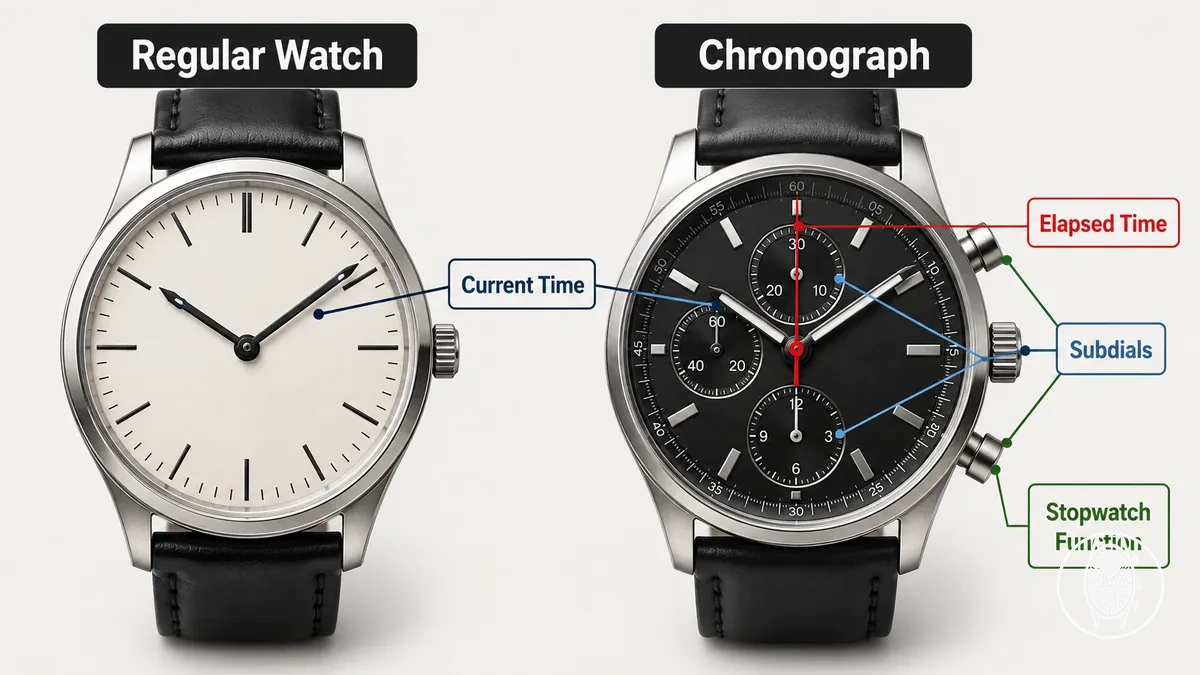
| Feature | Regular Watch | Chronograph Watch | Practical Effect |
|---|---|---|---|
| Current time | Displayed as the primary timekeeping information | Displayed alongside the chronograph function | The wearer can continue reading the current time while using elapsed-time recording. |
| Elapsed time | No dedicated chronograph stopwatch function | Separate start, stop, and reset timing function | A measured interval can be recorded independently of the current-time display. |
| Dial complexity | No chronograph-specific elapsed-time indicators required | Can include dedicated chronograph hands or subdials | The dial can present more timing information; the exact arrangement is model-specific. |
| Readability | Normal timekeeping is the principal timing information | Normal timekeeping and chronograph indications share the available dial area | The wearer must distinguish current-time indications from elapsed-time indications according to the specific dial layout. |
The practical distinction in a chronograph watch vs standard watch comparison is therefore the presence of dedicated elapsed-time recording, not a universal difference in quality or usefulness. Dial complexity, readability, subdial count, and control layout are model-specific attributes, so they should be established from the individual watch rather than inferred from the chronograph category alone.
Main Chronograph Parts on the Dial
A chronograph watch is commonly recognised by a dial that combines normal time hands with separate elapsed-time indications, such as a chronograph hand or subdials, plus pushers on the case for the timing function. These components are recognition cues rather than a fixed layout: their number, markings, position, and assigned function must be established from the individual watch.
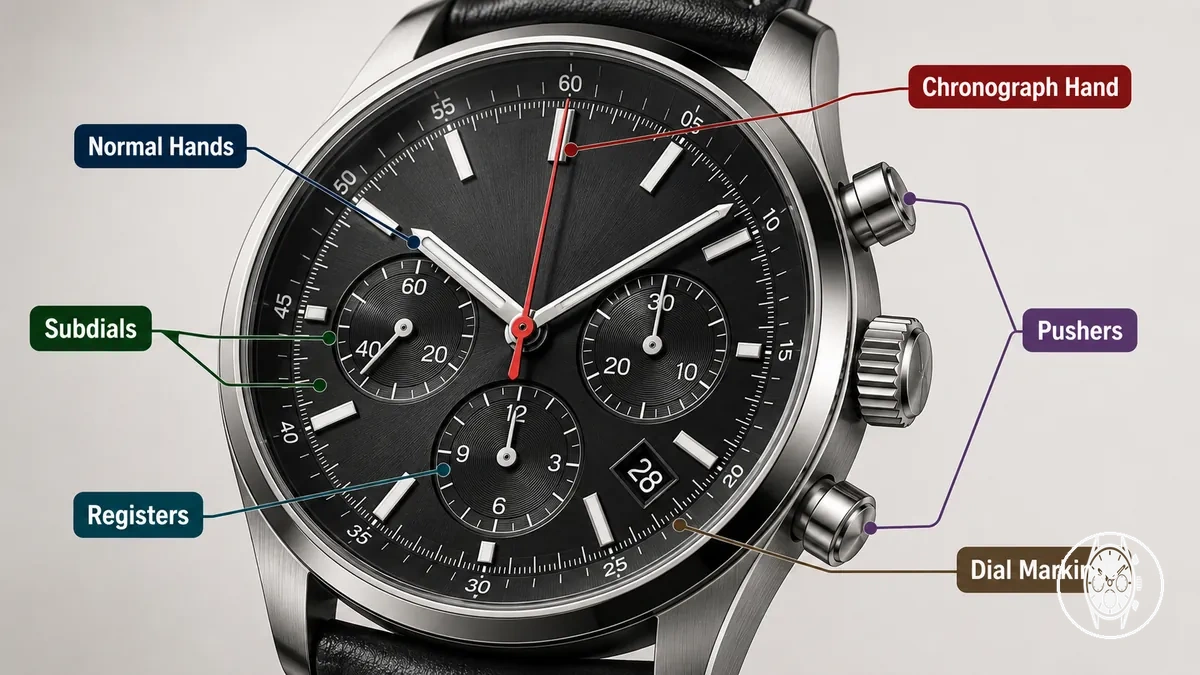
The Federation of the Swiss Watch Industry identifies chronograph counters for seconds, minutes, and hours and describes push-pieces as controls for starting, stopping, and returning the chronograph indication to zero. A concrete model-specific example comes from Timex documentation for the MK1 Chronograph, where the large seconds hand serves the chronograph, one subdial displays normal running seconds, and another is the chronograph minute counter; this illustrates why the markings and documentation, rather than subdial appearance alone, determine each register's role.
| Part | Where It Appears | What It Usually Does | What to Check |
|---|---|---|---|
| Dial and markings | Main watch face | Separate normal timekeeping information from chronograph indications | Identify which scales and markings correspond to current time and which correspond to elapsed time. |
| Normal time hands | Main dial | Display normal timekeeping independently of the elapsed-time counters | Identify the hour and minute hands and, where applicable, the normal running-seconds indication. |
| Chronograph hand | Commonly central on the dial | Records an elapsed-time unit assigned by the watch's chronograph layout | Confirm the hand's assigned unit from the dial markings or model documentation. |
| Subdials or registers | Smaller displays within the main dial | Can display elapsed seconds, minutes, or hours, or a normal timekeeping indication | Check the scale and labels because position alone does not establish the register's function. |
| Pushers | Case edge near the crown on common chronograph layouts | Control chronograph actions such as start, stop, and return to zero | Confirm the individual watch's control arrangement rather than assigning a function solely from pusher position. |
The number and arrangement of subdials, registers, pushers, and chronograph hands are not universal identifiers, so a three-subdial layout or decorative markings alone do not establish what each component does. For specific chronograph watch functions, use the dial markings and the individual model's documentation to connect each visible part to its stated role.
Subdials and Registers
Subdials, also called registers in chronograph contexts, are smaller displays within the main dial that organise specific timing information; depending on the watch's markings and layout, a register can show elapsed seconds, elapsed minutes, elapsed hours, or running seconds. The Federation of the Swiss Watch Industry identifies seconds, minutes, and hours as units that chronograph counters can record, so the scale and markings assigned to a register are stronger reading cues than its position on the dial.
- Elapsed seconds: A register assigned to chronograph seconds displays accumulated seconds during elapsed-time measurement; verify that role from the seconds scale, markings, or the individual watch manual.
- Elapsed minutes: A minute register displays accumulated elapsed minutes up to the value represented by its scale; verify the scale rather than inferring the function from the register's position.
- Elapsed hours: An hour register displays accumulated elapsed hours when that function is present; the Federation of the Swiss Watch Industry identifies hours as one possible chronograph counter unit, but the individual layout and markings determine whether a particular watch provides that display.
- Running seconds: A subdial can instead show normal running seconds rather than chronograph elapsed time, so a continuously moving seconds register should not be classified by appearance alone; its markings and the watch manual establish its assigned role.
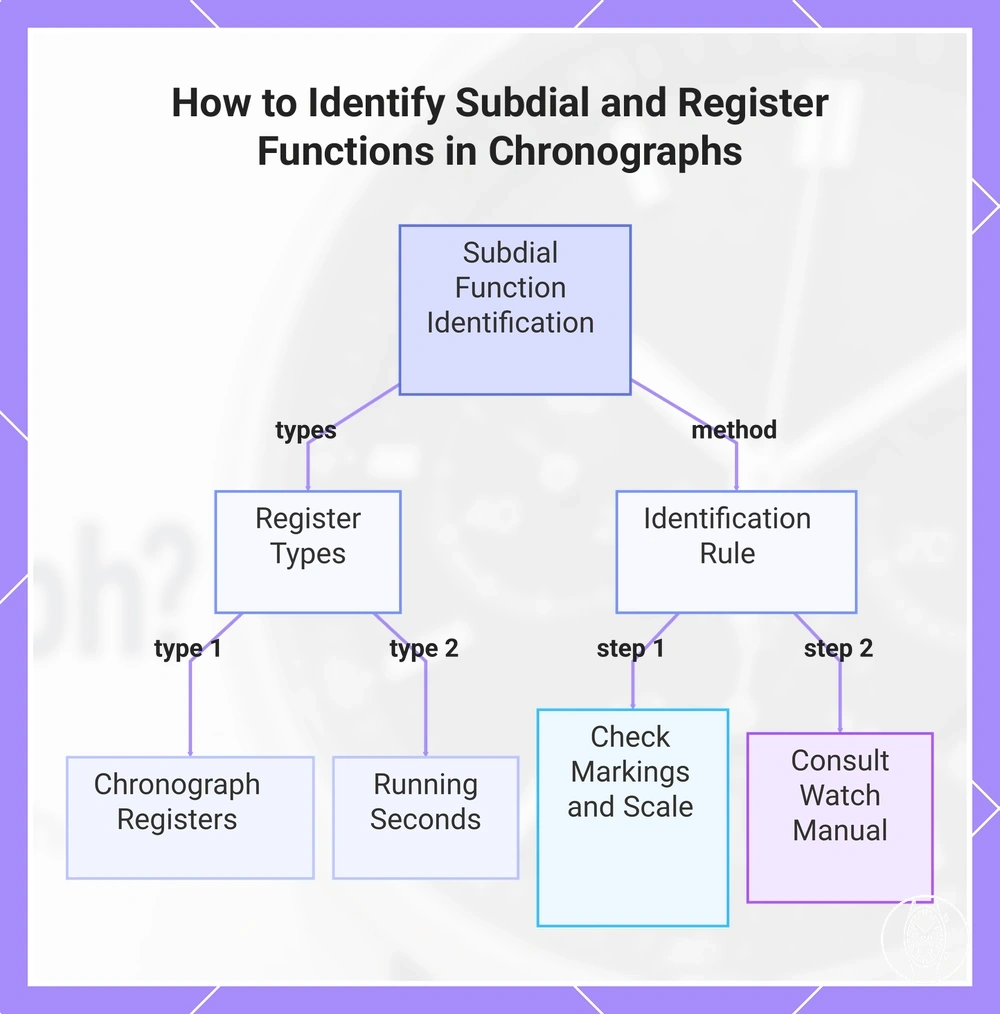
The practical reading rule is to match each subdial or register to its markings and displayed unit before interpreting its value. If a register's scale or layout does not clearly distinguish running seconds from elapsed seconds, elapsed minutes, or elapsed hours, the reviewed general chronograph evidence does not establish that register's function; the individual watch manual or specification is the appropriate verification source.
This chart shows the main types of subdials and the rule for identifying their function by markings rather than position.
This chart shows the main types of subdials and the rule for identifying their function by markings rather than position.
Pushers and Stopwatch Hands
Pushers are the external chronograph controls, while stopwatch hands provide the visible elapsed-time display. Citizen's instruction documentation for Calibre 0510 identifies one button for starting and stopping the chronograph and another for reset, while its component guide identifies separate chronograph hour, minute, and second hands as stopwatch-function indicators.
Pushers are the external chronograph controls, while stopwatch hands provide the visible elapsed-time display.
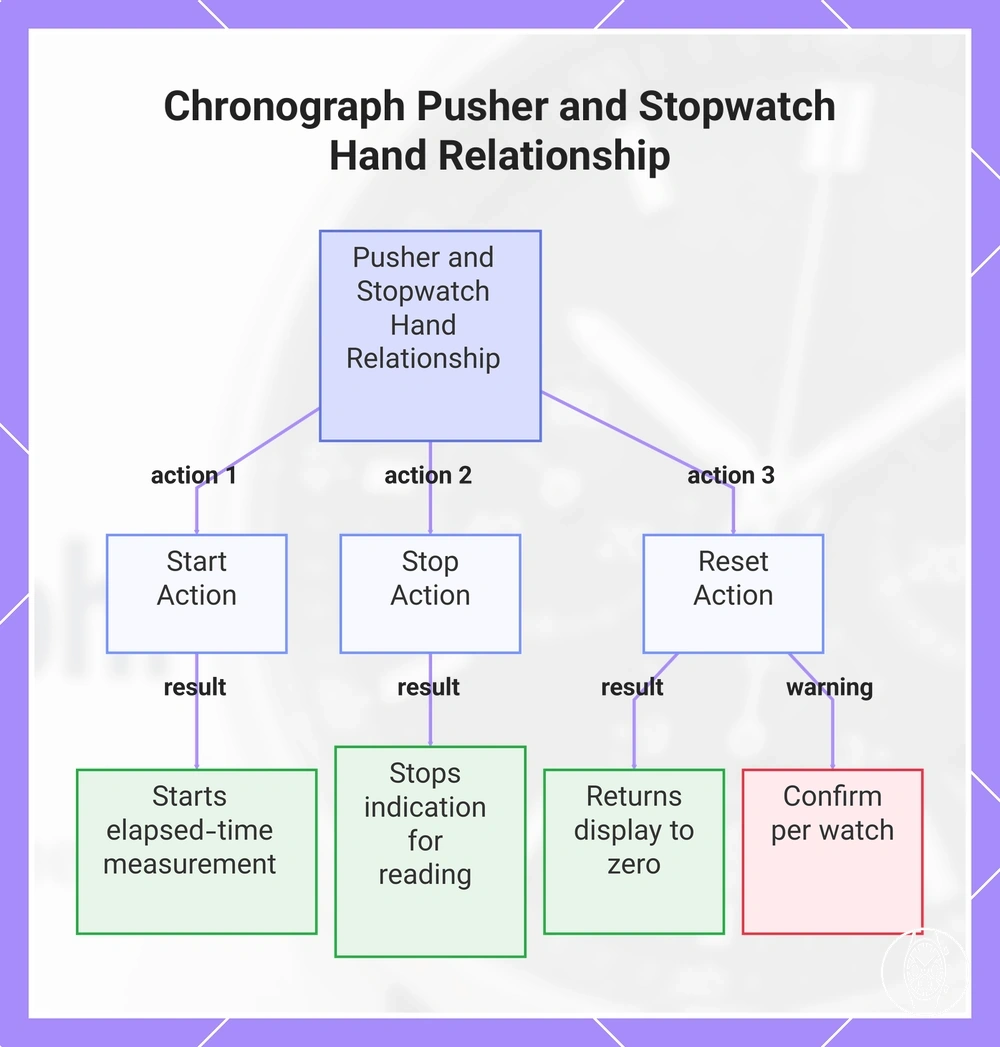
The control-to-display relationship is therefore start → elapsed-time indication moves, stop → the measured indication is held for reading, and reset → the chronograph indication returns to its zero position on layouts that use this control pattern. Citizen's Calibre B620 documentation provides a model-specific example: the upper-right button starts or stops the chronograph, the lower-right button resets it after stopping, and the chronograph displays elapsed time for up to 59 minutes 59.8 seconds; this example also shows why pusher position, stopwatch-hand layout, and reset behaviour should be confirmed for the individual watch rather than treated as universal.
- Start: The assigned pusher begins elapsed-time measurement and activates the chronograph hand or other stopwatch hands used by that display.
- Stop: The assigned control stops the active elapsed-time indication so the measured value can be read.
- Reset: The assigned reset control returns the chronograph display to its starting position after timing has stopped on models using that sequence.
This chart shows how the start, stop, and reset pushers control the stopwatch hands in a chronograph, and why settings vary per watch.
What Chronograph Watches Are Used For
Chronograph watches are used for measuring elapsed time with a stopwatch function while still displaying the current time. Seiko defines the chronograph function in its 8R46/8R48 instructions as measuring elapsed time while indicating the current time, so the primary practical value is timing a separate interval without replacing normal timekeeping.
Chronograph watches are used for measuring elapsed time with a stopwatch function while still displaying the current time.
That elapsed-time function can support everyday tasks, sport timing, travel intervals, cooking, and work tasks when the duration of an activity is useful to know. The examples below separate the activity, the duration being measured, and the practical outcome; hypothetical durations are illustrative rather than claims about chronograph accuracy or capacity.
- Everyday tasks: Suppose a laundry cycle is expected to take 30 minutes; measuring that 30-minute interval gives the wearer a visible reference for when to check the task while the current time remains available.
- Sport timing: Seiko's 8R46/8R48 instructions provide a 5,000-metre running example with an elapsed result of 20 minutes 41 seconds, illustrating how a chronograph can record the duration between the start and finish of a sporting activity.
- Travel intervals: Suppose a traveller wants to measure a 12-minute walk between two points; the chronograph can record that 12-minute interval so the measured duration can be compared with the time available.
- Cooking: Suppose a recipe requires 15 minutes of cooking; the stopwatch can measure that 15-minute interval independently of the watch's current-time display, giving the cook a direct elapsed-time reference.
- Work tasks: Suppose a focused work period is set at 25 minutes; timing that interval shows when the planned period has elapsed without requiring the wearer to calculate the difference between two clock times.
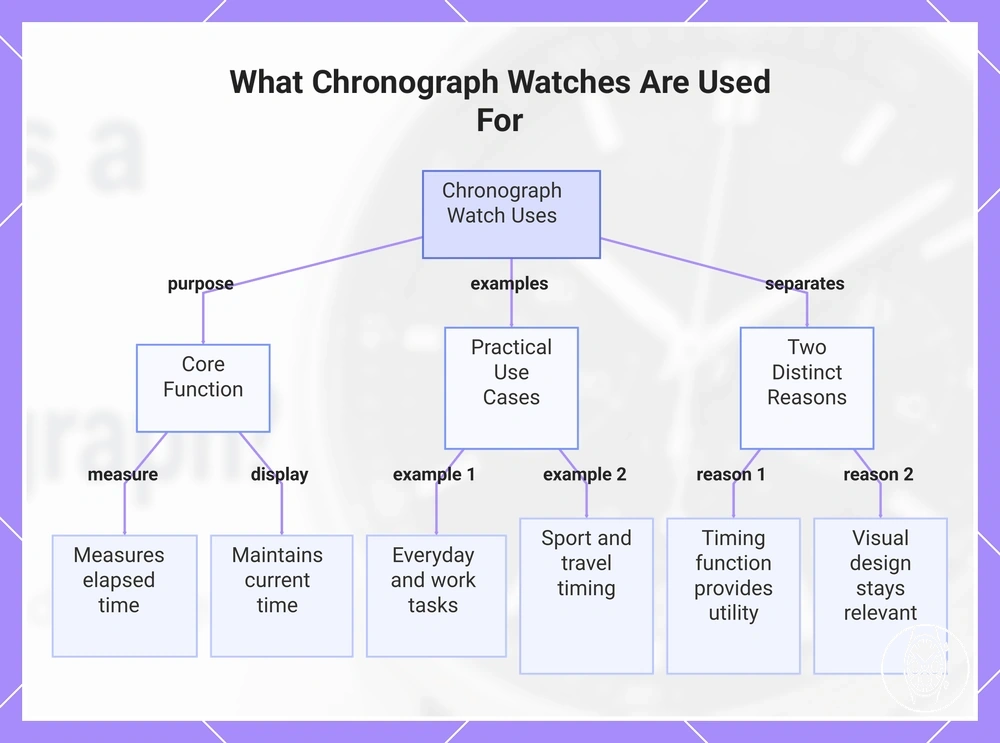
Function and design are separate reasons for wearing a chronograph: the stopwatch provides elapsed-time measurement, while the visual design may remain relevant even when the timing function is used infrequently. The relationship between the controls and elapsed-time display is covered in how chronograph watches work; usefulness, timing capacity, and display behaviour should still be judged from the individual watch rather than assumed from its appearance.
This chart shows the primary function, common use cases, and the distinction between function and design for chronograph watches.
This chart shows the primary function, common use cases, and the distinction between function and design for chronograph watches.
Power and Battery Basics for Chronograph Watches
Some chronograph watches need a battery and some do not because battery dependence is determined mainly by movement type and power source. A conventional quartz chronograph uses electrical energy from a cell, while an automatic chronograph or manually wound mechanical chronograph uses energy stored in a mainspring; light-powered quartz systems can instead use a rechargeable storage cell.
The power source determines whether battery replacement is part of ownership.
The power source determines whether battery replacement is part of ownership. Citizen states that non-rechargeable watch cells require replacement when depleted, while rechargeable cells can be charged repeatedly; Citizen also specifies that its automatic mechanical movements use a mainspring as their power source.
| Chronograph Type | Battery Need | What Powers It | Practical Note |
|---|---|---|---|
| Quartz chronograph | A conventional battery-powered quartz movement requires a cell | Electrical energy from a non-rechargeable cell | Battery life is calibre-specific. For example, Seiko specifies approximately 3 years for its quartz Calibre 8T63 chronographs, so that figure should not be generalised to every quartz chronograph. |
| Automatic chronograph | A conventional fully mechanical automatic movement does not require an electrical battery | A mainspring wound through an automatic winding mechanism | Available running time and maintenance requirements are movement-specific rather than battery-life specifications. |
| Mechanical chronograph | A conventional manually wound mechanical movement does not require an electrical battery | A mainspring wound manually | Absence of a battery does not remove movement-specific maintenance requirements. |
| Light-powered quartz chronograph | Uses a rechargeable storage cell rather than a conventional disposable battery | Light converted into electrical energy and stored in the rechargeable cell | Citizen states that Eco-Drive rechargeable cells do not require periodic replacement under normal operation. |
Battery life therefore has no single valid figure for all chronograph watches: it is tied to the specific movement, cell and usage pattern. Seiko, for example, specifies approximately 3 years of battery life for Calibre 8T63 quartz chronographs, while Citizen notes that long-term wear of internal components and deterioration of oils can increase power consumption in rechargeable-cell watches; for maintenance planning, use the battery or power specification for the individual calibre rather than treating one lifespan as universal.
Common Chronograph Watch Limits and Misunderstandings
A common misunderstanding is that a chronograph also identifies a watch's accuracy certification, movement type, subdial function, or smartwatch technology. It does not: chronograph identifies the stopwatch function for measuring elapsed time, while chronometer, automatic, functional subdials, power source, and smartwatch behaviour are separate attributes that require separate identification.
The safest distinction is to treat each term according to the attribute it describes rather than infer one characteristic from another.
The safest distinction is to treat each term according to the attribute it describes rather than infer one characteristic from another. The Federation of the Swiss Watch Industry defines a chronograph by its separate short-time measurement system, while its terminology distinguishes a chronometer as a high-precision watch whose movement has passed prescribed accuracy tests.
| Misunderstanding | Safer Clarification |
|---|---|
| A chronograph is a chronometer. | No. Chronograph identifies an elapsed-time stopwatch function; chronometer concerns accuracy certification. A watch can possess both attributes, but one does not establish the other. |
| A chronograph is automatic. | No. Chronograph identifies the timing function rather than the movement's winding or power source. Chronograph watches can use mechanical or quartz movement architectures, so automatic status must be established separately for the individual watch. |
| Every subdial is a functional chronograph register. | Not necessarily. A subdial's functional value is determined by what it displays: depending on the watch, a subdial can belong to elapsed-time measurement or another indication such as normal running seconds. The dial markings and model documentation are the appropriate evidence for assigning its role. |
| A smartwatch with stopwatch behaviour is therefore an analogue chronograph. | No. A smartwatch can provide elapsed-time measurement through its digital hardware and software, but that shared stopwatch behaviour does not establish an analogue chronograph movement, dial architecture, pushers, or power source. The common attribute is elapsed-time measurement, not an identical watch system. |
Chronograph status therefore does not establish automatic winding, a particular power source, a fixed number of functional subdials, accuracy certification, smartwatch architecture, or a value guarantee. For a specific chronograph watch, those attributes should be verified independently from its movement specification, dial documentation, and any stated certification rather than inferred from the chronograph label.
When a Chronograph Watch Makes Sense
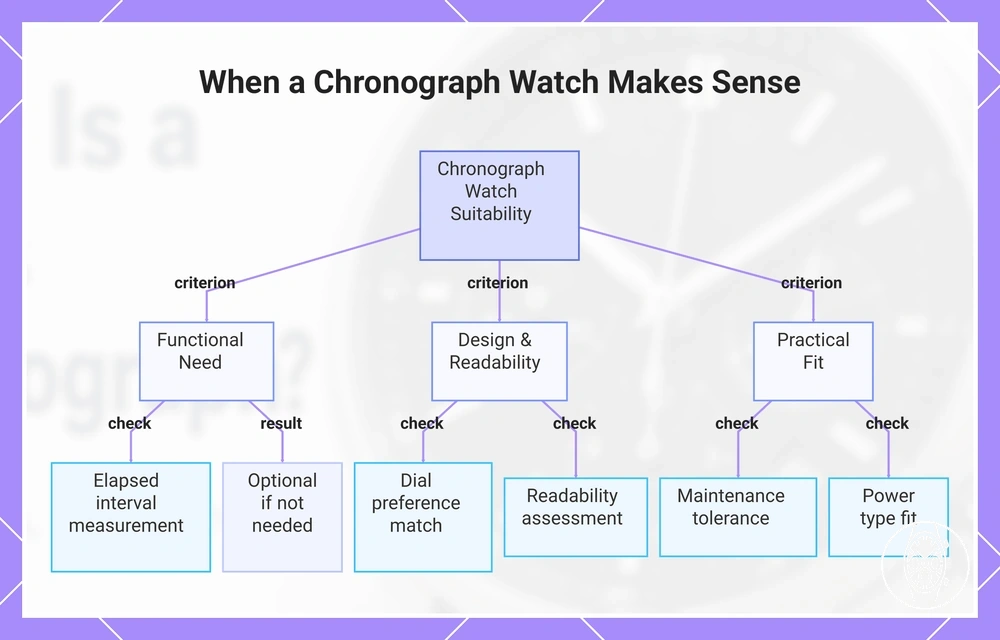
A chronograph watch makes sense when its stopwatch function meets a real timing need or when its more information-dense design matches your dial preference without reducing readability below what you find comfortable for everyday wear. Suitability is therefore conditional: timing need, dial preference, readability, visual complexity, maintenance tolerance, and power type should each produce an acceptable outcome for the wearer rather than being treated as automatic benefits.
Use the criteria below to separate functional need from design preference.
Use the criteria below to separate functional need from design preference. There is no universal numerical threshold for acceptable dial complexity, readability, or maintenance tolerance because those attributes are wearer- and model-specific; for a particular watch, the useful evidence is its visible dial arrangement and the manufacturer's documented movement, power source, and maintenance requirements.
- Timing need: If you expect to measure elapsed intervals on your wrist, the chronograph function has a direct practical role; if you do not need wrist-based elapsed-time measurement, the function is optional rather than necessary.
- Dial preference: If you prefer a dial containing normal timekeeping plus dedicated chronograph indications, the added design elements support your preference; if you prefer a minimal time display, the additional indications work against that preference.
- Readability: A chronograph makes practical sense when you can distinguish the current-time indications from the stopwatch indications quickly enough for your intended use. No evidence-based universal reading-time threshold applies to all wearers and chronograph layouts, so readability should be assessed on the specific dial rather than inferred from the category.
- Visual complexity: Additional chronograph hands, registers, scales, or controls increase the number of visible elements compared with a simpler time-only layout. That complexity is useful when you value the extra timing information or design; otherwise it is a trade-off without an equivalent functional need.
- Maintenance tolerance: A chronograph is a better practical fit when the maintenance requirements stated for its specific movement are acceptable to you. A universal chronograph service interval is not established by the chronograph function itself, so the applicable interval should come from the manufacturer documentation for the individual calibre.
- Power type: Chronograph describes a timing function rather than one power system, so the power type must be identified separately as quartz, automatic mechanical, manually wound mechanical, or another documented system. The appropriate option is the configuration whose charging, winding, battery, and maintenance conditions fit your intended everyday wear.
For everyday wear, the main trade-off is therefore added timing function and design information versus the readability, visual complexity, power, and maintenance conditions of the specific watch. If those criteria fit your intended use, the chronograph concept can be practically relevant; if the stopwatch function adds no useful capability and you prefer a simpler display, a chronograph is not functionally necessary.
For everyday wear, the main trade-off is therefore added timing function and design information versus the readability, visual complexity, power, and maintenance conditions of the specific watch.
The next decision is whether those benefits and trade-offs justify choosing the format for your own use, which is the relevant context for asking are chronograph watches worth it rather than assuming that the chronograph label creates universal value.
This chart shows the key criteria to determine whether a chronograph watch is suitable for your needs, including functional need, design preferences, and practical fit.
This chart shows the key criteria to determine whether a chronograph watch is suitable for your needs, including functional need, design preferences, and practical fit.