Men's Chronograph Watch Movement Types
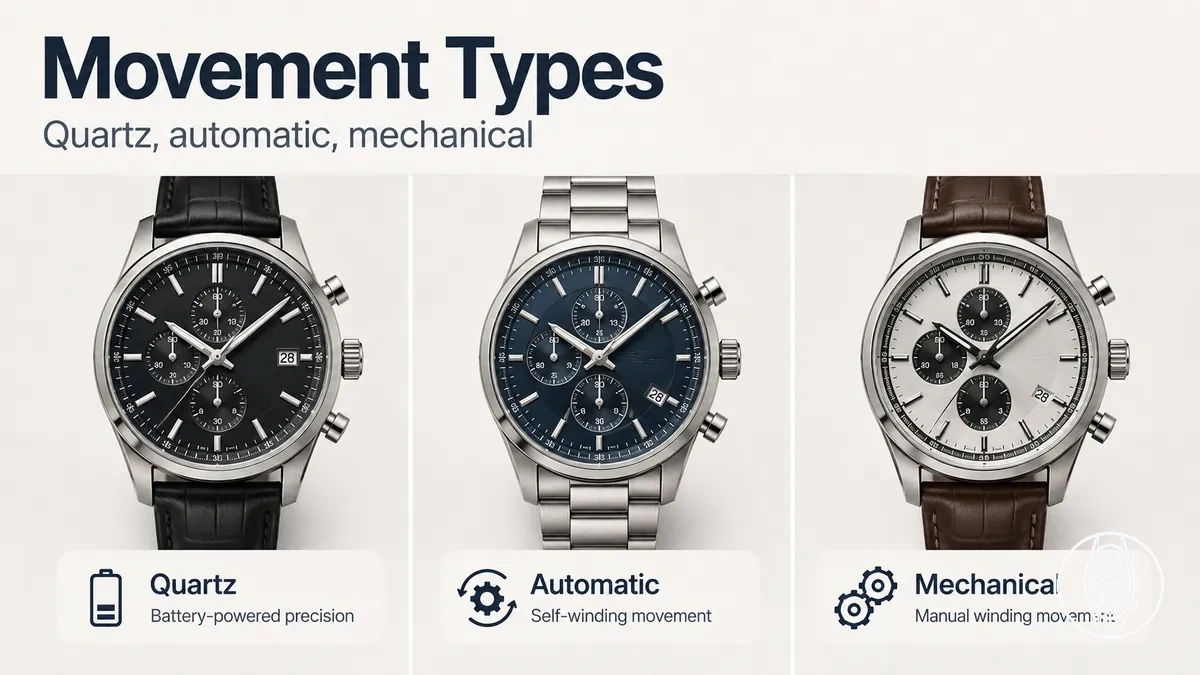
Men's chronograph watch movement types are the mechanisms that provide power and regulate timing while enabling chronograph operation, with quartz, automatic, and manual mechanical as the three main movement families considered here. Movement type is therefore a buying-relevant decision factor because the power source and regulation method influence accuracy expectations, maintenance, convenience, feel, case thickness, and long-term ownership, with the outcome depending on the specific movement design and use case.
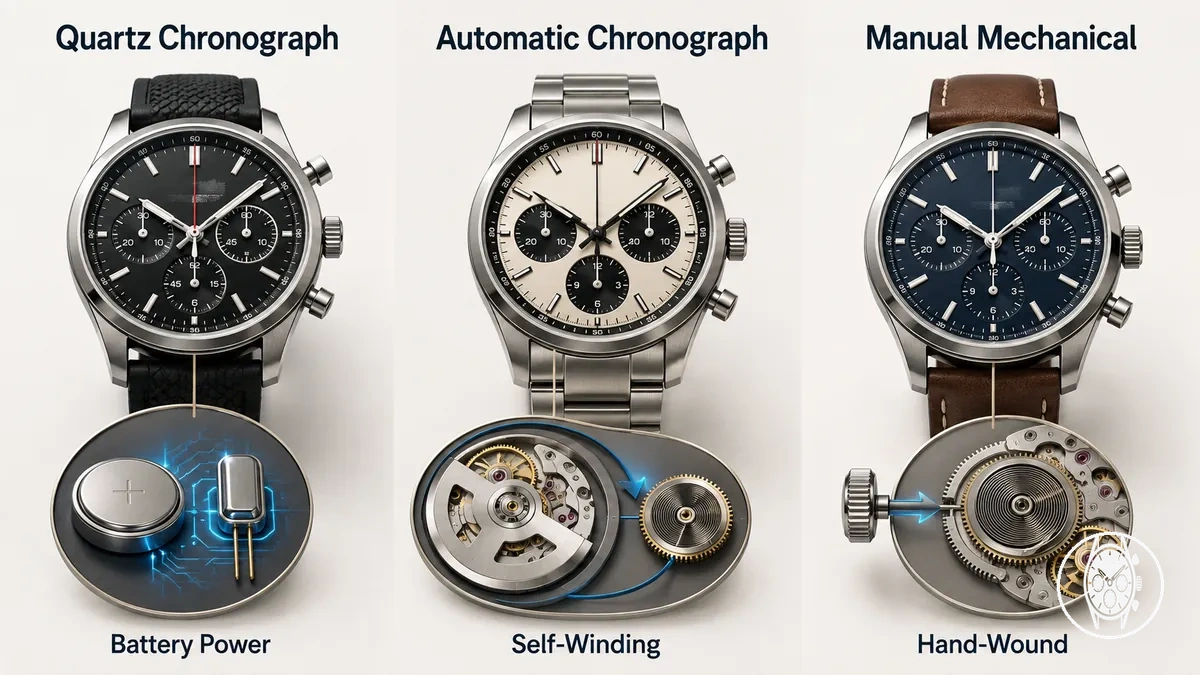
For daily wear, quartz uses a battery and quartz-crystal regulation, automatic mechanical uses a mainspring replenished through self-winding, and manual mechanical uses a mainspring that the wearer winds by hand.
For daily wear, quartz uses a battery and quartz-crystal regulation, automatic mechanical uses a mainspring replenished through self-winding, and manual mechanical uses a mainspring that the wearer winds by hand. Citizen's technical guidance states that an ordinary quartz watch uses a 32,768 Hz quartz oscillator, while its mechanical comparison uses a balance operating at 2.5–5 Hz; this difference helps explain why accuracy expectations and power-management routines are movement-specific. Servicing requirements and ownership consequences should still be assessed for the particular movement grade, condition, service history, and manufacturer's maintenance guidance rather than inferred from the movement family alone.
Quartz, automatic, and manual mechanical chronograph movements consequently represent different approaches to power, regulation, maintenance, and ownership rather than a universal ranking.
Quartz, automatic, and manual mechanical chronograph movements consequently represent different approaches to power, regulation, maintenance, and ownership rather than a universal ranking. For a model-specific mechanical example, Seiko specifies its automatic-with-manual-winding Calibre 8R46 at 28,800 vibrations per hour, a factory-adjusted daily rate of +25 to -15 seconds when worn on the wrist at 5°C to 35°C, and approximately 45 hours of running duration; Seiko also states that actual daily accuracy can move outside that specified range with changes in wearing time, temperature, arm movement, and mainspring state.
A chronograph refers to the stopwatch functionality of a men's chronograph watch, whereas movement type describes how the watch's timing mechanism is powered and regulated.
A chronograph refers to the stopwatch functionality of a men's chronograph watch, whereas movement type describes how the watch's timing mechanism is powered and regulated. Keeping those attributes separate provides the grounding for evaluating how each movement family controls both ordinary timekeeping behaviour and chronograph operation before comparing quartz, automatic, and manual mechanical movements in detail.
Table of Contents
What a Chronograph Movement Does in a Men's Watch
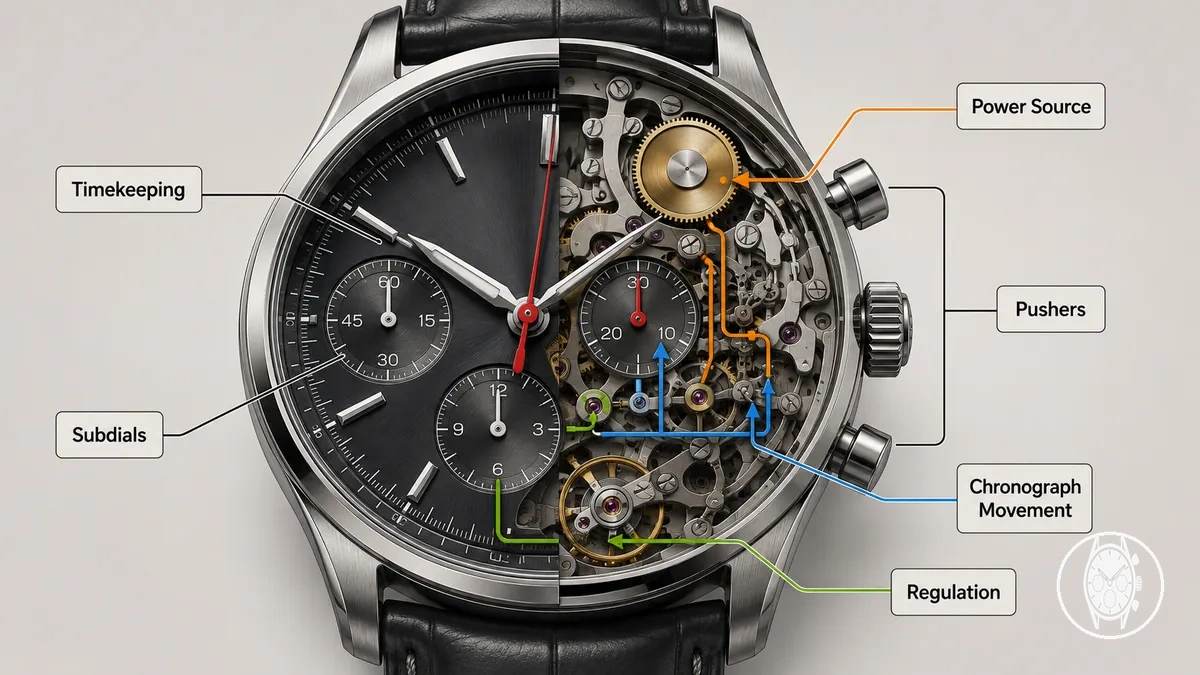
Chronograph movement: A chronograph movement is the mechanism in a men's watch that powers and regulates timekeeping while controlling the stopwatch function. Its two core duties are keeping ordinary time and controlling elapsed-time measurement.
Its two core duties are keeping ordinary time and controlling elapsed-time measurement.
The chronograph movement receives energy from its power source and applies the movement's regulation system to timekeeping, while its chronograph mechanism responds to pushers and drives the hands or subdials assigned to elapsed time. Citizen's Movement No. 0510 instruction manual provides a model-specific example: it identifies chronograph second, minute, and hour hands, with the chronograph measuring up to 12 hours in 1/5-second increments; this shows how one movement can connect pusher actuation to multiple elapsed-time displays. The number and arrangement of chronograph subdials and controls are configuration-specific, so the applicable movement or watch manual defines the functions for a particular model.
A common misconception is that chronograph names the watch's power system; the distinction is that chronograph describes the elapsed-time complication, while quartz, automatic, and mechanical identify movement types according to their power and regulation principles. For example, Seiko specifies its solar Calibre 8A50 as a chronograph that measures elapsed time in 1/100-second increments for the first 60 minutes and up to 12 hours, demonstrating that the chronograph function and the underlying movement type are separate attributes of the watch. This distinction provides the basis for understanding how chronograph watches work.
Main Movement Families in Men's Chronograph Watches
The three main movement families in men's chronograph watches are the quartz chronograph, automatic chronograph, and manual mechanical chronograph. Their primary distinction is the power source and regulation method: Citizen's technical guidance describes quartz watches as battery-powered and regulated by a quartz oscillator, while mechanical watches store energy in a mainspring and regulate time through a balance. This movement category affects accuracy, maintenance, convenience, servicing requirements, and ownership feel.
The table organises each movement family by power, regulation, upkeep, and decision effect.
For a wearer deciding how much interaction a chronograph should require, quartz uses electrical energy, automatic mechanical uses wrist motion to wind a mainspring through an oscillating weight or rotor, and manual mechanical requires hand winding through the crown. Citizen specifies 32,768 Hz for an ordinary quartz oscillator and 2.5–5 Hz for the mechanical balance in its technical comparison; as a model-specific example rather than a family-wide specification, Seiko specifies its automatic-with-manual-winding Calibre 8R46 at 28,800 vibrations per hour, approximately 45 hours of power reserve, and +25 to -15 seconds per day when worn on the wrist between 5°C and 35°C. The table organises each movement family by power, regulation, upkeep, and decision effect.
| Movement family | Power source | Regulation method | Ownership effect |
|---|---|---|---|
| Quartz chronograph | Battery supplies electrical energy. | Quartz-crystal oscillator; Citizen specifies 32,768 Hz for an ordinary quartz watch. | No mainspring-winding routine; maintenance includes the applicable battery or power-system service. Accuracy and servicing cost remain movement-specific. |
| Automatic chronograph | Wrist motion turns an oscillating weight or rotor that winds the mainspring; manual winding may also be provided. | Mechanical balance; Citizen gives 2.5–5 Hz for its mechanical-watch comparison. | Self-winding reduces the need for routine hand winding but retains mechanical servicing. Seiko's Calibre 8R46 illustrates one configuration with approximately 45 hours of power reserve and a stated +25 to -15 seconds-per-day range under its specified wearing conditions. |
| Manual mechanical chronograph | Hand winding through the crown supplies energy to the mainspring. | Mechanical balance rather than quartz-crystal regulation. | Winding becomes a deliberate ownership routine and contributes to a tactile feel; the reviewed evidence does not establish one universal accuracy figure, winding interval, maintenance interval, or servicing cost for all manual mechanical chronographs. |
Automatic and manual mechanical chronographs therefore share mainspring-and-balance regulation, but their winding method creates a practical ownership distinction: automatic movements obtain winding energy from wrist motion, while manual mechanical movements require hand winding. The preferred movement family consequently depends on whether the priority is battery-powered convenience, self-winding mechanical operation, or direct hand-wound interaction; accuracy, maintenance interval, and cost should then be checked for the specific calibre because no universal values for those attributes are established across each family.
Quartz Chronograph Movements
A quartz chronograph movement is the battery-powered, quartz-regulated branch of the chronograph movement family: a battery supplies electrical energy and an energised quartz crystal provides the regulating oscillation. Citizen's technical guidance identifies the battery as the power source for a quartz watch, specifies 32,768 Hz for an ordinary quartz oscillator, and states quartz accuracy on a monthly basis. The absence of a mainspring-winding routine makes this movement type convenient for daily ownership.
The absence of a mainspring-winding routine makes this movement type convenient for daily ownership.
Quartz chronographs still require battery replacement and appropriate watch servicing, so low-maintenance does not mean maintenance-free. For a numerical example, Seiko specifies its quartz Calibre 8T63 at ±15 seconds per month at 5°C to 35°C and approximately 3 years of battery life; Seiko's 8T63 instructions state that battery life can fall below 3 years when the stopwatch is used for more than 1 hour per day. These model-specific figures provide a concrete accuracy and upkeep example without treating them as universal values for every quartz chronograph.
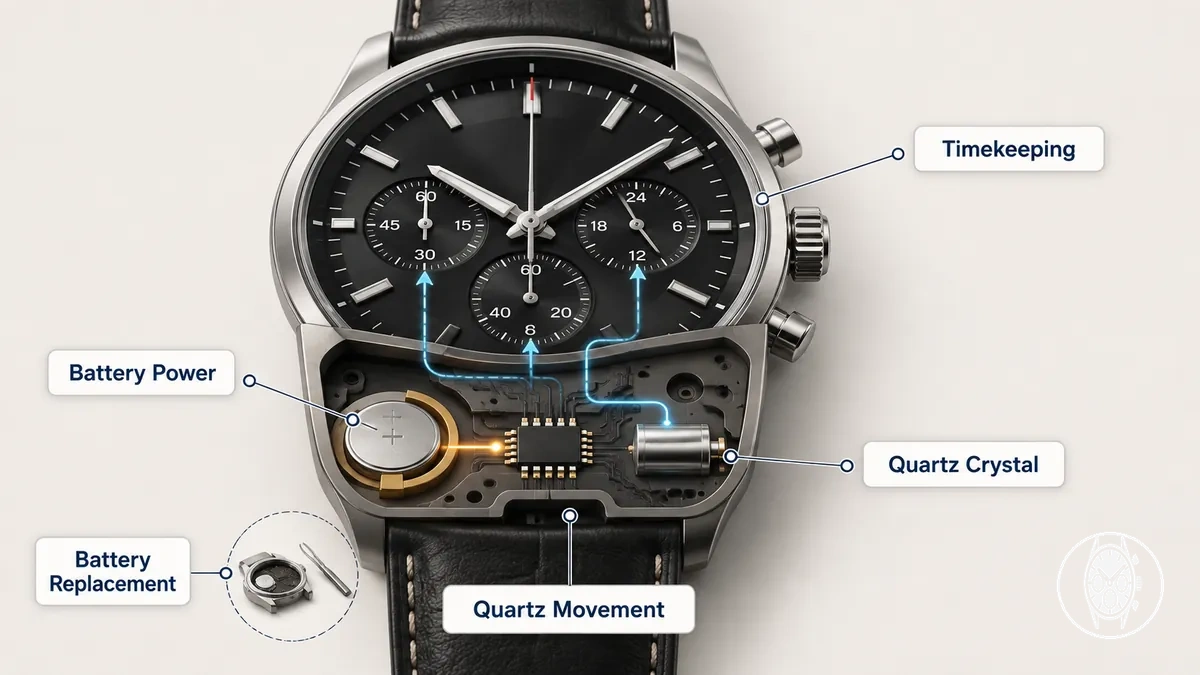
- Power: The battery supplies electrical energy, while the quartz crystal provides the regulating oscillation; Citizen specifies 32,768 Hz as the ordinary quartz-watch oscillator frequency.
- Accuracy: Accuracy is calibre-specific rather than identical across quartz chronographs; Seiko specifies ±15 seconds per month for Calibre 8T63 at 5°C to 35°C.
- Upkeep: Battery replacement is a recurring maintenance requirement. Seiko specifies approximately 3 years for Calibre 8T63 when stopwatch use remains below 1 hour per day; gasket condition and water resistance should be assessed according to the applicable watch manufacturer's service requirements.
- Affordability: Quartz chronographs occupy different price and movement-quality levels. The reviewed evidence does not establish a universal price range or support treating every quartz chronograph as cheaper than every mechanical chronograph.
- Trade-off: A quartz chronograph combines battery-powered convenience, quartz regulation, and no routine winding requirement, while battery life, accuracy, movement quality, maintenance needs, and affordability remain specific to the calibre and watch configuration.
Automatic Chronograph Movements
An automatic chronograph movement is a self-winding mechanical chronograph movement in which wrist motion rotates a rotor, or oscillating weight, to wind the mainspring, while a mechanical balance regulates timekeeping and the chronograph mechanism measures elapsed time. Citizen's mechanical-watch guidance confirms that arm movement rotates the oscillating weight to wind the mainspring and identifies the balance as the regulating component in a mechanical watch. “Automatic” therefore describes the winding method rather than the presence of the chronograph function; the mechanical movement itself usually does not require a battery, although separately powered features remain model-specific.
Power reserve, inactivity behaviour, thickness, accuracy, and service complexity are calibre-specific rather than universal properties of every automatic chronograph movement.
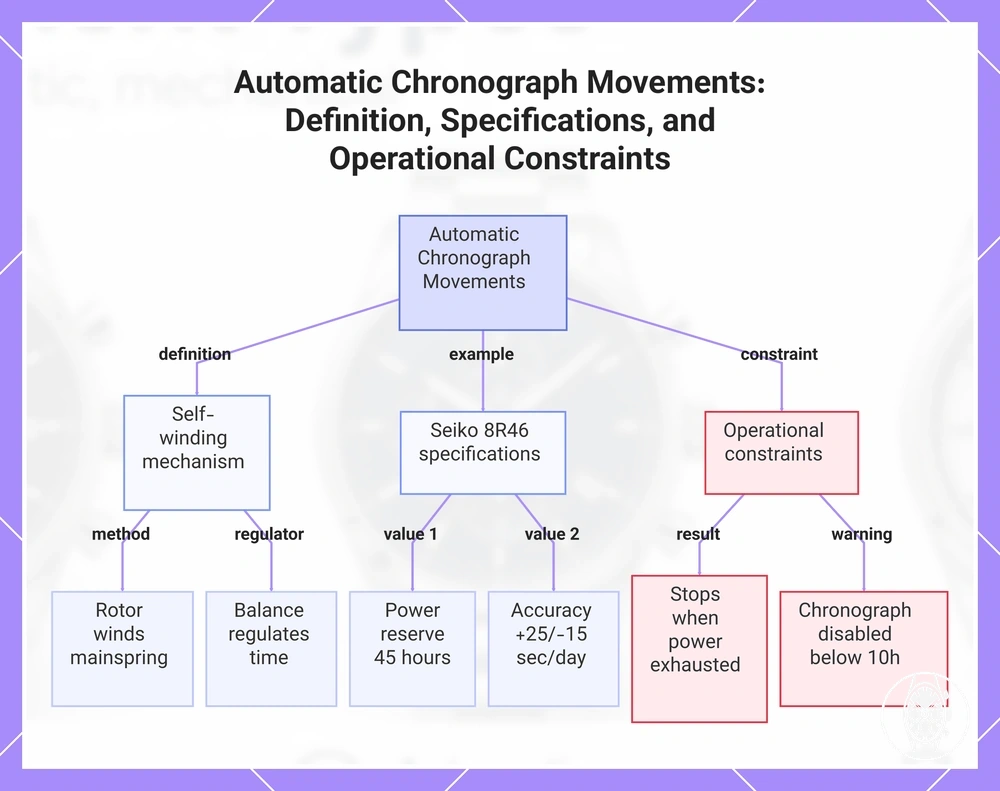
Power reserve, inactivity behaviour, thickness, accuracy, and service complexity are calibre-specific rather than universal properties of every automatic chronograph movement. Seiko specifies its automatic-with-manual-winding Calibre 8R46 at approximately 45 hours of power reserve, 28,800 vibrations per hour, and a factory-adjusted daily rate of +25 to -15 seconds when worn on the wrist at 5°C to 35°C; Seiko also states that its chronograph function cannot be used when the indicated power reserve falls below 10 hours. This provides a concrete inactivity boundary: once stored mainspring energy is exhausted, an automatic watch stops, while insufficient reserve can restrict chronograph operation before complete stoppage on movements such as the 8R46. Automatic chronographs also combine self-winding and chronograph mechanisms, increasing mechanical component complexity, but the reviewed evidence does not establish one defensible case-thickness value, service interval, or servicing cost for the movement family, so those attributes must be checked for the specific calibre and watch configuration.
This chart explains what an automatic chronograph movement is, how it works, and key constraints illustrated by the Seiko 8R46 calibre.
This chart explains what an automatic chronograph movement is, how it works, and key constraints illustrated by the Seiko 8R46 calibre.
Manual Mechanical Chronograph Movements
A manual mechanical chronograph movement is a hand-wound mechanical chronograph in which the wearer turns the crown to tension the mainspring that stores energy for timekeeping and chronograph operation. Longines identifies hand-winding as the power method for manual mechanical movements and states that most of its manual movements provide a maximum power reserve of about 64 hours, although the applicable reserve remains calibre-specific. Manual winding therefore requires wearer-supplied power through the crown, unlike automatic self-winding, which uses wrist motion and a rotor to replenish the mainspring.
Manual winding therefore requires wearer-supplied power through the crown, unlike automatic self-winding, which uses wrist motion and a rotor to replenish the mainspring.
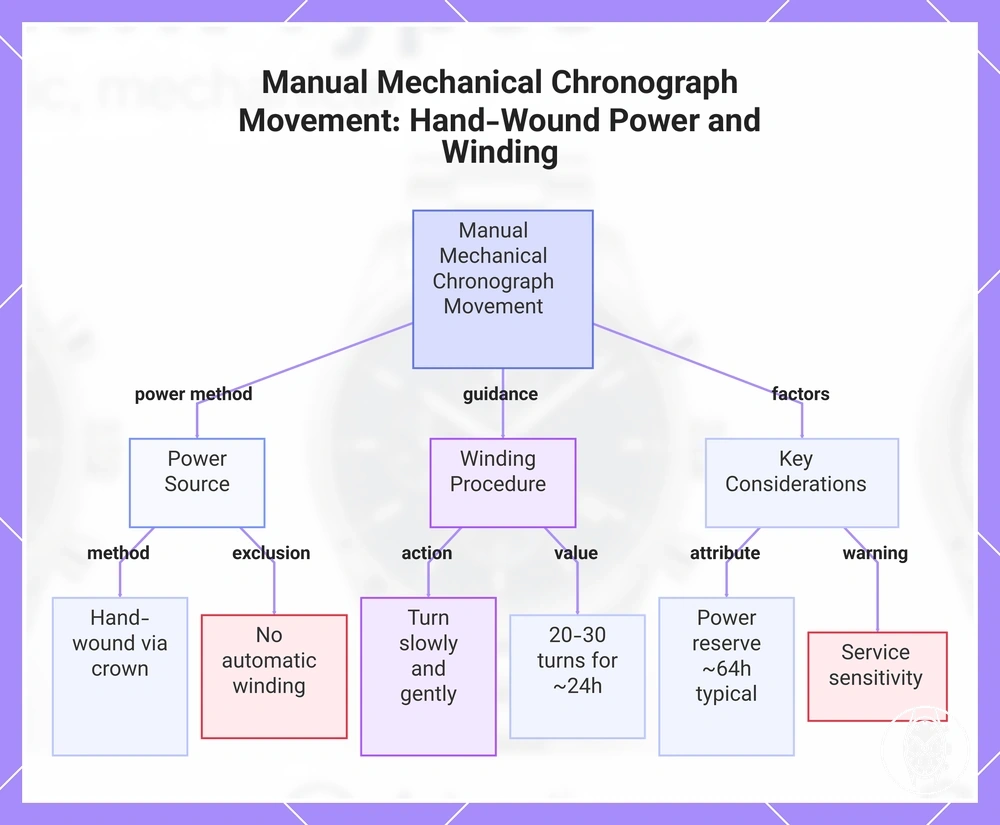
The winding routine gives a manual mechanical chronograph tactile operation and direct wearer interaction, but suitability, power reserve, and service sensitivity remain specific to the calibre and its condition. Longines advises turning the crown slowly and gently and states that 20 to 30 turns provide approximately 24 hours of power in its general mechanical-watch guidance, while the exact number of turns for a full wind depends on the calibre; the movement manufacturer's instructions should therefore determine the correct winding procedure. Mechanical condition is also affected by lubrication, wear, chronograph-component complexity, and service history, while the reviewed evidence does not establish one universal service interval or servicing requirement for all manual mechanical chronograph movements, making this movement type most appropriate for an owner comfortable with model-specific winding and maintenance.
This chart explains the power source, winding procedure, and key considerations of a manual mechanical chronograph movement.
This chart explains the power source, winding procedure, and key considerations of a manual mechanical chronograph movement.
Chronograph Mechanism Types Inside the Movement
A chronograph mechanism is the internal architecture that controls how a chronograph starts, stops, resets, and connects its elapsed-time components to the base movement. The main construction distinction is integrated chronograph versus modular chronograph, while the main control distinction covered here is column wheel versus cam-operated actuation. Mechanism type is therefore an internal movement attribute rather than a replacement for the broader quartz, automatic, or manual mechanical movement-family distinction.
Integrated and modular describe construction, whereas column wheel and cam-operated describe chronograph control architecture.
Integrated and modular describe construction, whereas column wheel and cam-operated describe chronograph control architecture. TAG Heuer identifies its Calibre TH20-11 as an integrated chronograph with a column-wheel mechanism and contrasts it with the historical Calibre 11, which combined a base movement with a separate chronograph module; Seiko states that the column wheel in its 8R series controls chronograph operation and produces a different tactile sensation during starting, stopping, and resetting compared with cam-and-lever construction. These examples establish the architectural distinctions, but the reviewed evidence does not support one universal numerical difference in pusher force, thickness, service cost, or retail price across the four mechanism types because those outcomes also depend on movement design, execution, adjustment, and service condition.
| Mechanism type | What it controls | Practical effect | Qualification |
|---|---|---|---|
| Integrated chronograph | The chronograph functions are built into the movement's internal architecture rather than added as a separate chronograph module. | Timekeeping and chronograph components share one movement construction, which changes component layout and service access relative to a modular design. | Integrated construction alone does not establish a universal thickness, service complexity, pusher feel, or price advantage; those attributes remain design- and calibre-specific. |
| Modular chronograph | A separate chronograph module is combined with a base movement to provide elapsed-time start, stop, and reset functions. | The layered construction changes movement packaging and can change service access because the chronograph mechanism is a distinct module. | TAG Heuer identifies the historical Calibre 11 as a modular construction, but the reviewed evidence does not establish one universal thickness increase, repair-cost difference, or price difference for modular chronographs as a class. |
| Column wheel | A rotating column-wheel component coordinates chronograph start, stop, and reset commands. | Seiko states that its 8R-series column wheel provides precise chronograph control and a different pusher feel during starting, stopping, and resetting than cam-and-lever construction. | Pusher feel still reflects the complete actuation system, adjustment, lubrication, component geometry, and service condition; a column wheel alone does not establish overall movement quality. |
| Cam-operated | A cam-and-lever or coulisse-style control system coordinates chronograph actuation without a column wheel. | The cam and lever geometry transfers pusher input to the start, stop, and reset mechanism, creating a different control architecture from a column-wheel system. | The reviewed evidence supports the architectural distinction but does not establish a universal numerical pusher-force difference, thickness value, servicing-cost difference, or quality ranking for all cam-operated chronographs. |
Chronograph mechanism types should therefore be treated as construction and actuation choices rather than a quality hierarchy. Integrated or modular construction can change packaging and service access, while column-wheel or cam-operated control can change pusher feel and operating behaviour, but thickness, service complexity, cost, and perceived feel must be judged from the specific movement design and its adjustment and service condition.
Integrated and Modular Chronograph Movements
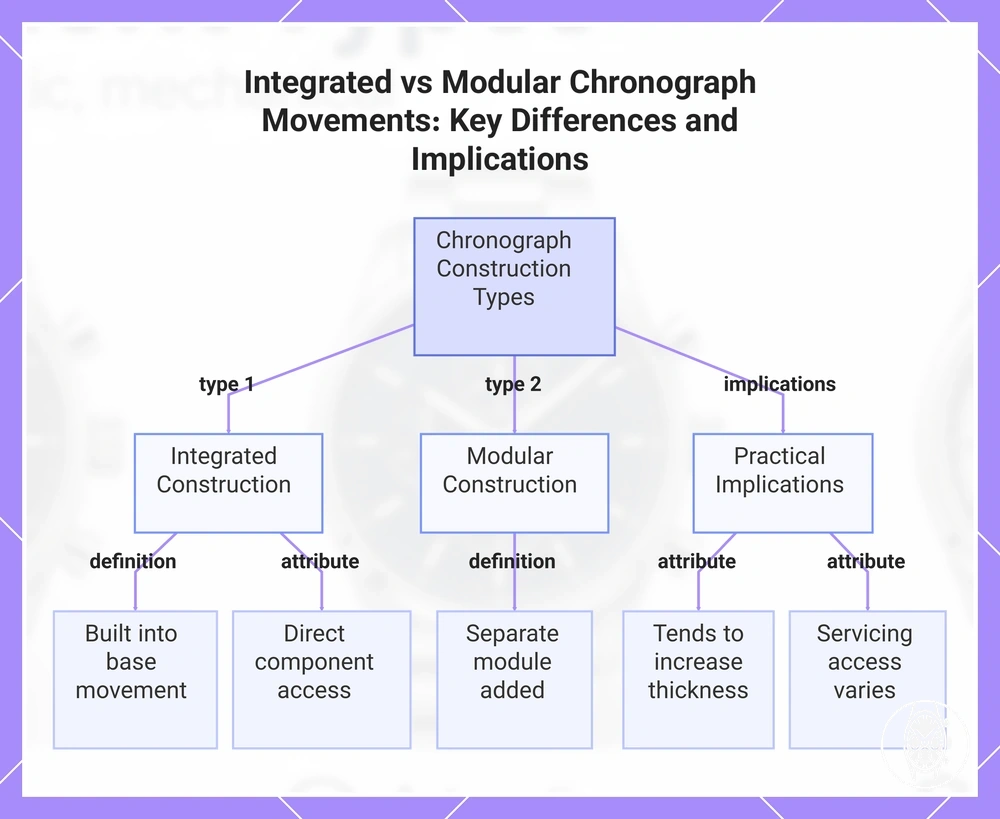
An integrated chronograph is a chronograph construction in which the chronograph components are built into the movement architecture, while a modular chronograph adds a separate chronograph module to a base movement. Worn & Wound describes integrated construction as incorporating the chronograph complication into the base movement and modular construction as adding the chronograph mechanism as a separate layer. The distinction therefore concerns construction rather than quality by itself.
The distinction therefore concerns construction rather than quality by itself.
Construction can affect thickness, servicing access, and ownership expectations because a modular chronograph places an additional module above or alongside the base movement, whereas an integrated chronograph incorporates those functions within one movement architecture. LUXUO notes that modular chronographs tend to be thicker because the module is layered onto the base movement, while Worn & Wound reports that servicing access and difficulty differ by modular design; the reviewed evidence does not establish one universal thickness increase, service interval, or servicing-cost difference for either layout. Integrated construction can offer more direct access to chronograph components within the movement architecture, but actual service complexity, performance, and ownership quality still depend on design execution, component layout, condition, parts availability, and watchmaker requirements rather than on integrated or modular construction alone.
This chart compares integrated and modular chronograph constructions, showing their definitions and practical implications.
This chart compares integrated and modular chronograph constructions, showing their definitions and practical implications.
Column Wheel and Cam-Operated Chronographs
A column wheel and a cam-operated or coulisse lever are two chronograph actuation systems that coordinate start, stop, and reset commands inside the movement. The column wheel uses an indexed rotating wheel to control the chronograph levers, while the cam-operated system uses a shaped cam and lever arrangement; Seiko states that its column-wheel construction provides precise chronograph control and a different tactile sensation during starting, stopping, and resetting compared with cam-and-lever construction. :contentReference[oaicite:0]{index=0} The actuation system can therefore influence pusher feel without making pusher feel the sole measure of movement quality.
- Column wheel: The column wheel coordinates chronograph control through its indexed columns and associated levers. Seiko identifies precise operational control and a different tactile response from cam-and-lever construction as practical effects of this architecture; the reviewed manufacturer evidence does not specify a universal numerical pusher-force advantage for column-wheel chronographs. :contentReference[oaicite:1]{index=1}
- Cam-operated: A cam-operated chronograph uses a cam or coulisse lever to change the state of the start, stop, and reset mechanism. Revolution Watch describes the cam system as simpler and more economical to produce, assemble, and maintain than a column-wheel system and notes that it does not require the same demanding manufacturing tolerances; these are construction and serviceability characteristics rather than proof of inferior performance. :contentReference[oaicite:2]{index=2}
Manufacturing complexity, serviceability, pusher feel, and perceived prestige can differ between the two actuation systems, but the practical result remains conditional on movement design, adjustment, lubrication, component geometry, wear, and service condition. Seiko supports a tactile difference between its column-wheel and cam-and-lever constructions, while Revolution Watch supports lower manufacturing and assembly complexity for the cam system; neither source establishes one universal numerical service-time, service-cost, or pusher-force difference across all chronographs. :contentReference[oaicite:3]{index=3} Movement condition and adjustment can therefore matter as much as the actuation-system category when evaluating real pusher action and performance.
Battery, Winding, and Power Differences by Movement Type
A quartz chronograph usually uses a battery, an automatic chronograph usually does not use a battery for its mechanical movement because wrist motion winds a mainspring, and a manual mechanical chronograph relies on hand winding through the crown. Seiko specifies approximately 3 years of battery life for its quartz Calibre 8T63 and approximately 45 hours of power reserve for its automatic-with-manual-winding Calibre 8R46, while Longines specifies approximately 68 hours of power reserve for its hand-wound Spirit Pilot Flyback chronograph. Chronograph describes the elapsed-time function, whereas automatic describes a winding system, so the exact power source and ownership routine depend on the movement family and model configuration.
The comparison below connects movement type to battery replacement, winding method, power reserve, inactivity, and ownership effect.
The comparison below connects movement type to battery replacement, winding method, power reserve, inactivity, and ownership effect. Quartz shifts routine power upkeep toward periodic battery replacement, automatic winding uses a rotor and wrist motion to replenish stored mainspring energy, and manual mechanical winding requires the wearer to supply that energy through the crown.
| Movement type | Power source | What the owner does | Practical effect |
|---|---|---|---|
| Quartz chronograph | A battery supplies electrical energy. Seiko specifies approximately 3 years of battery life for quartz Calibre 8T63. | No mainspring winding is required; the owner replaces the battery according to the watch's applicable service guidance when its usable life is exhausted. | Power management requires little routine interaction between battery changes, although the replacement interval remains calibre- and usage-specific rather than a universal 3-year value. |
| Automatic chronograph | A mainspring stores mechanical energy, and a rotor uses wrist motion for self-winding. Seiko specifies approximately 45 hours of power reserve for automatic-with-manual-winding Calibre 8R46. | Normal wrist motion replenishes the mainspring, while Calibre 8R46 also permits manual winding. | Inactivity can exhaust the power reserve and stop the watch. Seiko further states that the 8R46 chronograph cannot be used when its indicated power reserve falls below 10 hours, showing that available reserve can affect chronograph operation before complete stoppage. |
| Manual mechanical chronograph | A mainspring stores energy supplied by hand winding through the crown. Longines specifies approximately 68 hours of power reserve for the hand-wound Spirit Pilot Flyback chronograph. | The owner winds the crown according to the movement manufacturer's guidance rather than relying on a self-winding rotor. | Hand winding becomes a recurring ownership routine, and inactivity beyond the available power reserve can stop the movement. The cited 68-hour reserve is model-specific rather than a universal value for manual mechanical chronographs. |
The ownership effect follows the power source: a quartz chronograph prioritises battery-based convenience, an automatic chronograph reduces routine hand winding when wrist motion is sufficient, and a manual mechanical chronograph makes hand winding part of normal use. Power reserve determines how long a mechanical chronograph can remain inactive before stored mainspring energy is depleted, but the duration must be checked for the specific calibre. For a deeper comparison of these ownership differences, see quartz vs automatic chronographs.
Accuracy Differences Between Quartz, Automatic, and Mechanical Chronographs
Quartz chronographs generally provide more consistent timekeeping accuracy than automatic or manual mechanical chronographs because quartz regulation is less susceptible to the rate variance of a mechanical balance. Seiko specifies its quartz Calibre 8T63 at ±15 seconds per month, while its automatic chronograph Calibre 8R46 is specified at +25 to -15 seconds per day when worn on the wrist between 5°C and 35°C; Seiko also states that actual mechanical accuracy can move outside that range with changes in wearing time, temperature, arm movement, and mainspring state. :contentReference[oaicite:0]{index=0} These are model-specific values, so movement family indicates an accuracy tendency rather than a universal rate.
:contentReference[oaicite:0]{index=0} These are model-specific values, so movement family indicates an accuracy tendency rather than a universal rate.
The table separates general timekeeping accuracy from elapsed-time measurement because a watch's daily rate and its chronograph stopwatch resolution are different attributes. Seiko specifies Calibre 8T63 with chronograph measurement up to 60 minutes in 1/5-second increments, while chronometer-grade claims should be treated as separate certification claims rather than inferred from mechanical construction alone. :contentReference[oaicite:1]{index=1}
| Movement type | Accuracy tendency | What affects it | Decision impact |
|---|---|---|---|
| Quartz | Quartz regulation provides comparatively stable timekeeping; Seiko specifies Calibre 8T63 at ±15 seconds per month. | Calibre design, temperature, battery condition, electronic regulation, and movement condition affect actual performance. | Accuracy should receive greater weight when daily timekeeping consistency matters more than mechanical interaction. The 8T63's 1/5-second chronograph increment describes elapsed-time measurement resolution rather than its monthly timekeeping rate. |
| Automatic mechanical | An automatic chronograph uses mechanical balance regulation; Seiko specifies Calibre 8R46 at +25 to -15 seconds per day when worn between 5°C and 35°C. | Seiko identifies wearing time, temperature, arm movement, and mainspring state as conditions that can move actual daily accuracy outside the factory-adjusted range; service condition and regulation also influence observed variance. | Mechanical feel and self-winding operation may matter more when the stated daily-rate range is acceptable, while users prioritising tighter consistency should compare the specific movement's stated accuracy. |
| Manual mechanical | A manual mechanical chronograph also relies on mechanical balance regulation, so no single family-wide daily accuracy value is established by the reviewed evidence. | Regulation, winding state, position, temperature, wear, lubrication, and service condition influence practical rate variation. | Manual winding and collector appeal can outweigh maximum consistency when the movement's stated or certified performance meets the user's requirement; chronometer-grade status should be verified from the applicable certification or manufacturer documentation. |
Accuracy should outweigh mechanical feel or collector appeal when accumulating daily or monthly rate error would create a practical inconvenience and the wearer wants less frequent correction; the cited Seiko examples show why movement-specific specifications matter more than broad category assumptions. Elapsed-time measurement should still be judged separately by chronograph increment, maximum timing duration, and control behaviour because timekeeping accuracy does not by itself define stopwatch resolution. Unexpected rate changes outside the applicable calibre specification, especially after changes in usage or service condition, belong with chronograph accuracy problems. :contentReference[oaicite:2]{index=2}
Maintenance and Service Needs by Chronograph Movement
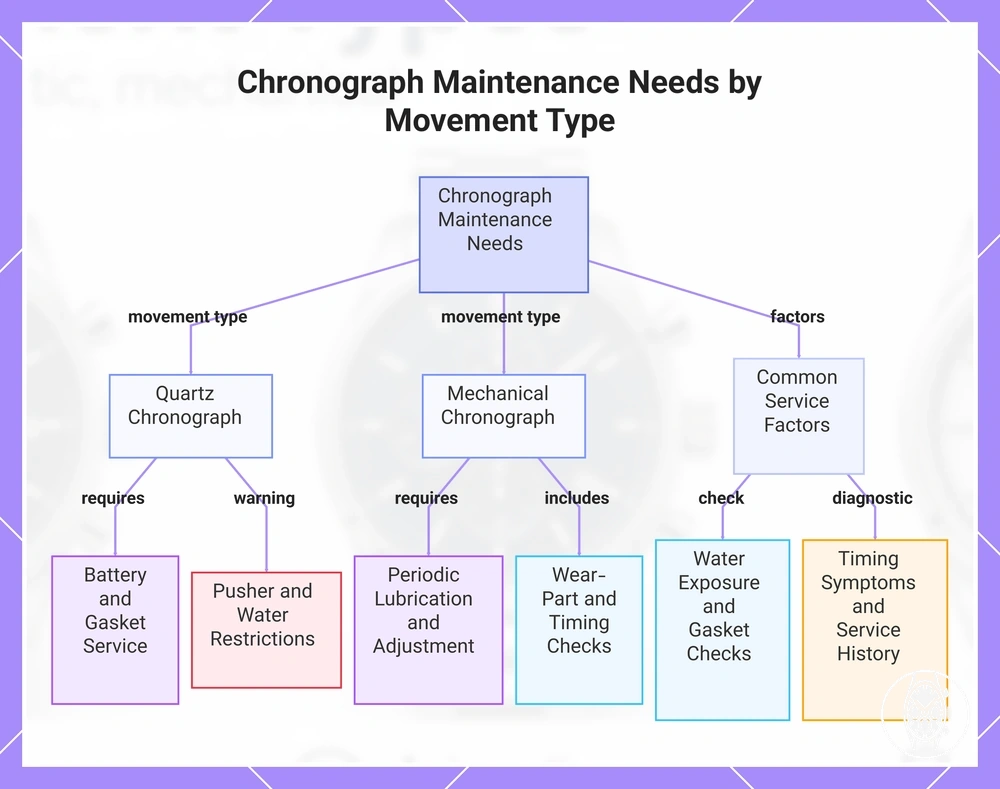
For an owner comparing long-term upkeep, chronograph maintenance is an ownership-cost and reliability factor that changes with movement type: a quartz chronograph primarily requires battery-related service and sealing checks, while a mechanical chronograph adds periodic inspection, cleaning, lubrication, adjustment, and wear-part replacement. Seiko recommends servicing its watches about every 3 years as a general guideline, with the interval qualified by climate and usage conditions, and states that worn movement parts or aged lubricant can cause time loss or stoppage. Service needs therefore follow the power source, chronograph parts count, water exposure, use frequency, and service history rather than one universal interval or cost.
Service needs therefore follow the power source, chronograph parts count, water exposure, use frequency, and service history rather than one universal interval or cost.
The checklist covers battery changes, gasket checks, water exposure, pusher care, mechanical servicing, timing symptoms, and service history because each condition changes the maintenance decision. Seiko recommends replacing aged gaskets when a battery is replaced and regularly checking water resistance, while OMEGA recommends a water-resistance test once a year; these manufacturer values apply to their stated guidance rather than every chronograph.
- Battery changes: A battery-powered quartz chronograph requires replacement when its battery is exhausted. Seiko advises replacing an exhausted battery as soon as possible and, for watches rated to 10 bar or more in the cited battery guidance, requires a water-resistance test whenever the battery is replaced; this makes battery service part of sealing upkeep as well as power restoration.
- Gasket checks: Gaskets age and can lose sealing performance after time or accidental shock. Seiko recommends regular water-resistance checks and replacement of deteriorated gaskets during appropriate service, while OMEGA specifies a water-resistance test once a year through an authorised service centre.
- Water exposure: Water exposure increases the importance of intact seals and correct pusher use. OMEGA instructs owners not to operate chronograph pushers in water, except on identified Seamaster Diver 300M and Planet Ocean 600M chronograph models designed for underwater pusher operation, so the applicable model instructions define the safe operating condition.
- Pusher function: Pusher care means monitoring whether start, stop, and reset controls operate normally without sticking, abnormal resistance, or failure to return the chronograph indication as specified. A persistent change in pusher action is a condition for professional attention because the reviewed manufacturer guidance does not provide a universal user-serviceable pusher adjustment.
- Mechanical service: Mechanical servicing addresses lubrication, worn parts, contamination, adjustment, and chronograph-component condition. Seiko recommends examination, cleaning, and oiling about every 3 years as a general service interval and explains that aged oil and worn movement parts can contribute to time loss or stoppage; climate and usage conditions can change the appropriate timing.
- Timing symptoms: Persistent gains or losses beyond the movement's stated specification, unexpected stoppage, reduced running behaviour, or chronograph malfunction justify professional assessment. Seiko identifies aged lubricant and worn components as possible causes of deteriorating performance, so a measurable change from the calibre's specified behaviour is more useful than assuming the movement family alone determines service need.
- Service history: A documented battery replacement, gasket replacement, pressure or water-resistance test, or mechanical overhaul provides a dated maintenance baseline. When service history is unknown, the reviewed evidence does not support assigning a universal remaining service interval; current sealing condition, movement behaviour, manufacturer guidance, and professional inspection provide the relevant decision inputs.
Professional attention is appropriate when a chronograph develops persistent timing variance, moisture intrusion, abnormal pusher action, stoppage, or another departure from its specified operation. Quartz ownership can reduce routine mechanical service complexity between battery-related visits, whereas a mechanical chronograph has additional lubrication, wear, regulation, and chronograph-part service needs; neither movement family has a universally supported fixed service cost. For the broader routines used between professional services, see chronograph watch care. :contentReference[oaicite:0]{index=0}
For the broader routines used between professional services, see chronograph watch care .
This chart shows how maintenance and service needs differ between quartz and mechanical chronographs, including key service factors and diagnostic checks.
Battery Replacement and Quartz Chronograph Upkeep
Battery replacement and quartz chronograph upkeep usually centre on replacing a depleted battery, checking seals, and confirming normal pusher function. Seiko specifies approximately 3 years of battery life for Calibre 8T63 when stopwatch use remains below 60 minutes per day; use beyond 60 minutes per day can shorten that period, and a two-second small-seconds interval signals that the battery is nearing depletion. :contentReference[oaicite:0]{index=0} When water resistance must be retained, battery replacement should also account for gasket condition and the manufacturer's resealing and testing requirements.
- Battery timing: For Seiko Calibre 8T63, the model-specific replacement warning is a small seconds hand moving at two-second intervals rather than its normal one-second intervals. :contentReference[oaicite:1]{index=1}
- Gasket inspection: Citizen states that water-resistant gaskets on watches with replaceable batteries are replaced during battery replacement because ageing seals can lose elasticity or become brittle or cracked. :contentReference[oaicite:2]{index=2}
- Pusher function: If start, stop, or reset pusher function becomes abnormal after a battery change or during normal use, professional assessment is the appropriate boundary because the reviewed sources do not provide one universal user-adjustment procedure for quartz chronograph pushers.
- Moisture risk: Visible condensation or suspected water entry requires professional attention because Citizen states that internal water can damage mechanical precision parts, electronic components, and the dial. :contentReference[oaicite:3]{index=3}
- Professional resealing: For divers' watches and watches with high water resistance, Citizen advises service-centre battery replacement because inspection of water-resistance performance after the battery change requires an appropriate service environment. :contentReference[oaicite:4]{index=4} :contentReference[oaicite:5]{index=5}
Mechanical Chronograph Servicing and Ownership Cost
When an automatic or manual mechanical chronograph develops changing timing, abnormal pusher feel, or reduced operating consistency, mechanical chronograph servicing becomes an ownership consideration because the movement combines a comparatively high parts count with lubrication points and components subject to wear. The reviewed section evidence identifies movement complexity, age, service history, parts availability, lubrication, testing, and replacement of worn components as factors that increase service complexity and labour. Movement design and service condition therefore determine the maintenance burden more reliably than movement type alone. :contentReference[oaicite:0]{index=0}
- Timing changes: Persistent timing symptoms outside the movement's established performance pattern can signal regulation, lubrication, or wear that warrants professional assessment.
- Pusher feel: Start, stop, or reset controls that become sticky, inconsistent, or unusually resistant are service warning signs because the change indicates altered chronograph-control behaviour.
- Service history: An unknown service history leaves lubricant age and previous wear correction unspecified, increasing uncertainty about current mechanical condition.
- Unusual resistance: New resistance during winding, setting, or chronograph operation is a service warning because continued force can place additional stress on worn or poorly lubricated components.
Ownership cost should be treated as a qualified range rather than a fixed outcome: the retained section evidence cites approximately US$400–US$700 or more for independent mechanical-chronograph servicing, with movement complexity, condition, region, parts requirements, and service history capable of moving the final amount outside that range. Mechanical chronographs can remain serviceable through long ownership periods when lubrication, wear, timing symptoms, and chronograph controls receive appropriate professional attention, but the reviewed evidence does not establish a universal lifespan or service interval. Mechanical chronographs may therefore cost more to maintain than simpler quartz options, for which the retained evidence cites approximately US$20–US$50 for basic battery-related service rather than a full mechanical overhaul. :contentReference[oaicite:1]{index=1}
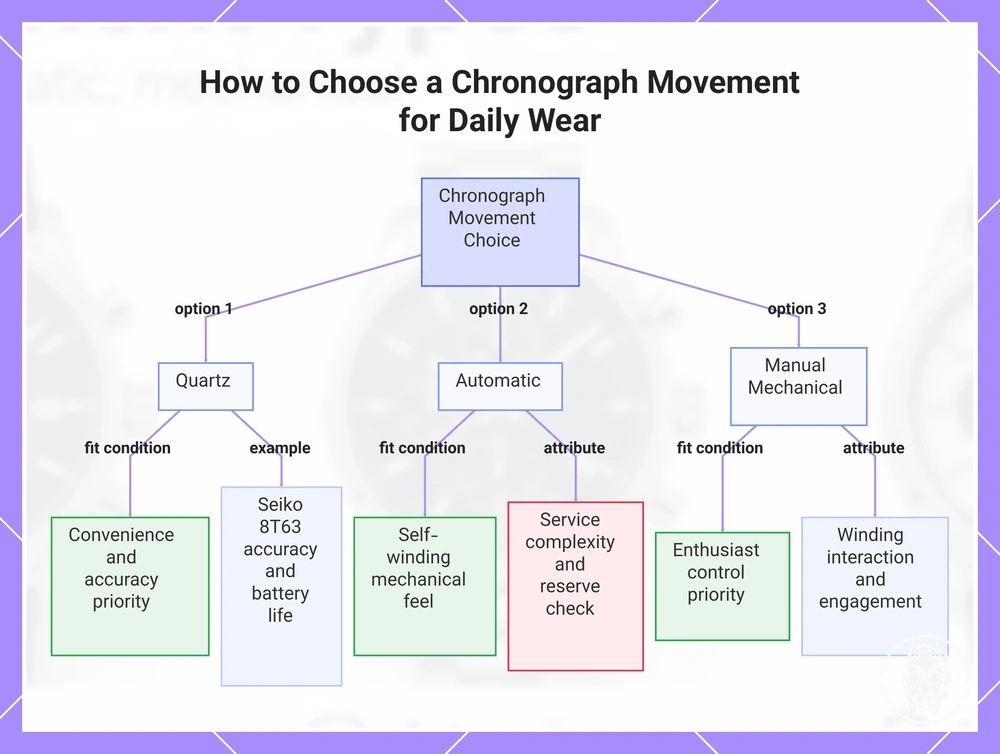
Choosing the Right Chronograph Movement for Daily Wear and Long-Term Value
Choosing the right chronograph movement for daily wear means matching the movement to your accuracy needs, maintenance tolerance, budget, thickness preference, wearing frequency, and interest in mechanical feel rather than treating one type as universally superior. Quartz prioritises convenience and stable timekeeping, automatic adds self-winding mechanical ownership, and manual mechanical adds deliberate hand-winding control. These criteria should determine the movement choice before individual models are compared.
- Accuracy: Choose quartz when tighter routine timekeeping is the priority; Seiko specifies Calibre 8T63 at ±15 seconds per month between 5°C and 35°C, while its automatic Calibre 8R46 is specified at +25 to -15 seconds per day when worn on the wrist between 5°C and 35°C.
- Maintenance: Choose quartz when periodic battery replacement is preferable to mechanical lubrication, regulation, wear inspection, and chronograph servicing; choose mechanical when those service requirements are acceptable parts of ownership.
- Budget: Compare purchase price with expected battery or mechanical service requirements because no universal lifetime ownership-cost range is established across all quartz, automatic, and manual chronograph movements.
- Thickness: Compare the finished watch's stated case thickness rather than assuming movement family determines wrist profile; for example, Seiko lists 8T63 quartz chronographs at 11.5 mm, 11.6 mm, 12.1 mm, and 12.6 mm across current models, demonstrating model-level variation within one movement family.
- Wearing frequency: Automatic suits regular wear because wrist motion replenishes the mainspring; Seiko specifies approximately 45 hours of power reserve for Calibre 8R46, so inactivity beyond available reserve can stop the movement.
- Mechanical interest: Choose automatic when self-winding mechanical feel is the priority, or manual mechanical when deliberate crown winding is part of the desired ownership routine.
- Service tolerance: Mechanical chronographs suit owners willing to accept greater component and service complexity, while quartz suits owners who place greater weight on simpler power-related upkeep.
Quartz is the clearest fit for daily wear when convenience and accuracy needs outweigh mechanical interaction. Seiko specifies its 8T63 quartz chronograph movement at ±15 seconds per month and approximately 3 years of battery life, providing a concrete example of the accuracy and power-upkeep advantage that can matter in daily use. These values are specific to Calibre 8T63 rather than universal specifications for every quartz chronograph.
These values are specific to Calibre 8T63 rather than universal specifications for every quartz chronograph.
An automatic chronograph fits frequent wear when the owner wants self-winding mechanical feel without making hand winding the primary ownership routine. Seiko specifies Calibre 8R46 with approximately 45 hours of power reserve and a daily rate of +25 to -15 seconds under its stated wrist-worn temperature conditions, while Longines specifies up to 59 hours for its self-winding Conquest Chronograph movement, showing why reserve and accuracy should be checked at calibre level. Automatic chronographs also add service complexity, while thickness remains watch-specific rather than an automatic-movement constant.
Automatic chronographs also add service complexity, while thickness remains watch-specific rather than an automatic-movement constant.
A manual mechanical chronograph is a stronger fit when enthusiast control, winding interaction, and direct engagement with the movement matter more than convenience. Chronograph mechanism type can further affect mechanical feel, construction complexity, and service cost, but integrated, modular, column-wheel, or cam-operated architecture should be treated as a design attribute rather than a guarantee of quality or long-term value. For a broader comparison of condition, budget, servicing, and chronograph watch value, assess the complete watch rather than movement type alone.
Use the men's chronograph watch buying guide to apply those criteria to complete watch specifications and product examples.
The decision checklist reduces movement choice to seven practical criteria: accuracy, maintenance tolerance, budget, thickness, wearing frequency, mechanical interest, and service tolerance. Quartz usually fits convenience-led priorities, automatic fits frequent-wear mechanical priorities, and manual mechanical fits deliberate enthusiast-control priorities. Use the men's chronograph watch buying guide to apply those criteria to complete watch specifications and product examples. :contentReference[oaicite:0]{index=0}
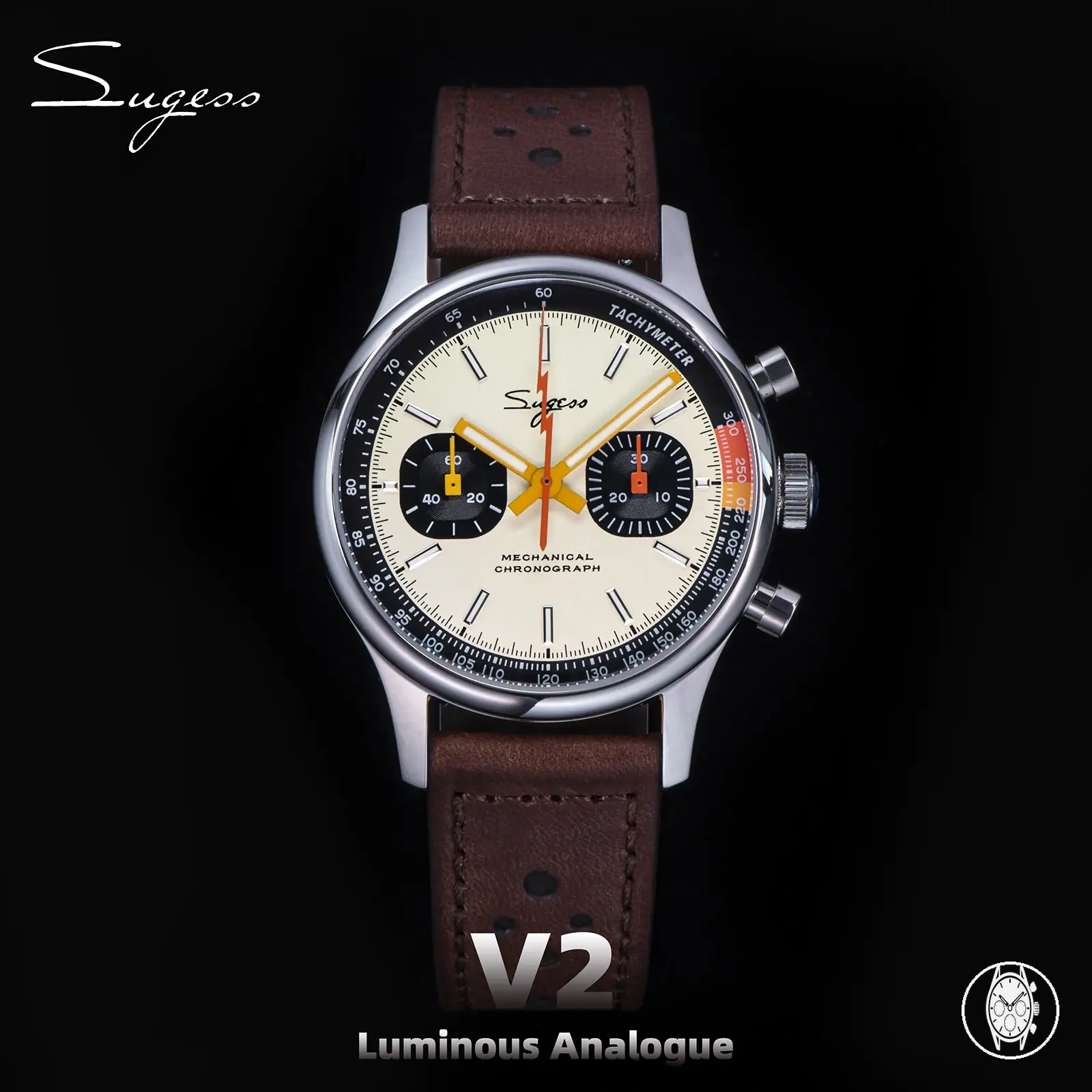
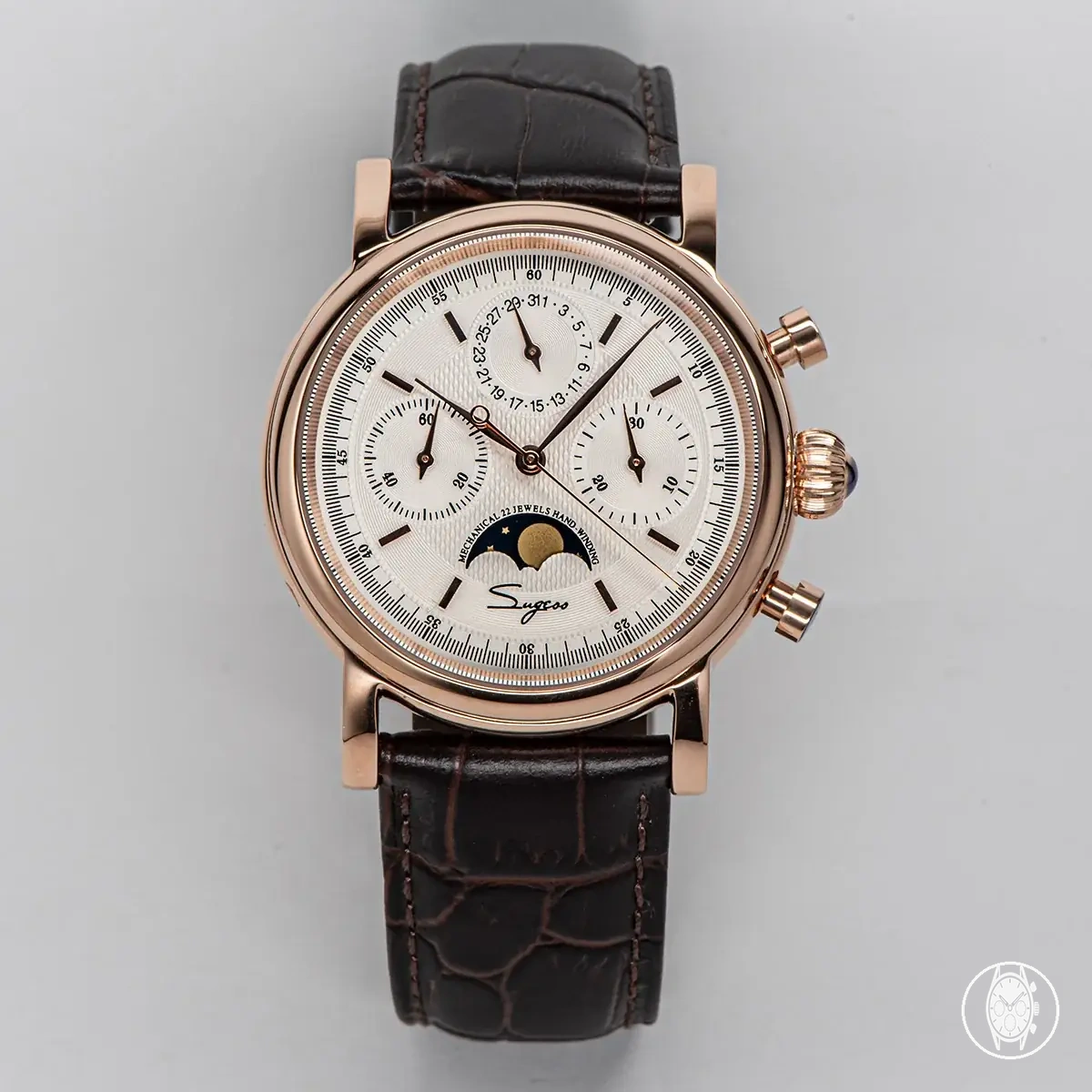
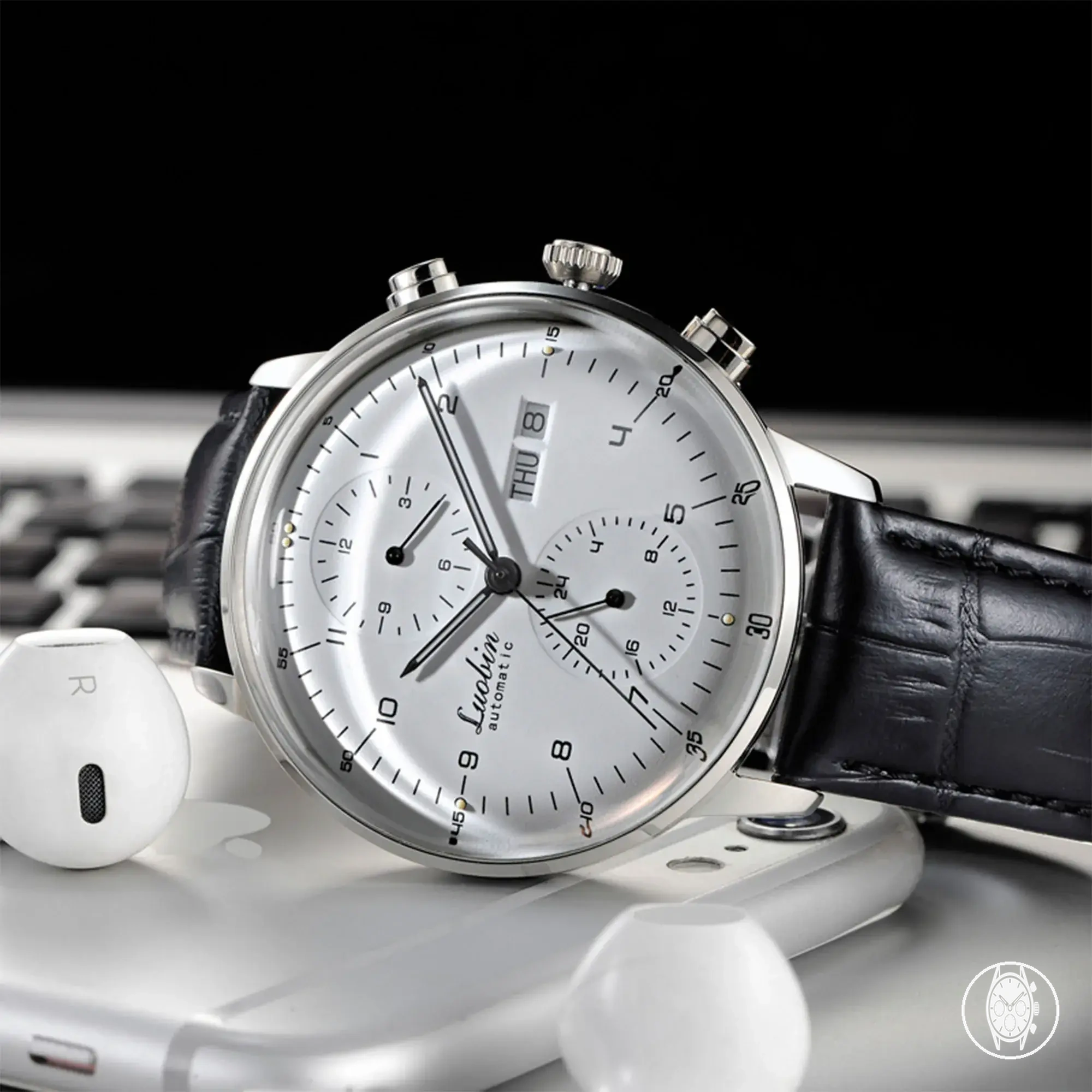
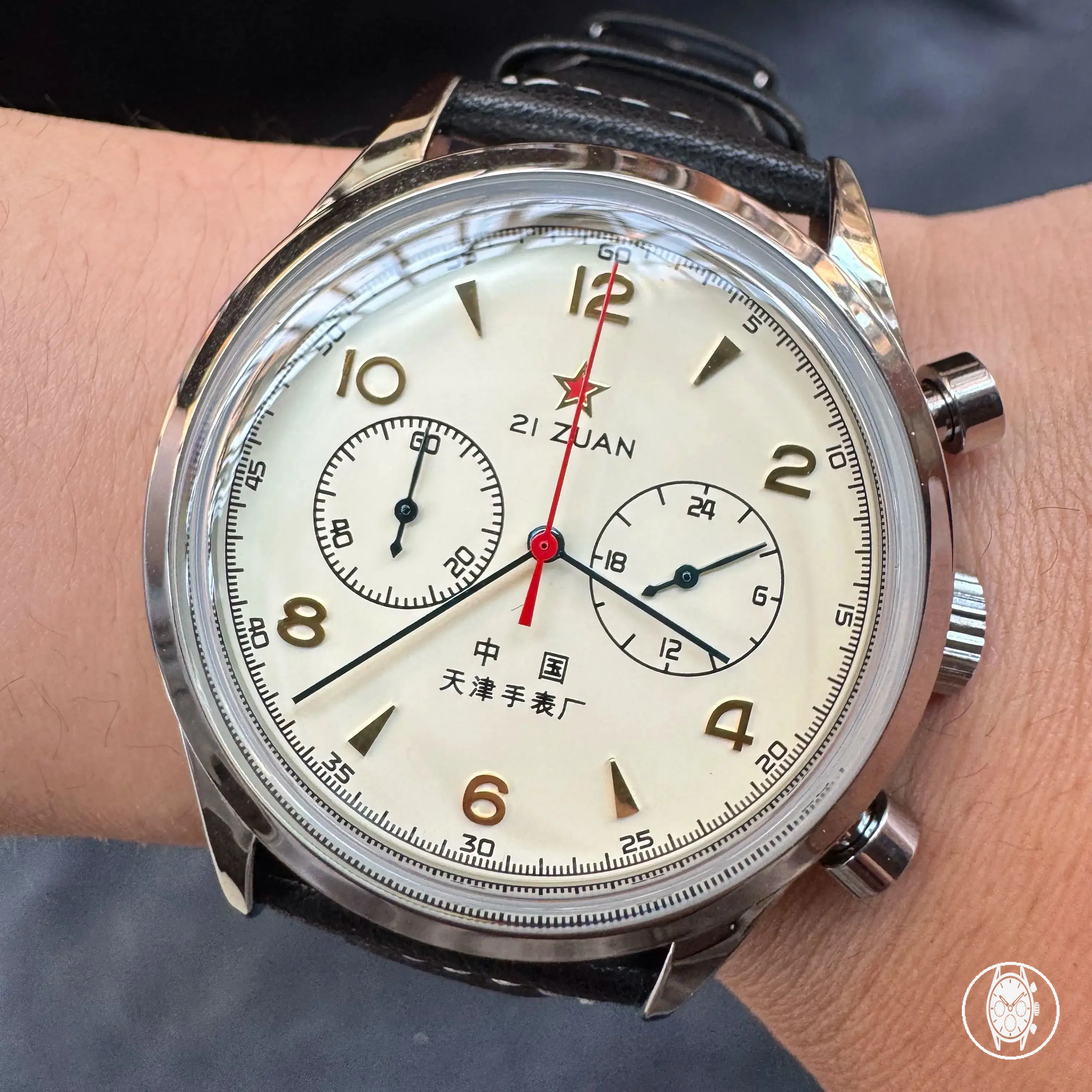
Here are product examples that may make comparison easier.
Here are product examples that may make comparison easier. Before buying, always review the compatibility criteria, essential features, and product details.

This chart shows the three main chronograph movement types and their best-fit conditions based on accuracy, maintenance, and mechanical preference.